Published on: 2026-07-15
Updated on: 2026-07-15
IBM delivered a second quarter that fell only modestly short of expectations, yet the market treated it as something far worse. Shares closed 25.21% lower at $217.07 on July 14, 2026, the steepest single-day decline in the company’s history, after an unscheduled letter from chief executive Arvind Krishna disclosed preliminary revenue and earnings below consensus. The drop erased close to $68.8 billion of market value, even though revenue came in only about 3.7% under the forecast.
The July 22 results must answer whether the revenue IBM lost was simply pushed into the third quarter, or whether the warning exposed genuinely softer demand across its software, mainframe and AI businesses.

Preliminary Q2 revenue of $17.2 billion missed the $17.86 billion FactSet consensus by about $660 million, and operating EPS of $2.93 fell eight cents short of the $3.01 estimate.
Software growth slowed from 11% in Q1 to 5%, well below IBM’s prior target for full-year growth above 10%.
Infrastructure revenue fell 7% amid weaker IBM Z performance, while associated Transaction Processing software also missed expectations. Red Hat grew 11% and Distributed Infrastructure rose 37%.
IBM did not update or reaffirm its full-year revenue and free-cash-flow outlook, leaving the July 22 call to show whether the missing revenue was delayed, reduced or lost.
Krishna blamed delayed deals and a late-June client shift into AI hardware, making the durability of that spending shift the central question.
IBM pre-announced eight days before its scheduled July 22 conference call, reporting revenue up 1% to $17.2 billion (about $660 million below the $17.86 billion FactSet consensus) and operating EPS of $2.93, eight cents light of the $3.01 estimate.
The earnings shortfall was small relative to the share-price reaction, indicating that the selloff reflected weaker confidence in IBM’s forward growth and execution rather than the quarterly miss alone.
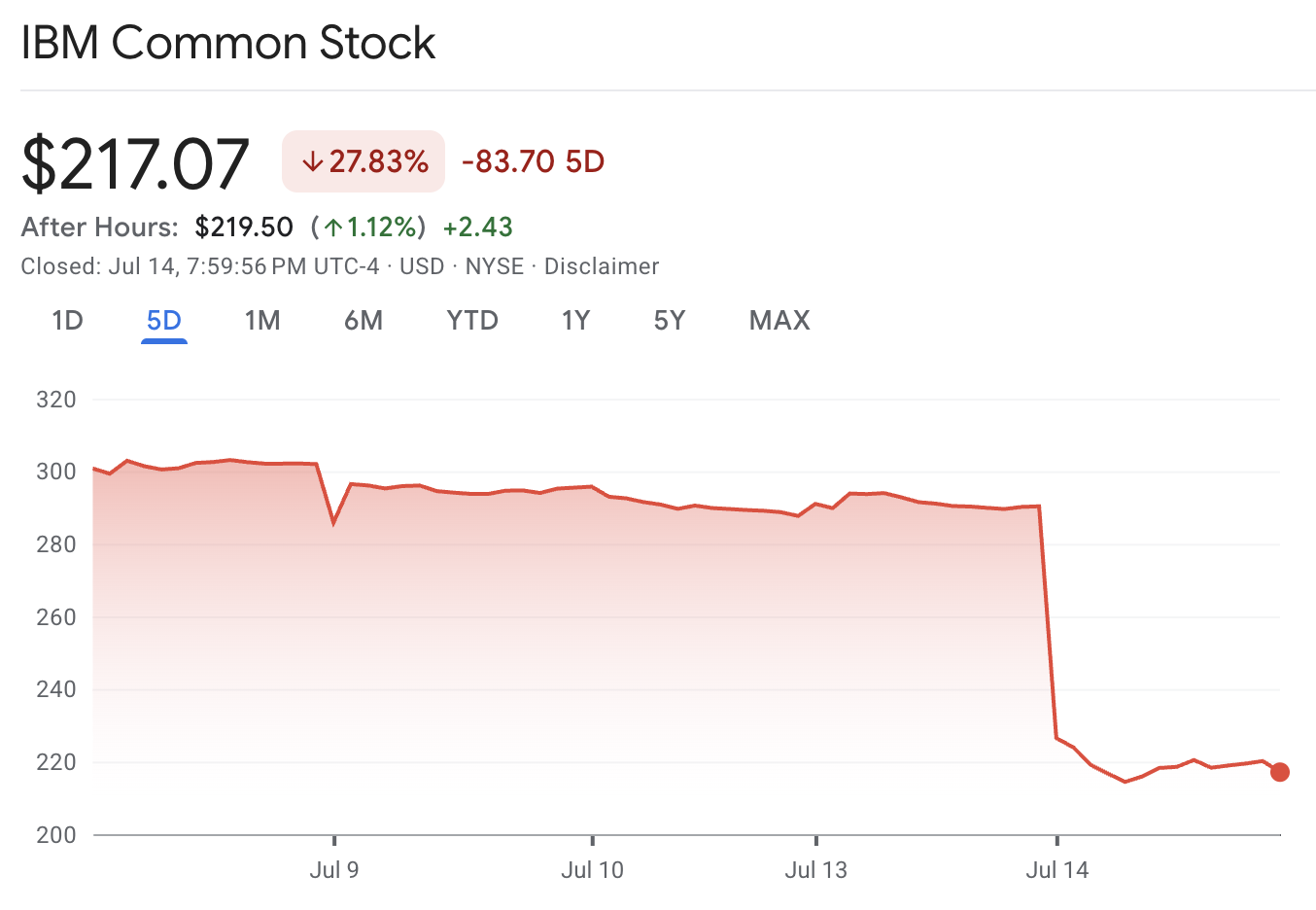
The scale of the reaction follows from the starting valuation. IBM had closed the prior session at $290.23, near a recent $332.46 high, at about 23 times forward earnings on the pre-warning $12.47 estimate, a multiple that prices in sustained double-digit software growth.
When a company carrying that expectation grows revenue only 1% and leaves its full-year outlook unaddressed, investors reprice the entire forward earnings stream rather than a single quarter, which is how a 3.7% shortfall compressed the multiple toward 17 times and erased roughly a quarter of the market value.
| Metric (preliminary Q2 2026) | Result | Why It Mattered |
|---|---|---|
| Revenue | $17.2bn, +1% | Approximately $660m below the $17.86bn consensus |
| Software | +5% | Down sharply from 11% in Q1 |
| Consulting | Flat | Only 1% growth at constant currency |
| Infrastructure | −7% | IBM Z underperformed; associated Transaction Processing software was also weak |
| Operating EPS | $2.93, +5% | Eight cents below the $3.01 estimate |
| Operating gross margin | 59.4%, −70bps | Gross profitability weakened YoY; operating pre-tax margin rose 30bps |
| First-half free cash flow | $4.76bn, −1% | Nearly flat versus $4.81bn a year earlier |
| Full-year outlook | Not updated | Discussion deferred to July 22 |
On July 6, BofA raised its price target to $330 and forecast approximately $18.0 billion of Q2 revenue, above IBM’s preliminary $17.2 billion result. All figures remain preliminary.
Krishna traced most of the shortfall to large contracts that failed to close before quarter-end. Three threads run through his explanation, each with a different implication for how quickly the lost revenue returns.
Several sizeable transactions slipped past their expected timetable and drove the bulk of the gap. The one thing IBM has not clarified is whether those deals moved into the third quarter or were reduced or lost. It disclosed neither their value nor whether any have since closed, and the timing explanation only holds if that revenue reappears at broadly similar values.
The weakness sat in IBM Z and the Transaction Processing software that runs alongside it, as the z17 product cycle matured. A mainframe sale is seldom a single transaction, because one installation pulls years of high-margin licences, maintenance and transaction-processing revenue behind it, so a hardware delay reaches beyond infrastructure into IBM’s most profitable recurring revenue.
The platform itself still looks healthy: z17 placements are near 130% of the z16 cycle at the equivalent point, and 85% of installed capacity is holding or growing. Those indicators argue against a broad contraction in IBM’s installed mainframe base, although they do not establish whether the missing Q2 transactions were postponed, reduced or cancelled.
The most consequential explanation is where corporate budgets went in the quarter’s final weeks. IBM said clients brought spending forward into servers, storage and supply-constrained memory to secure allocation before expected price rises, leaving less room to close software and mainframe deals.
Read cyclically, that is a temporary scramble that reverses once component supply normalises and the deferred deals close. Read structurally, AI infrastructure is absorbing a durably larger share of enterprise IT spending, at the expense of enterprise software and services that still generate most of IBM’s profit.
IBM provided no breakdown by memory type, so any reference to specific components remains inference.
The bull case treats the quarter as a timing problem rather than a demand problem. The segments most important to IBM’s growth kept expanding, the mainframe indicators suggest the installed base remains active, and the timing explanation would gain credibility if IBM confirms that the delayed contracts remain intact, reports subsequent closures and maintains its previous full-year expectations.
On that reading the selloff leaves a durable business on a free-cash-flow yield near 7.7% (the ~$15.7 billion free-cash-flow outcome implied by prior guidance, against a ~$204 billion market value) and a dividend yielding about 3.1%.
A lower price does not settle the valuation on its own, because the appropriate multiple can fall alongside the share price. Consensus estimates are likely to be trimmed once analysts fold in the results, so the stock’s apparent value at 17 times may narrow as forecasts come down.
The composition of the software growth is the harder issue. IBM reported $7.39 billion of software revenue in the second quarter of 2025, so growth of 5% implies about $7.76 billion this year, an increase of roughly $370 million. BofA had estimated Confluent alone could contribute around $340 million over the quarter.
If that proves close, acquired revenue accounts for almost the entire increase and organic growth is negligible, exactly the outcome a 23-times multiple was never built to withstand. IBM must disclose the actual acquisition contribution before the point is settled.
IBM ended Q1 with $66.4 billion of total debt and $11.8 billion of cash, restricted cash and marketable securities, implying net debt of approximately $54.6 billion. That leverage increases the importance of preserving free cash flow following the Confluent acquisition.
Seven days from now, the results will convert Krishna’s account into testable figures. Downside signals: software growth stalling near 5%, Red Hat slipping out of double digits, gross margin weakening further, or any cut to the roughly $15.7 billion free-cash-flow figure implied by prior guidance.
Recovery would run the other way: delayed contracts closing, organic software improving once Confluent and HashiCorp are excluded, the backlog converting into recognised revenue, and management attaching quantified revenue, not just bookings, to its AI portfolio.
IBM pre-announced preliminary Q2 revenue of $17.2 billion and operating EPS of $2.93, both below consensus, blaming delayed deals and a late-June client shift toward memory and servers.
It is possible but unproven. IBM said clients redirected budgets toward AI hardware and delayed software deals, which could be a one-off timing effect or a lasting change in enterprise spending.
The forward multiple fell from about 23 to 17 times, but earnings estimates may be cut and full-year expectations were left for the July 22 update, so the valuation case stays unresolved until then.
The width of the gap between IBM’s small miss and its outsized selloff reflects doubts about execution, the quality of its software growth, and the premium the shares carried. The July 22 results must quantify the delayed contracts, confirm how many have since closed, and separate acquired growth from organic.
Guidance held at prior levels would support the timing explanation; a cut, or further software deceleration, would recast the warning as a broader reset of IBM’s software, mainframe and AI growth assumptions.