Published on: 2026-07-14
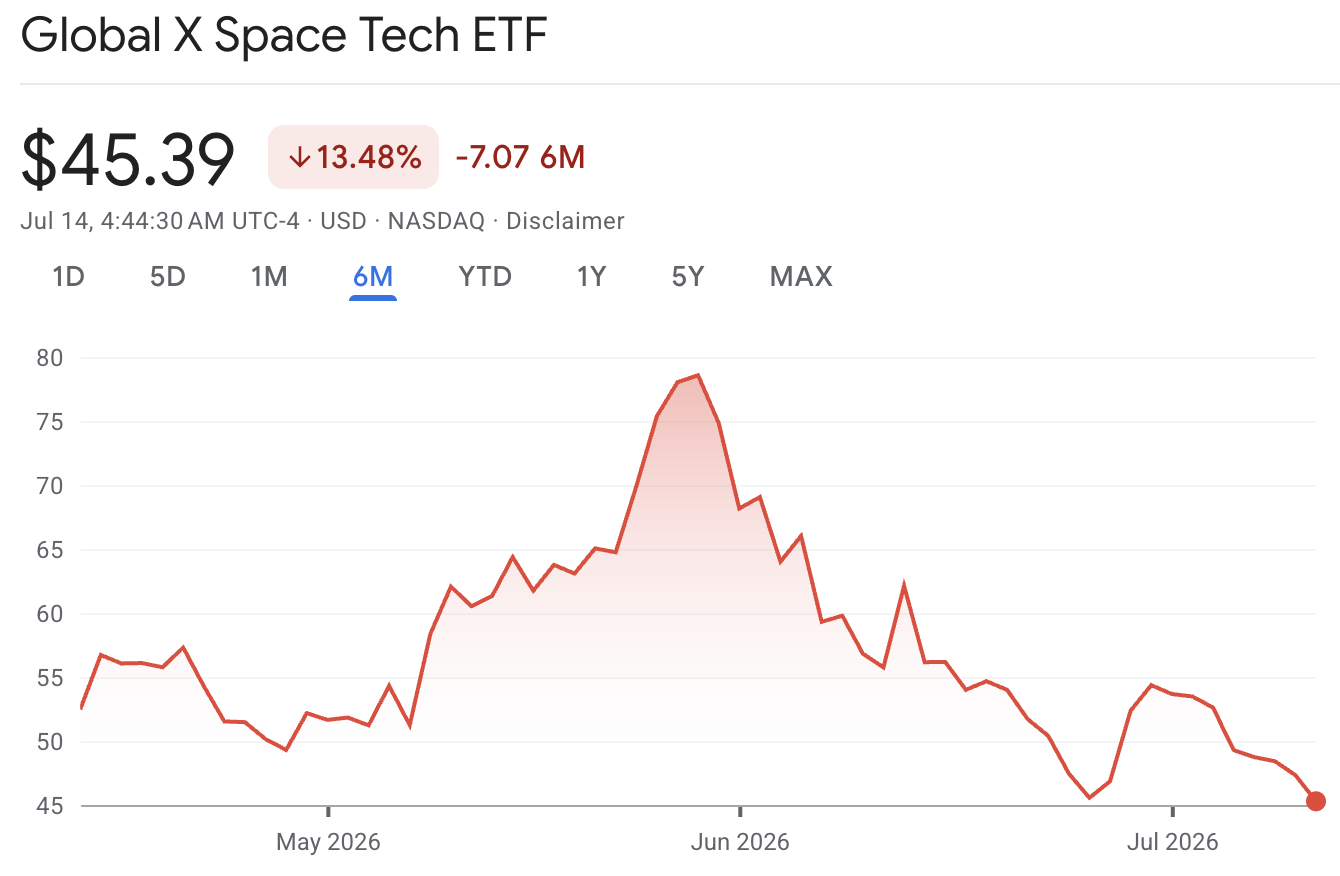
The commercial space economy now includes reusable launch systems, satellite constellations, Earth-observation platforms and space-derived data. The Global X Space Tech ETF, listed on Nasdaq under ORBX, packages that theme into a single fund.

One clarification matters before trading: a separate Canadian Global X fund also uses the ORBX ticker on the Toronto Stock Exchange. This article covers the US-listed Nasdaq fund, so confirm the exchange, trading currency and domicile before placing an order.
ORBX passively tracks the Global X Space Tech Index for a 0.50% expense ratio.
New constituents generally must derive at least 50% of revenue from qualifying space activities.
The largest holding can reach a 20% weight, creating material single-name exposure.
The mandate spans launch systems, satellite communications, infrastructure, software and data services.
Capital intensity, launch risk, financing needs and regulation are the dominant risk factors.
ORBX is a passive thematic equity ETF launched on 14 April 2026. It seeks to replicate the Global X Space Tech Index before fees, carries a 0.50% total expense ratio and distributes semi-annually. It is classified as non-diversified, meaning it may invest a larger share of assets in fewer issuers than a diversified fund.
The fund targets companies building rockets, satellites and orbital infrastructure, as well as operators monetising that hardware through connectivity, imaging, navigation and analytics. Its revenue screen creates a narrower portfolio than a conventional aerospace-and-defence or broad-technology fund.
| Fund detail | ORBX |
|---|---|
| Issuer | Global X |
| Exchange | Nasdaq |
| Launch date | 14 April 2026 |
| Underlying index | Global X Space Tech Index |
| Expense ratio | 0.50% |
| Management style | Passive |
| Classification | Thematic and non-diversified |
| Distributions | Semi-annual |
*Fund details reflect Global X disclosures and are subject to change.
The index divides the commercial space economy into four subthemes. Rocket launch and reusable rockets covers vehicles and systems designed to reduce the cost of placing payloads into orbit. Space technology and components spans propulsion, orbital transportation, space-grade hardware, satellite imagery, software, artificial intelligence and analytics.
Satellite telecommunications and data services includes network operators and spacecraft manufacturers delivering broadband, navigation, secure communications and Earth observation. Space transportation, tourism and exploration ranges from human spaceflight to orbital services and deep-space missions.
These activities span the upstream and downstream space economy. Hardware manufacturers sit upstream, while network and data providers sit downstream. ORBX can therefore be driven as much by satellite economics as by launch cadence.
ORBX applies a pure-play revenue gate. A new constituent generally needs at least 50% of revenue from qualifying space activities, while an existing constituent can remain eligible at 40%. This buffer reduces unnecessary turnover when a borderline company moves slightly above or below the entry threshold.
The screen filters out diversified conglomerates whose space operations are immaterial to group revenue and tilts the portfolio towards specialist issuers.
Liquidity and size tests also apply. New entrants generally require at least $200 million in security-level market capitalisation, $2 million in six-month average daily traded value, sufficient trading history and adequate free float. Existing constituents face lower thresholds.
The fund invests at least 80% of net assets, plus investment-purpose borrowings, in index securities, including common shares, ADRs and GDRs. Global X generally replicates the index but may use representative sampling when full replication is impractical.
The index uses modified free-float market-capitalisation weighting, counting only shares readily available for public trading rather than total shares outstanding.
The largest constituent is capped at 20%, while every other security is capped at 10%. Positions above 5% cannot collectively exceed 40%, and remaining companies are capped at 4.5% during weighting.
The index reconstitutes and rebalances quarterly at the end of February, May, August and November. A fast-entry mechanism allows large IPOs, direct listings and spin-offs to enter between scheduled reviews. A newly listed company generally needs a market capitalisation of at least $10 billion and at least five index business days of trading before evaluation.
Because weighting is based on free-float capitalisation, a newly listed mega-cap can move rapidly towards the 20% ceiling. SpaceX is the clearest example. Its public listing allowed it to enter the portfolio through the index’s fast-entry mechanism, and its free-float market value quickly pushed it towards the maximum single-security weight.
As of July 2026, SpaceX represented 19.25% of ORBX, followed by AST SpaceMobile at 10.03% and Rocket Lab at 9.62%.
The SpaceX position creates substantial idiosyncratic risk. A sharp move in the largest holding can steer the fund even when the rest of the portfolio moves differently. The concentration is a deliberate output of the methodology, giving ORBX meaningful exposure to the sector’s largest listed company in exchange for greater single-stock sensitivity.
ORBX responds to both space-specific developments and the wider risk environment. Direct drivers include launch success rates, satellite-deployment schedules, government and defence contracts, subscriber growth and demand for Earth-observation data.
Financing conditions matter disproportionately because many holdings fund heavy development and infrastructure spending before generating positive cash flow. Equity raises, wider credit spreads, delayed profitability and higher interest rates can trigger sharp valuation changes.
Interest rates create additional duration-like sensitivity. Much of the portfolio is valued on cash flows expected years into the future, so higher discount rates can place greater pressure on these long-duration equities.
Operationally, launch failures, mission anomalies, component shortages and cost overruns can disrupt revenue and damage reputations. Export controls, sanctions, spectrum licences, telecommunications rules and national-security restrictions can also determine market access.
Space ETFs follow different mandates, and their names do not always reveal how much direct space exposure they provide.
| ETF | Management | Main exposure | Expense ratio |
|---|---|---|---|
| ORBX | Passive | Pure-play space technology and services | 0.50% |
| ARKX | Active | Space and defence innovation | 0.75% net |
| UFO | Passive | Global space-related companies, including satellite businesses | 0.75% |
| WARP | Passive | Launch, satellite infrastructure, observation and space data | 0.50% |
| ROKT | Passive | Outer-space and deep-sea technologies | 0.45% |
ORBX is distinguished by its 50% revenue gate, modified cap weighting and 20% single-name ceiling. ARKX grants its managers discretion and includes defence innovation. UFO tracks a broader index of space-related businesses, WARP follows another rules-based space index, and ROKT extends its mandate to deep-sea technology.
The main question is whether the objective is pure-play space exposure, active management, broader aerospace participation or lower concentration.
ORBX offers concentrated exposure to a capital-intensive industry with uncertain development timelines and rapid technological change. Its non-diversified status magnifies the impact of company-specific setbacks.
Several holdings are small-cap, micro-cap or newly listed companies with limited histories, thinner liquidity and less predictable earnings. Some need repeated capital-market access to fund research, manufacturing and satellite deployment.
Dependence on licences, government procurement, specialist suppliers and long-duration contracts means a failed launch, budget cut, contract cancellation or production delay can reset expectations quickly. International holdings also add currency, political and settlement risk.
The fund has a short operating history, so its behaviour across a full market cycle remains untested.
ORBX may fit a satellite allocation seeking targeted commercial-space exposure rather than broad-market beta. It requires a high tolerance for volatility and a long horizon because infrastructure can take years to reach full utilisation.
It is less aligned with income, capital-preservation or predictable-earnings objectives. Diversification across holdings does not remove shared launch, regulatory and financing risks.
Yes. SpaceX entered the portfolio after its public listing and represented 19.25% of ORBX as of 13 July 2026.
It spans several countries and space-industry segments but is legally classified as non-diversified, so a handful of positions can account for a substantial share of assets.
ORBX distributes semi-annually. Income is incidental to its thematic-growth objective and depends on distributions paid by portfolio companies.
ORBX provides rules-based access to launch systems, satellites, orbital infrastructure and space-enabled services. Its 50% revenue gate keeps exposure close to the theme, while modified cap weighting gives the largest names substantial influence.
The trade-off is concentration. A few holdings can dominate performance, while many underlying businesses face high capital requirements, regulatory constraints and uncertain profitability. ORBX is a specialised thematic allocation rather than a substitute for a diversified equity core.
For those who prefer direct exposure rather than a diversified ETF, SpaceX stock is also available through EBC, allowing market participants to follow the company separately from the wider space-technology theme.