Published on: 2026-02-24
Updated on: 2026-02-24
On February 23, 2026, International Business Machines Corporation (IBM) stock declined by approximately 13% in a single trading session, prompting a reassessment of near-term market sentiment and the perceived resilience of IBM’s hybrid cloud and modernization revenue streams.

The broader market environment remains challenging. Cloud infrastructure spending is accelerating, with Q4 2025 revenue reaching approximately $119.1 billion, representing about 30% year-over-year growth. Hyperscalers (the largest cloud providers) continue to drive this growth, expanding AI-centric services more rapidly than legacy enterprise providers. In this context, IBM’s strategy must remain relevant through product differentiation and pricing power as competitors intensify efforts within IBM’s core accounts.
The February 23 selloff appeared to be a competition-driven repricing rather than a routine post-earnings pullback. Investors concentrated on risks to modernization initiatives and hybrid cloud attach rates.
Cloud infrastructure revenue reached roughly $119 billion in Q4 2025, up about 30 % year over year. AWS held around 28% share, Microsoft 21%, and Google 14%, keeping pressure high on smaller players and adjacent platforms.
IBM’s Q4 2025 print showed operational strength, with $19.7 billion in revenue (+12 %) and Software up 14 %, but Red Hat's 10 % growth reads slower than hyperscalers, which are still expanding at a faster clip.
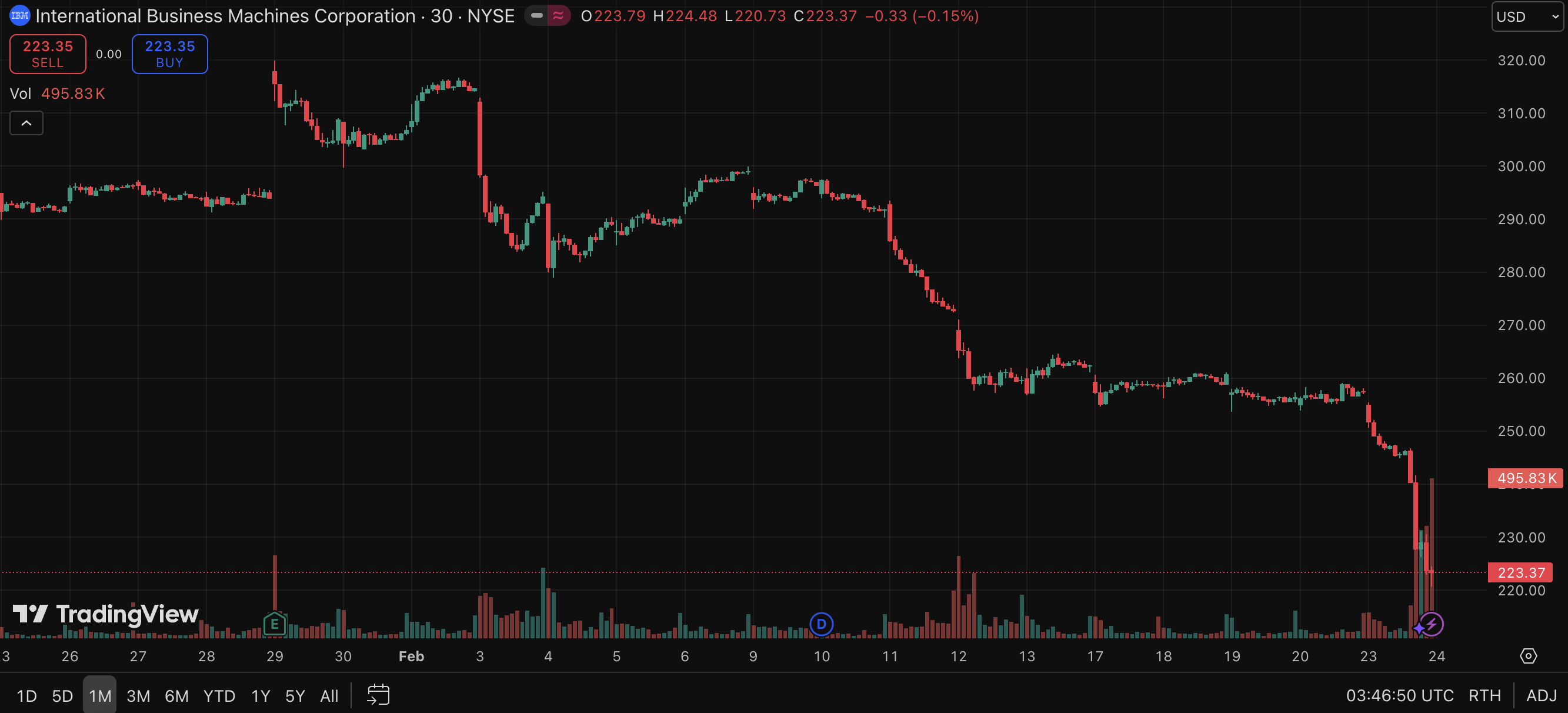
The stock’s technical indicators shifted to extreme oversold conditions, with the Relative Strength Index (RSI) near 10 and widespread “strong sell” signals across moving averages. As a result, support and resistance levels will be critical in the upcoming trading sessions.
The immediate catalyst was not a traditional earnings shortfall. Instead, the decline was driven by renewed investor concerns that artificial intelligence (AI) tools could erode the value of labour-intensive modernization services, a core component of IBM’s enterprise business. IBM shares fell about 13% intraday after Anthropic announced a tool aimed at automating parts of COBOL code modernization (Claude Code).
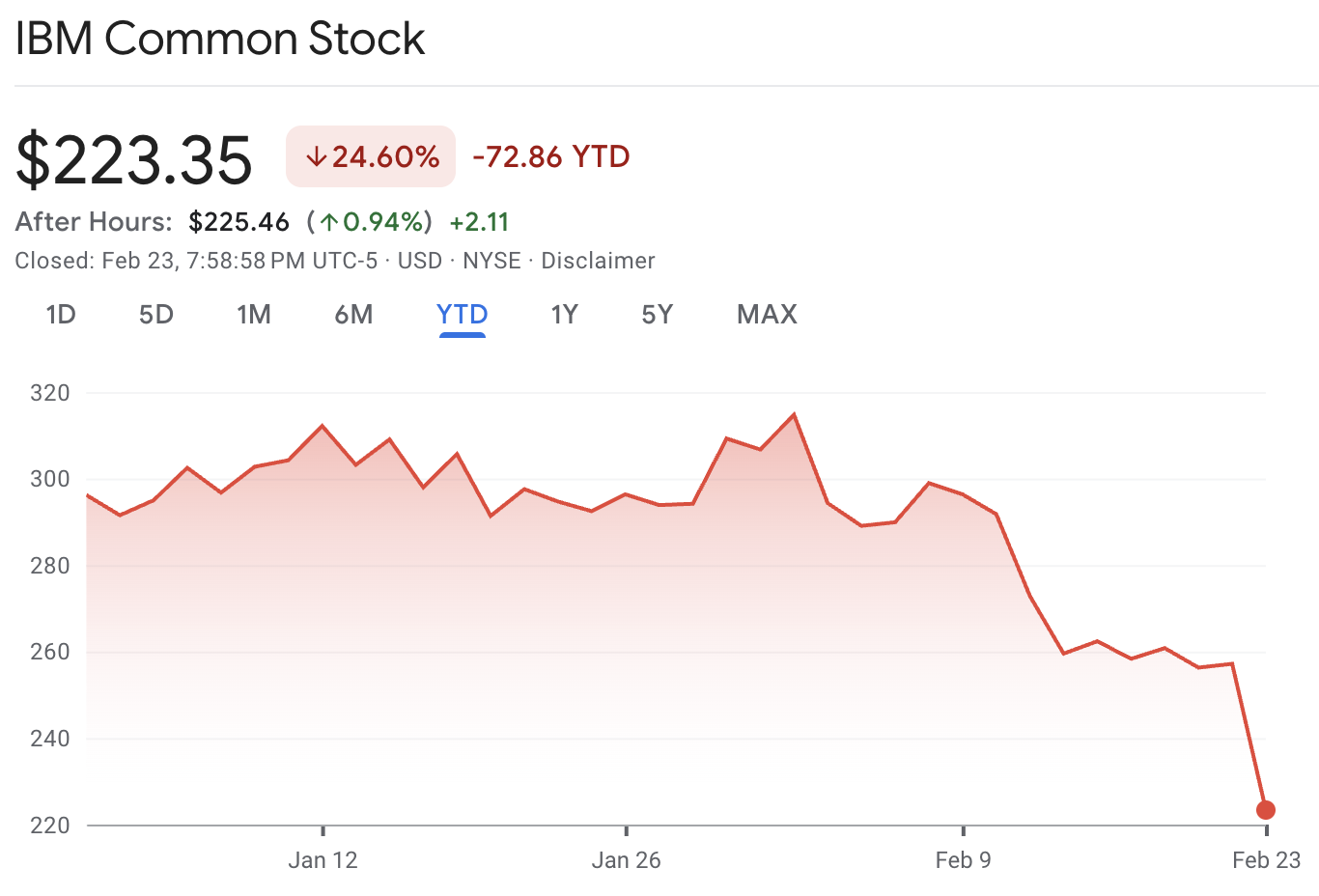
A recent product launch by Anthropic, which automates aspects of COBOL modernisation, simultaneously impacted IBM and several IT services peers, suggesting that the market views the risk as structural rather than company-specific.
If AI reduces the time, personnel, and complexity required to update legacy code, clients gain bargaining power. This dynamic may initially manifest as pricing pressure in consulting margins, followed by reduced platform attach rates (the share of services work that converts into platform or subscription revenue).
A secondary consideration is IBM’s strategic positioning. The company has invested several years in repositioning itself as a hybrid cloud and artificial intelligence (AI) platform provider, with Red Hat as a central component. Although the market has previously rewarded this transition during periods of strong execution, the February decline demonstrates how quickly investor sentiment can shift when competitive dynamics challenge the perceived durability of switching costs.
Cloud demand continues to grow, but market share remains concentrated. Synergy Research Group estimates Q4 2025 cloud infrastructure services revenue at about $119.1 billion, with the top three providers (AWS, Microsoft, Google) holding worldwide market shares of 28%, 21%, and 14% respectively, and accounting for about 68% of public cloud (IaaS and PaaS). IBM does not compete at hyperscale, its positioning is in enterprise integration, middleware, hybrid orchestration, security, and multi-cloud operations.
| Metric | Q4 2025 |
|---|---|
| Global cloud infrastructure services revenue | ~$119B |
| Year-over-year growth | ~30% |
| AWS market share | ~28% |
| Microsoft market share | ~21% |
| Google market share | ~14% |
| Big Three combined share | ~68% |
| IBM market share | ~2% |
IBM’s positioning remains potentially advantageous. The company does not need to match AWS or Azure spending, but must maintain its role as the trusted “control layer” for enterprises managing workloads across AWS, Azure, Google Cloud, and on-premises systems. The primary challenge is monetization, as hyperscalers continue to bundle additional tools such as managed Kubernetes, data services, and AI platforms into their offerings.
Simultaneously, artificial intelligence (AI) reduces barriers to migration and re-platforming. These factors may compress the value IBM captures per project, even if overall customer demand remains robust.
IBM’s fourth-quarter 2025 earnings report (released January 28, 2026) showed broad-based momentum across the P&L, led by Software and a strong mainframe-driven Infrastructure cycle.
IBM posted $19.7 billion in quarterly revenue, up 12% year over year. Software revenue rose 14% to $9.0 billion, Consulting increased 3% to $5.3 billion, and Infrastructure climbed 21% to $5.1 billion.
The software segment’s growth is notable for its breadth rather than reliance on a single product. Hybrid Cloud (Red Hat) increased by 10%, Automation by 18%, Data by 22%, and Transaction Processing by 8%. Infrastructure performance was significantly powered by IBM Z, which grew 67% year over year, reflecting robust demand for mainframe refresh cycles.
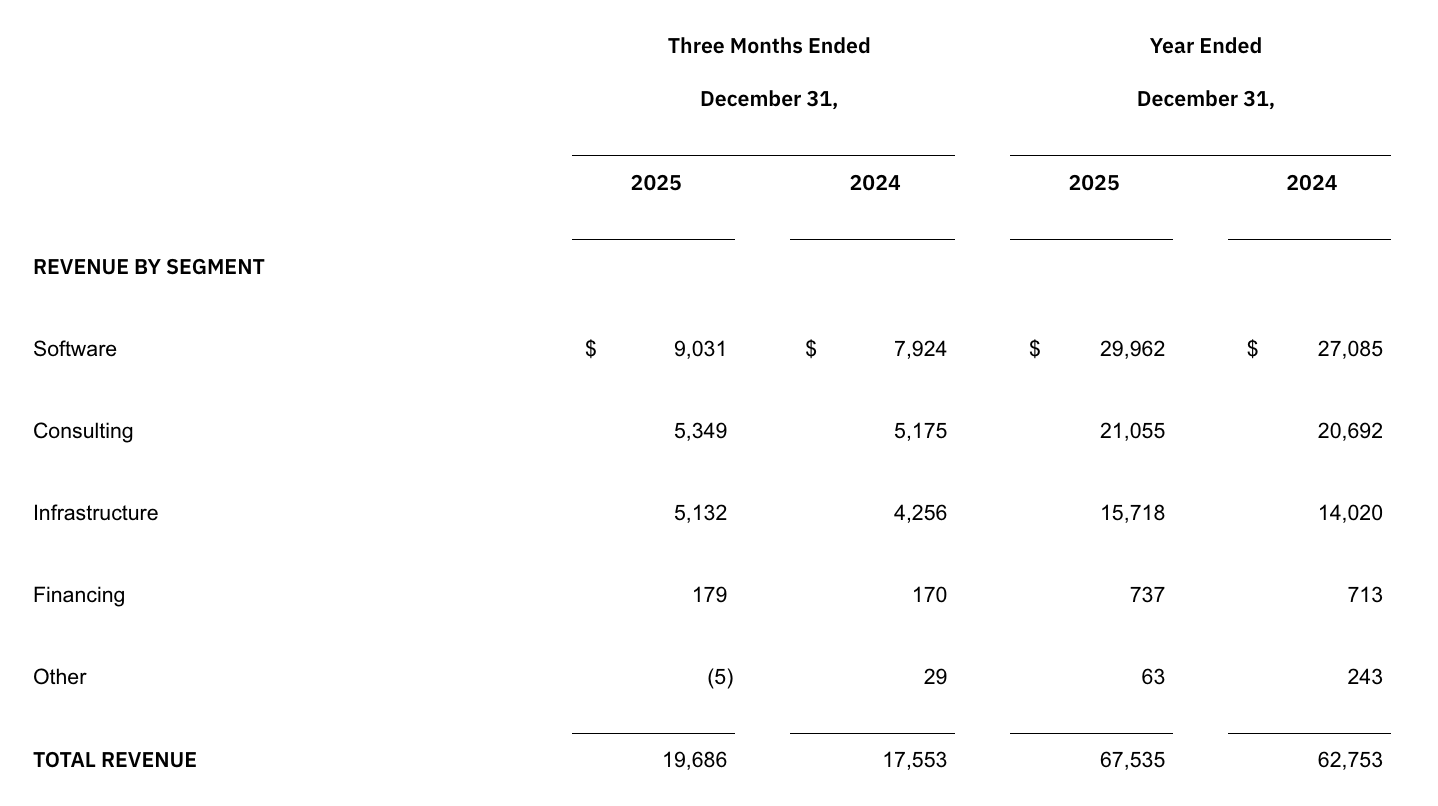
(Table is directly from IBM’s Segment Results for Fourth Quarter in its January 28, 2026 earnings release.)
| Segment | Revenue | YoY growth |
|---|---|---|
| Total IBM | $19.7B | +12% |
| Software | $9.0B | +14% |
| Consulting | $5.3B | +3% |
| Infrastructure | $5.1B | +21% |
So why did the IBM stock fall so hard? Because the debate moved from “Can IBM execute?” to “Can IBM defend economics in the modernization funnel as AI lowers the billable complexity and hyperscalers deepen their enterprise stacks?” That is a multiple question, not only an earnings question.
The future trajectory of IBM shares will likely be influenced by several key catalysts and checkpoints.
AI automation can reduce billable hours and weaken pricing power in modernization-heavy consulting work. Watch for management commentary on consulting signings, backlog, utilization, and margin mix (fixed-price versus time-and-materials). If modernization becomes faster and cheaper, IBM will need to protect economics through software-led engagements and higher attach into subscriptions.
Red Hat growth of 10 percent is respectable, but hyperscalers are growing AI workloads aggressively and pushing more tooling into native bundles. IBM needs to show that OpenShift and its hybrid stack remain a must-have layer for multi-cloud customers, not an optional add-on.
IBM Z's 67% year-over-year growth reflects a strong refresh cycle rather than a sustainable long-term trend. Infrastructure performance can shift from a tailwind to a headwind as the upgrade cycle matures. Investors will monitor whether IBM can maintain infrastructure resilience as the cycle progresses.
IBM’s reported generative artificial intelligence (AI) book of business exceeding $12.5 billion indicates significant demand. However, markets prioritize realized outcomes over pipeline size. Key factors include the pace of conversion, margin profile, and the proportion of revenue derived from software subscriptions versus services-intensive implementations.
IBM has flagged April 22, 2026, as a preliminary date for Q1 2026 earnings. With the stock already repriced, the market will likely focus on management’s tone around competitive intensity, customer budgets, and how IBM plans to protect pricing and attach rates in hybrid cloud and modernization.
Following the February 23 decline, IBM’s technical chart indicates deeply oversold conditions. While this may prompt sharp rebounds, it often reflects unstable price discovery, making support and resistance levels more significant than overarching narratives. The technical dashboard below reflects end-of-day data after the February 23, 2026 session.
| Indicator | Latest reading | Signal |
|---|---|---|
| RSI (14) | 10.222 | Oversold |
| MACD (12,26) | -6.67 | Sell |
| EMA 20 | 248.11 | Sell |
| EMA 50 | 258.29 | Sell |
| EMA 200 | 281.24 | Sell |
| Support (Classic S1 / S2 / S3) | 223.20 / 217.48 / 208.58 | Levels to defend |
| Resistance (Pivot / R1 / R2) | 232.10 / 237.82 / 246.72 | Levels to reclaim |
| Trend | Below major MAs | Bearish |
| Momentum | High volatility | Fragile |
Interpretation: An RSI near 10 indicates capitulation-style selling, while the Moving Average Convergence Divergence (MACD) remains firmly negative, typically signaling that the downtrend persists. In the near term, traders will monitor whether IBM can maintain support in the low $220s and subsequently reclaim $232, followed by resistance in the mid-$230s.
The latest break was driven by competitive fear, not just macro risk. A new wave of AI tooling raised concerns that legacy modernization work could become faster and cheaper, reducing pricing power in services-heavy workflows that feed hybrid cloud adoption.
Yes, because hyperscalers are not only IaaS providers. They bundle managed Kubernetes, data platforms, security, and AI services in ways that can reduce the need for third-party orchestration layers. In a market where the Big Three hold about 68% of the market share, competitive gravity is unavoidable.
Recently reported fundamentals were strong. Q4 2025 revenue rose 12%, and Software rose 14%, while 2025 free cash flow reached $14.7 billion, and the 2026 outlook targeted more than 5% constant-currency revenue growth. The stock move reflected a valuation reset tied to competitive durability.
The next major scheduled checkpoint is IBM’s first-quarter 2026 earnings update, listed as a preliminary date of April 22, 2026, on IBM’s investor relations site. Guidance tone and competitive framing are likely to matter as much as the headline EPS figure.
Oversold conditions increase the likelihood of a bounce, but they do not guarantee one. With RSI near 10 and broad “Strong Sell” readings across moving averages, the near-term path typically depends on whether the stock can hold support near $223 and then reclaim resistance near $232.
The late-February decline in IBM shares demonstrates how rapidly cloud and artificial intelligence (AI) competition can undermine market confidence in established enterprise franchises. IBM’s recent results indicate solid execution, robust cash flow, and clearly defined 2026 targets. The primary shift is in market perception regarding the defensibility of IBM’s modernization funnel as AI reduces operational friction and hyperscalers expand further into enterprise workloads.
In the near term, attention should be directed toward Red Hat growth momentum, indications of services pricing pressure, and IBM’s ability to stabilize above key support levels following the initial decline. These factors, rather than headlines alone, will determine the next phase for IBM stock.
Disclaimer: This material is for general information purposes only and is not intended as financial or investment advice.
1) IBM 1Q 2026 Earnings Announcement (preliminary date)
2) IBM RELEASES FOURTH-QUARTER RESULTS