Published on: 2026-07-14
Morgan Stanley expects about $500 billion of total AI-related debt financing in 2026, roughly double the amount raised by mid-June, and on the bank’s own reading the immediate pressure sits in the sheer volume of supply rather than in solvency concerns.

Most of the money still comes from investment-grade hyperscaler bonds backed by strong cash flows, so the near-term question is pricing and absorption instead of repayment. The figure also spans investment-grade bonds, high-yield project finance and securitised credit, so treating it purely as corporate bond issuance understates how varied the borrowing has become.
Morgan Stanley expects about $500 billion of total AI debt financing in 2026, roughly double last year, spanning investment-grade bonds, high-yield project finance and securitised credit.
Supply is the risk, not defaults. The likely first sign is modestly wider spreads, not missed payments, echoing 1997–98.
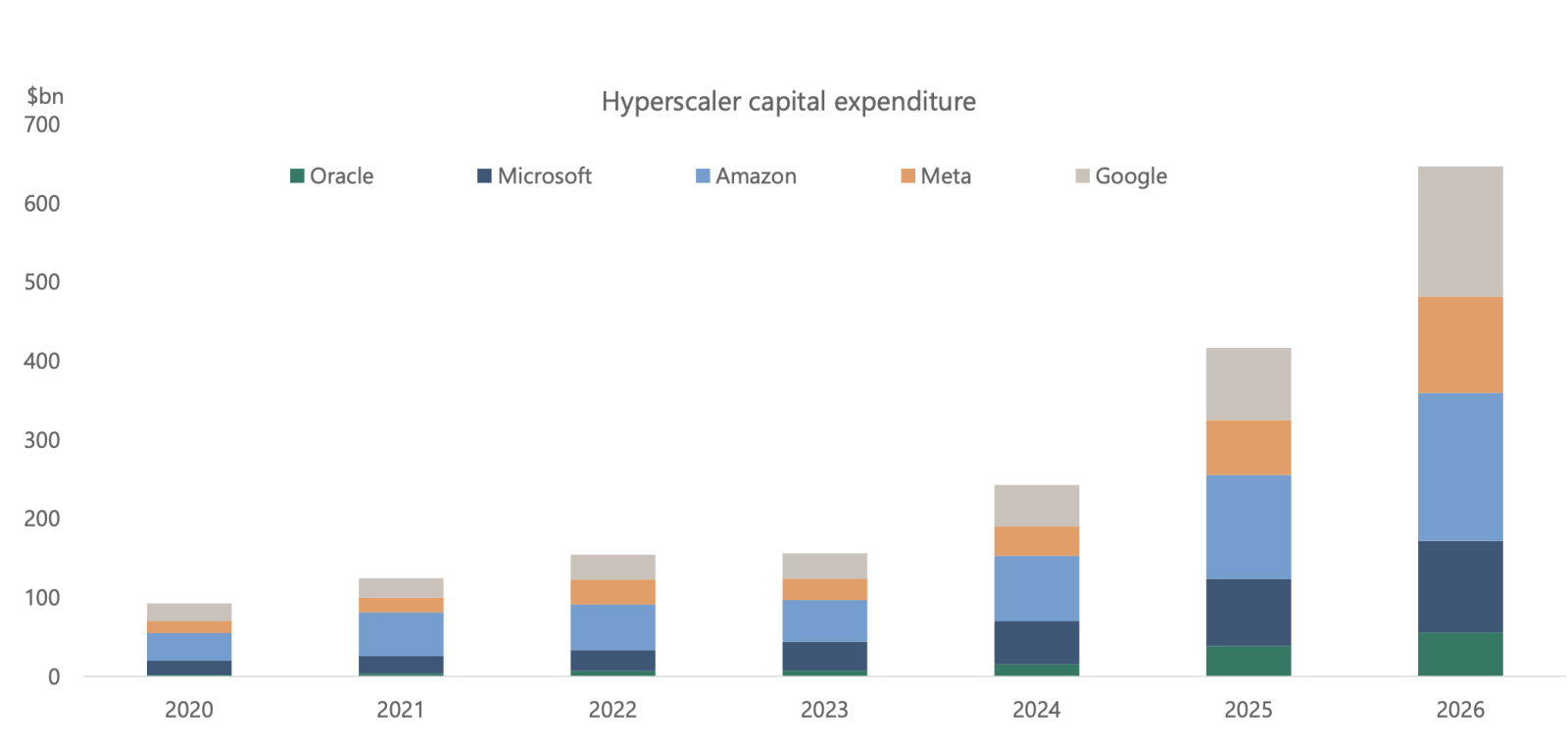
Most of it is strong credit. The bulk is investment-grade hyperscaler debt, backed by ~$700bn of combined 2026 capex.
High-yield project finance carries construction risk, and Oracle is the investment-grade outlier with negative outlooks and negative free cash flow.
Passive bond and target-date funds now hold AI exposure as tech's weight in the credit index climbs.
An AI debt bubble describes borrowing built on optimistic assumptions about future AI demand, where the debt load and future repayment obligations outpace the cash flow needed to service them.
The version most investors discuss involves equity, meaning whether Nvidia or the hyperscalers are overvalued. The credit version is separate and surfaces in different places: bond prices, credit spreads, downgrades and refinancing terms rather than share prices.
The speed of the shift is part of why credit desks are paying attention. Morgan Stanley notes that it wrote about AI infrastructure financing for the first time less than a year ago, identifying a roughly $1.5 trillion financing gap that credit markets could help bridge, at a point when data-centre debt was not a focus for most investors.
Within twelve months, Morgan Stanley described data-centre financing as the leading theme across its corporate-credit and securitised-credit discussions.
For years the largest technology firms funded expansion from free cash flow. AI capital expenditure has broken that pattern, and company guidance now points to combined spending of roughly $700 billion across the four largest US hyperscalers in 2026.
Amazon has guided to about $200 billion, Microsoft to roughly $190 billion for the calendar year, Alphabet to $180 billion to $190 billion and Meta to $125 billion to $145 billion. Much of the increase is going into data centres, AI chips, networking and the power infrastructure required to run them.
The scale of the wider buildout explains why so much of it reaches debt markets. Morgan Stanley Research estimates roughly $2.9 trillion of global data-centre construction spending through 2028, with more than 80% still ahead, and maps the funding across several sources.
| Funding source | Estimated amount | Notes |
|---|---|---|
| Hyperscaler cash flow | $1.4 trillion | Internal funding from the largest cloud and AI platforms |
| Corporate debt | $200 billion | Traditional debt financing raised by companies |
| Securitised credit | $150 billion | Includes structured financing backed by assets or cash flows |
| Private credit / asset-based finance / joint-venture funding | $800 billion | Alternative financing outside the public bond market |
| Other capital | $350 billion | Includes private equity, venture capital and sovereign investors |
| Total estimated global data-centre construction spending through 2028 | $2.9 trillion | More than 80% of the spending is still ahead |
Debt is often preferred over equity because it avoids diluting shareholders, and issuers have broadened their funding base beyond the dollar market. Amazon’s activity illustrates the point, with a euro bond of roughly $16.8 billion equivalent in March 2026 and a Canadian dollar issue of about $10.0 billion equivalent in June.
Structured arrangements are also growing, as with the $27 billion joint venture Morgan Stanley advised Meta on to fund a US data-centre campus in 2025.
The pace of issuance is the clearest measure of how far the trend has run. Morgan Stanley put total AI-related debt financing at close to $250 billion by mid-June 2026 and expects that figure to roughly double to about $500 billion for the full year.
Across the overall investment-grade market, supply is running almost 25% above last year, consistent with the bank’s call for a record year of issuance.
The composition is as important as the total, because the three segments carry different risk. Investment-grade hyperscaler bonds dominate, with more than $100 billion issued in the dollar market and more than $50 billion in other currencies so far this year.
High-yield project finance for data-centre construction has expanded from close to zero last autumn to about $40 billion, with a further $20 billion expected by year-end. Securitised products, backed by stabilised and cash-flowing assets, are forecast at around $30 billion for the year.
| Segment | 2026 scale | Credit characteristics |
|---|---|---|
| Investment-grade hyperscaler bonds | More than $100bn in USD; more than $50bn in other currencies YTD | Unsecured debt, strong issuer fundamentals and supply-driven pricing risk |
| High-yield project finance | About $40bn, with another $20bn expected | Construction risk, first-time borrowers and structural protections |
| Securitised credit (ABS and CMBS) | About $30bn forecast for 2026 | Stabilised, cash-flowing assets with diversified tenants, but continued vacancy and demand risk |
Large supply and weak credit are separate things, and the bulk of the 2026 borrowing sits with issuers Morgan Stanley describes as among the most creditworthy in the market’s history.
The vast majority still comes from investment-grade hyperscaler bonds, where the bank’s emphasis is less on fundamentals, which it considers very strong, and more on the quantity of supply the market must absorb. Company cash generation and highly predictable revenue support that view.
The bank’s base case frames the risk as a repricing rather than a solvency event. It draws a comparison with 1997 and 1998, when credit began financing the business cycle, spreads widened modestly and investment-grade credit could underperform other risk assets while still trading at historically low spreads.
On that reading, the danger to bondholders is gradual and technical, driven by how much paper the market can take, rather than a sudden wave of missed payments.

The warning indicators sit in credit metrics rather than headlines. Watching the following would give earlier notice than any equity sell-off:
Leverage rising faster than revenue. Debt and future lease obligations climbing while AI revenue lags the buildout, so balance-sheet risk grows ahead of cash generation.
Falling interest coverage. Operating cash flow covering a shrinking multiple of interest costs as capital spending turns free cash flow negative.
Spreads widening as supply tests demand. Investors demanding more yield to absorb record issuance, which Morgan Stanley identifies as the main pressure point for investment-grade AI credit.
Construction delays and weak utilisation. Slipping delivery dates or idle capacity that weakens the link between spending and repayment, with the first delivery dates for high-yield deals arriving in the second half of 2026.
Repeated refinancing. Issuers returning to market to roll maturing debt rather than repay it, a particular concern for first-time high-yield borrowers with limited track records.
The market prices sharp differences across the three segments, ordered by how directly each borrower depends on unproven demand. Investment-grade hyperscalers sit at the strong end, with diversified revenue, large cash balances and unsecured bonds that trade on the issuer's strength rather than any single project.
Oracle is the investment-grade outlier. It is rated BBB by S&P Global (negative outlook) and Fitch (stable), and Baa2 by Moody's (negative outlook), and it reported negative free cash flow of $23.7 billion in fiscal 2026 as spending ran ahead of cash.
Its $638 billion of remaining performance obligations is recognised over time while much of the outlay lands earlier, a timing gap that roughly $75 billion of prepaid or customer-supplied GPU contracts partly narrows.
Further out, high-yield project-finance and neocloud deals carry construction risk in the first two to three years and often come from first-time issuers, though with more structural protection than most high-yield debt. Securitised credit is steadier, backed by stabilised, cash-flowing assets, while private credit is the largest and least transparent layer, sized by Morgan Stanley at roughly $800 billion of the buildout through 2028.
A slowdown would likely reprice debt before causing defaults. In investment-grade credit, softer demand for new issuance would widen spreads, raise borrowing costs and push existing bond prices lower.
High-yield borrowers face greater risk because their valuations depend on projects being completed and demand for computing capacity holding up. Delays, weaker utilisation or tighter refinancing conditions would hit first-time issuers hardest.
For Oracle and other leveraged borrowers, the key question is whether contracted backlog converts into cash quickly enough to support committed spending.
The reason this extends beyond AI stockholders is that AI debt is moving into mainstream fixed-income portfolios.
Overall investment-grade market supply is running almost 25% above last year, consistent with Morgan Stanley’s call for a record year of issuance. Morgan Stanley Research expects the technology sector’s weight in the investment-grade index to rise from roughly 10% to more than 12%.
Investors in passive credit index funds and target-date funds pick up that exposure without choosing individual AI names. The spread of securitised and asset-backed structures widens the reach further, bringing data-centre credit into portfolios that previously had little direct technology exposure.
Morgan Stanley’s own fixed-income guidance points investors toward structured credit and asset-backed financing tied to contracted AI infrastructure, alongside the diversification benefit of highly rated, cash-rich hyperscaler bonds in the unsecured investment-grade market.
If realised, the estimated $800 billion private-credit opportunity would place a meaningful share of the buildout in less transparent financing structures whose holdings are generally valued less frequently than public bonds, which makes the exposure harder for end investors to see.
No. The stock debate concerns equity valuations for firms like Nvidia. The debt question concerns whether borrowing outpaces future cash flow, and it surfaces through credit spreads, downgrades and refinancing terms rather than share prices.
Morgan Stanley put total AI-related debt financing at close to $250 billion by mid-June 2026 and expects roughly $500 billion for the full year, spanning investment-grade bonds, high-yield project finance and securitised credit.
The majority is investment-grade hyperscaler debt backed by strong cash flows and predictable revenue. High-yield project finance and neocloud borrowers carry construction and demand risk, so safety varies widely across the three segments.
Spreads widening as record supply tests demand, falling interest coverage, construction delays or idle capacity, and issuers refinancing rather than repaying. Oracle’s negative free cash flow illustrates capital spending running ahead of operating cash flow, although it is not evidence of financial distress by itself.
The near-term test is absorption rather than issuance. Morgan Stanley expects the heaviest supply still to come, so whether the investment-grade market can take it without spreads widening beyond the modest, 1997-style adjustment the bank describes is the first thing to track.
The first delivery dates for high-yield data-centre projects arrive in the second half of 2026, and any slippage would show up in sentiment and valuations for that segment before anywhere else.
For the most leveraged issuers, the decisive question is whether contracted backlog converts into cash on schedule, and the rising weight of technology inside credit indices is worth monitoring for investors who hold AI debt only through funds.