Published on: 2026-01-29
Updated on: 2026-01-29
IBM shares rose 8.3% in post-market trading following fourth-quarter revenue of $19.7 billion. This movement represents a rapid reassessment of IBM’s evolving profile as a higher-quality cash-flow generator, with software driving growth, infrastructure providing cyclical leverage, and enterprise AI transitioning from potential to a measurable backlog. The most significant indicators are not solely revenue figures, but rather the improved business mix, margin expansion, and a more resilient 2026 cash flow outlook in a higher interest rate environment.
This context is significant as the quarter concludes a year in which IBM generated $67.5 billion in revenue and $14.7 billion in free cash flow, while increasing its GAAP gross margin to 58.2%. Such performance is particularly valued in an environment where growth is limited and capital is costly. It also raises a critical question for 2026: whether IBM can maintain software-led growth following a mainframe-driven surge, while supporting its AI and data initiatives without compromising balance-sheet flexibility.
Macro: With long-end yields still elevated near the mid-4% range, equity markets continue to reward companies that can convert revenue into durable free cash flow rather than purely narrative growth.
Fundamentals: Q4 revenue rose 12% to $19.7B, while GAAP gross margin climbed 110 bps to 60.6%, indicating mix shift and operating leverage, not just top-line momentum.
Sector mix: Software grew 14% to $9.0B, driven by double-digit expansion in Red Hat, Automation, and Data, which are structurally higher-margin parts of the portfolio.
AI pipeline: Generative AI book of business exceeded $12.5B, implying that AI monetization is broadening beyond pilots into contracted work across software and services.
Balance-sheet risk: IBM ended Q4 with $14.5B in cash and $61.3B in total debt, up $6.3B year over year, as capital allocation and M&A ambitions collide with higher financing costs.
Technicals: Into the print, daily RSI sat near 48, and MACD was negative, so the post-market gap is a genuine regime change attempt that must hold above long-term averages to confirm.
After-hours rallies of this scale during earnings season are seldom driven by revenue alone. IBM delivered multiple positives: accelerated growth, improved margins, and explicit guidance on 2026 revenue and free cash flow. Fourth-quarter revenue reached $19.7 billion, a 12% year-over-year increase, with operating (non-GAAP) earnings per share at $4.52. Notably, GAAP gross margin rose to 60.6% and operating (non-GAAP) gross margin reached 61.8%, both increasing by over one percentage point from the previous year. This type of performance is favored by the market, as it indicates a higher long-term cash-flow trajectory rather than a temporary surge in demand.

IBM’s own 2026 frame was the second catalyst. Management guided to more than 5% constant-currency revenue growth and about $1B of year-over-year free-cash-flow improvement, with currency expected to be a modest tailwind. In other words, the company is not treating Q4 as an end-of-cycle peak. It is positioning it as the start of a higher baseline. In a market that increasingly prices equities as long-duration cash flows discounted at higher rates, that statement carries real valuation weight.
The quarter is best characterized by a shift in business mix toward segments that effectively translate growth into margin. Software functions as the primary earnings driver, consulting provides stability, and infrastructure acts as a cycle-sensitive amplifier. Fourth-quarter results showed positive performance across all three segments, but market response indicates increased investor confidence that software will continue to lead even as infrastructure growth normalizes.
| Segment | Q4 2025 revenue ($B) | Q4 2024 revenue ($B) | Q4 YoY | FY 2025 revenue ($B) | FY 2024 revenue ($B) | FY YoY |
|---|---|---|---|---|---|---|
| Software | 9.031 | 7.924 | +14% | 29.962 | 27.085 | +11% |
| Consulting | 5.349 | 5.175 | +3% | 21.055 | 20.692 | +2% |
| Infrastructure | 5.132 | 4.256 | +21% | 15.718 | 14.020 | +12% |
| Financing | 0.179 | 0.170 | +5% | 0.737 | 0.713 | +3% |
| Total | 19.686 | 17.553 | +12% | 67.535 | 62.753 | +8% |
The key is what this does to the enterprise's earnings quality. In Q4, software accounted for about 46% of revenue, while infrastructure rose to roughly 26% during the mainframe cycle. Consulting fell to about 27%. That matters because software gross margins are structurally above 80%, while consulting gross margins are near the high 20s. Even modest share shifts toward software translate into outsized gross-profit dollars.
Software revenue rose 14% to $9.0B, and the internal composition points to where IBM is increasingly strongest: platform software that sits close to regulated workloads and hybrid environments. Red Hat grew 10%, Automation grew 18%, and Data grew 22%. Transaction Processing, which tends to reflect deep entrenchment in enterprise systems, rose 8%. These are not fragile categories. They are sticky, renewal-driven, and mission-critical.
The AI number adds a second layer. IBM’s generative AI book of business now exceeds $12.5B. Importantly, this figure is not framed as vague “interest.” It is tied to monetizable categories, including software transactional revenue, new SaaS annual contract value, and consulting signings for specific offerings. That definition matters because it reduces the risk that AI is being counted as marketing rather than contracts. It also clarifies the likely path of monetization: a blend of one-time software activity, subscription build, and services delivery.
The economic implication is that IBM is aligning AI offerings with enterprise budget categories that are prioritized during periods of cost scrutiny. In higher-interest-rate environments, chief information officers typically reduce experimental spending and prioritize projects with demonstrable productivity or resilience benefits. IBM’s focus on governed AI, integration, and automation aligns with this trend. Additionally, the fastest-growing software subsegments address enterprise requirements for scaling AI, such as clean data, reliable workflow automation, and hybrid deployment management.
Infrastructure revenue rose 21% to $5.1B, with Hybrid Infrastructure up 29% and IBM Z up 67%. This is classic mainframe cycle behavior: strong refresh demand, high-value upgrades, and meaningful gross-profit contribution. The market usually assigns a lower multiple to this type of growth because it tends to fade. But in the short run, it can meaningfully lift cash generation and margin, and it can also pull through adjacent software and services.
The durability question is 2026 comparables. If IBM Z remains elevated, infrastructure could continue to add upside. If it normalizes, investors will want software to absorb the growth baton. This is why the software print matters so much. IBM does not need infrastructure to keep growing at 20%+. It needs infrastructure to remain healthy enough to support overall free cash flow while the software mix shift continues.
A second-order benefit is strategic. Mainframe clients are typically among the most regulated and operationally complex enterprises. They are also the clients most likely to insist on governance, auditability, and hybrid control in AI deployments. That creates a natural bridge between the strength of infrastructure and IBM’s broader AI and data narrative.
Consulting revenue rose 3% to $5.3B, which is a respectable outcome in an environment where discretionary services are the first line item to face budget pressure. Strategy and Technology grew 2%, while Intelligent Operations rose 5%. This split is telling: enterprises are still willing to pay for execution and operating efficiency, even as high-level transformation talk becomes more selective.
From an economic perspective, consulting serves as an indicator of IBM’s demand environment. Consulting activity typically slows first when economic conditions deteriorate or corporate confidence declines. Even modest growth in consulting revenue suggests that enterprise spending remains resilient, indicating a shift toward more focused modernization, automation, and managed operations rather than broad, open-ended initiatives. This trend is consistent with the observed strength in IBM’s Data and Automation software segments.
IBM’s Q4 cash flow adds credibility to the rally. The company generated $7.6B of free cash flow in Q4, up $1.4B year over year, and returned $1.6B to shareholders in dividends during the quarter. For the full year, free cash flow reached $14.7B, up $2.0B year over year. On $67.5B of revenue, that implies a free-cash-flow margin near 22%, a level that places IBM firmly in the “cash engine” category rather than the “story stock” category.
The balance sheet is the counterweight. IBM ended Q4 with $14.5B of cash and marketable securities and $61.3B of total debt, including $15.1B in financing debt. Debt rose $6.3B from year-end 2024. Meanwhile, interest expense for 2025 totalled $1.935B. In a high-rate world, leverage is not just a solvency issue. It is a strategic constraint that competes with growth investment, dividends, and acquisitions.
That tension becomes more relevant given IBM’s planned acquisition of Confluent for $31 per share in cash, representing an enterprise value of $11B, expected to close by mid-2026. IBM expects the deal to be accretive to adjusted EBITDA within the first full year after close and to free cash flow in year two. Strategically, it tightens IBM’s grip on real-time data movement, which is foundational for AI systems that need trusted, governed information across hybrid environments. Financially, it raises the bar for execution and synergy delivery.
Put these together and the valuation debate becomes clear. Bulls will argue IBM is buying growth and data relevance while simultaneously expanding margins and funding a reliable dividend. Bears will argue that rising debt and integration risks from M&A could cap multiples and increase sensitivity to a macro slowdown.
Technicals into the print were not euphoric. Daily RSI stood at 48.0, which is neutral, while daily MACD was negative at about -0.47, reflecting subdued momentum heading into earnings. Moving averages were also heavy: the 20-day and 50-day exponential averages were clustered just above the pre-earnings close, and the 200-day exponential average sat near 300, above the closing price.
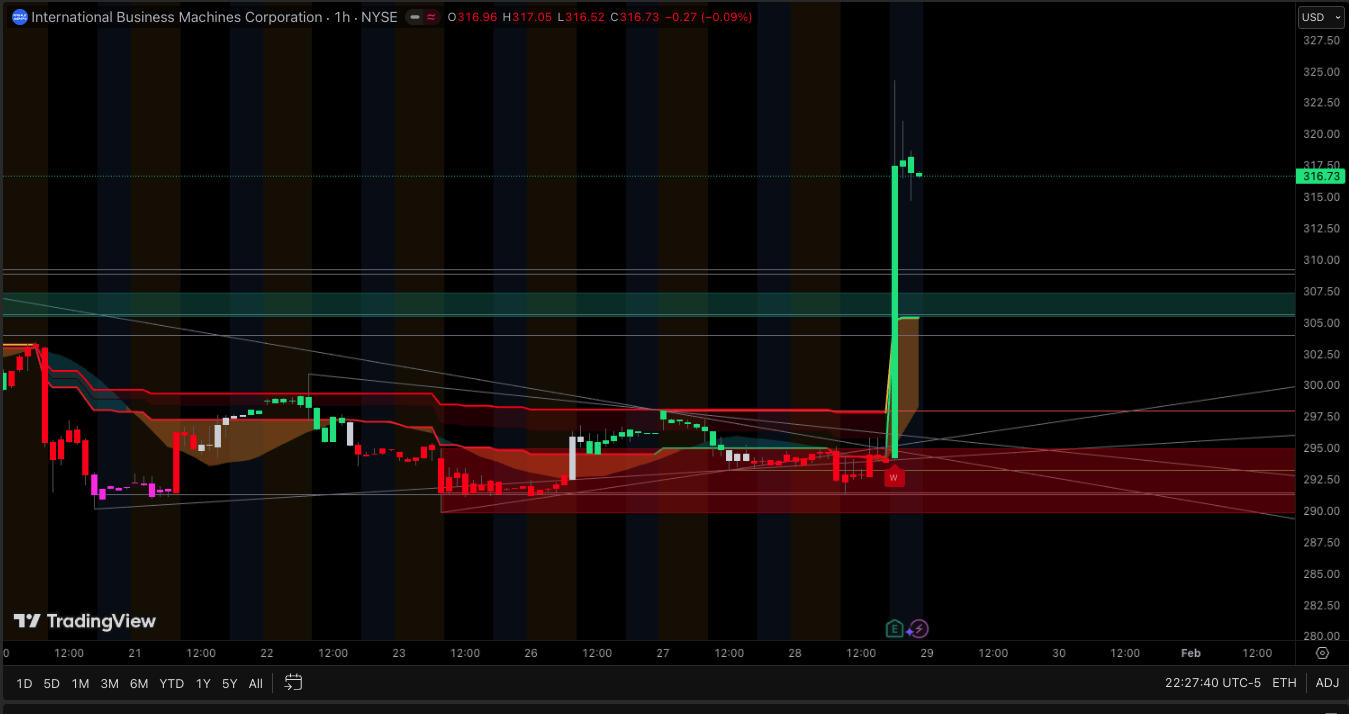 Then the earnings gap hit. The stock closed around $294 and traded after hours near $316, a move of roughly 7% to 8%. In technical terms, that is an attempted breakout back above long-term trend gauges, with the 52-week high near 324.9 now the next obvious reference level. The market will watch whether price action holds above the 200-day zone after liquidity normalizes.
| Indicator | Latest reading | Signal | What it suggests now |
|---|---|---|---|
| RSI (14) | 48.0 | Neutral | Momentum was balanced pre-earnings, leaving room for a post-gap trend rebuild. |
| MACD (12,26) | -0.47 | Bearish | Downward momentum was present before the report, so the gap needs follow-through. |
| EMA 20 | 294.19 | Slight resistance turned support | Holding above this zone helps prevent a rapid gap fade. |
| EMA 50 | 295.85 | Resistance turned support | A close above strengthens the near-term uptrend structure. |
| EMA 200 | 299.90 | Major trend line | Acceptance above 300 is the technical confirmation level for longer-term bulls. |
| Support | 300, then 294 | Key zones | 300 is the trend test; 294 is the gap-fill risk line. |
| Resistance | 324.9, then 330 | Breakout zones | Clearing 324.9 signals a new high attempt; 330 is the psychological extension. |
| Trend | Rebuilding | Improving | The earnings gap flips the setup from heavy to constructive if defended. |
| Momentum | Transitioning | Improving | Needs strong volume and closes above 300 to confirm. |
Three risks stand out.
First, infrastructure strength can fade quickly after a mainframe cycle peak. If IBM Z demand normalizes faster than expected, headline growth rates will compress, and the market will test whether software can keep overall growth above the 5% constant-currency ambition.
Second, consulting can turn from stabilizer to drag if enterprises tighten discretionary spend. The current growth rate is modest. Any macro shock could flip it negative and pressure utilization, margins, and sentiment.
Third, the balance sheet is less forgiving than it was in the zero-rate era. Debt is higher year over year, interest expense is meaningful, and the Confluent transaction adds integration and execution risk, even if it strengthens IBM’s AI data stack over time.
The rally reflects a mix shift toward higher-margin software, sharp infrastructure acceleration, and stronger cash generation. Q4 revenue reached $19.7B, gross margin rose to 60.6%, and free cash flow in the quarter increased to $7.6B, strengthening confidence in 2026 execution.
It signals contracted, monetizable AI-related activity rather than abstract demand. The figure includes software transactional revenue, new SaaS annual contract value, and consulting signings tied to specific offerings, implying multiple revenue pathways as deployments scale.
IBM expects more than 5% constant-currency revenue growth in 2026 and about $1B of year-over-year free-cash-flow improvement. Sustainability depends on software maintaining double-digit momentum as infrastructure growth normalizes after a strong mainframe-driven quarter.
Full-year free cash flow reached $14.7B, and IBM declared a quarterly dividend of $1.68 per share, continuing a dividend history that extends back to 1916. Strong free cash flow supports the payout, but debt levels and M&A funding remain key constraints.
The critical level is the 200-day exponential average near 300. Holding above it supports a bullish regime shift. Resistance sits near the 52-week high around 324.9, with support near 300 and the pre-earnings close around 294 as the gap-fill line.
Confluent strengthens real-time data streaming, a central enabler for scaling enterprise AI systems across hybrid environments. IBM expects the $11B cash deal to be accretive to adjusted EBITDA within the first full year after close and to free cash flow in year two, but execution of the integration will matter.
IBM’s post-market surge should be interpreted as a cash-flow revaluation with an added premium for AI capabilities, rather than a reaction to a single quarter’s results. Software provided the most significant structural contribution, infrastructure delivered cyclical gains through IBM Z, and consulting remained sufficiently stable to confirm ongoing enterprise demand. The next challenge for the company is to maintain margin improvements, convert its $12.5 billion AI portfolio into recurring revenue, and finance strategic acquisitions without overextending the balance sheet.
From both a fundamental and a technical perspective, this quarter has set higher expectations and established a clearer strategic path for 2026.
Disclaimer: This material is for general information purposes only and is not intended as (and should not be considered to be) financial, investment, or other advice on which reliance should be placed. No opinion given in the material constitutes a recommendation by EBC or the author that any particular investment, security, transaction, or investment strategy is suitable for any specific person.
1. IBM Newsroom