Published on: 2026-05-22
Updated on: 2026-05-22
D-Wave Quantum stock exploded 33.3% to $25.74 as Washington turned quantum computing from a speculative technology theme into a national industrial-policy trade. The move was violent, liquid and unmistakably institutional: QBTS traded roughly 119 million shares, lifting its market value by about $2.36 billion in one session.
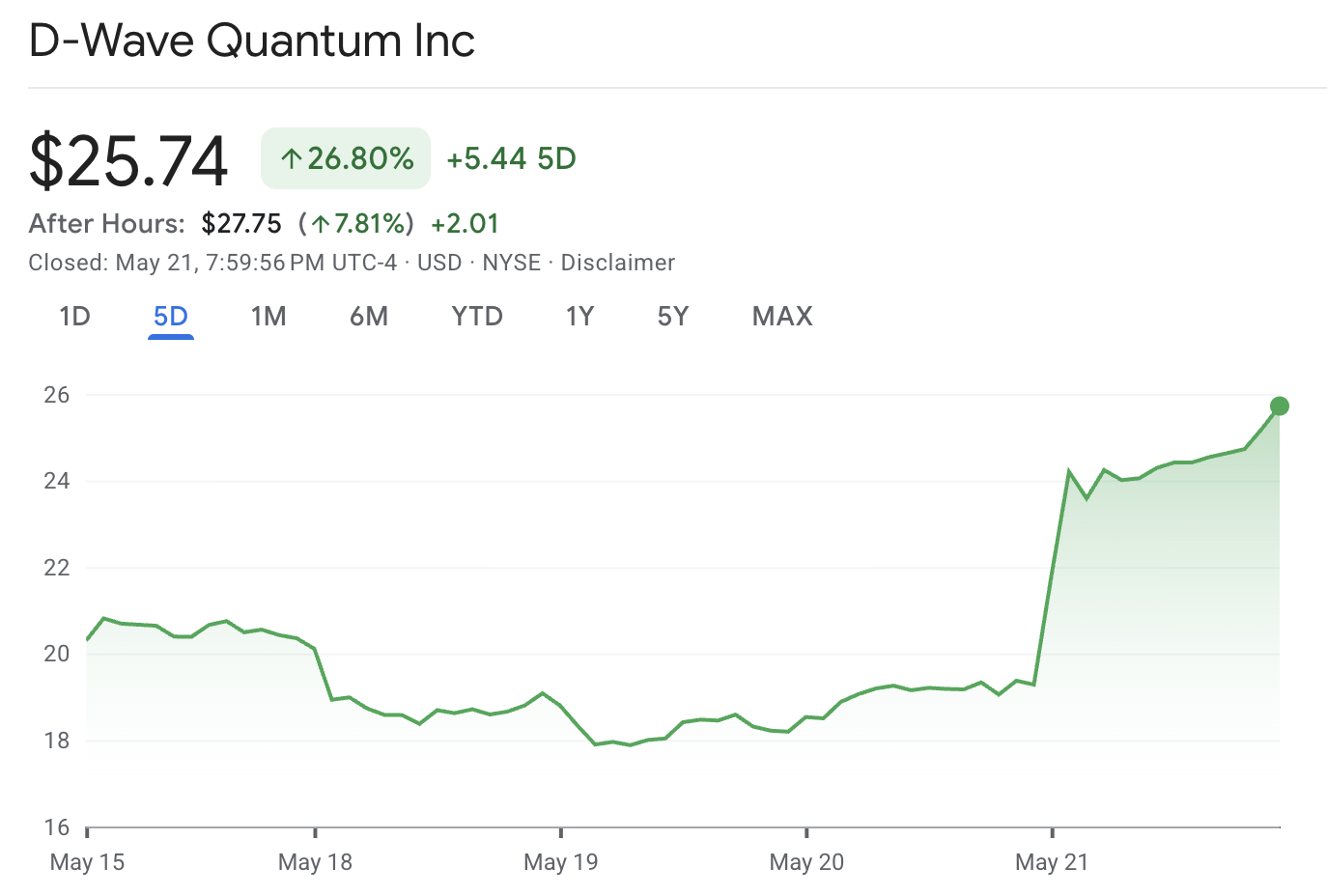
The headline catalyst was a $100 million letter of intent with the U.S. Department of Commerce under the CHIPS and Science Act. But the sharper story is not the check. It is that the government is willing to take common stock in D-Wave in exchange for funding, effectively turning quantum hardware into a strategic-asset class rather than a distant science project.
QBTS did not merely rise. It repriced on extreme volume, suggesting the move was more than retail enthusiasm chasing a quantum headline.
The $100 million award is small beside the one-day market-cap gain, but large enough to reshape perceived policy risk.
D-Wave’s fundamentals remain unusual: low current revenue, record bookings, deep cash and a still-unproven path to large-scale quantum utility.
The market is rewarding “strategic validation,” while quietly ignoring dilution, final-award risk and milestone execution.
Rigetti stock joined the same trade, but its move carries a different message: survival odds and scaling credibility improved overnight.
Public coverage has mostly framed the rally as a broad quantum computing surge, tied to a reported $2 billion Commerce Department push across nine quantum companies, including IBM, GlobalFoundries, D-Wave and Rigetti. That is accurate, but incomplete.
D-Wave’s move was powerful because the market treated the LOI as a government stamp on two disputed parts of its story: annealing quantum systems that are commercial today, and gate-model systems that still require years of scaling. The company says the funding would accelerate development of a 100,000-qubit annealing system and a 10,000-qubit gate-model system. Its gate-model roadmap targets 100 logical qubits as a key utility milestone.
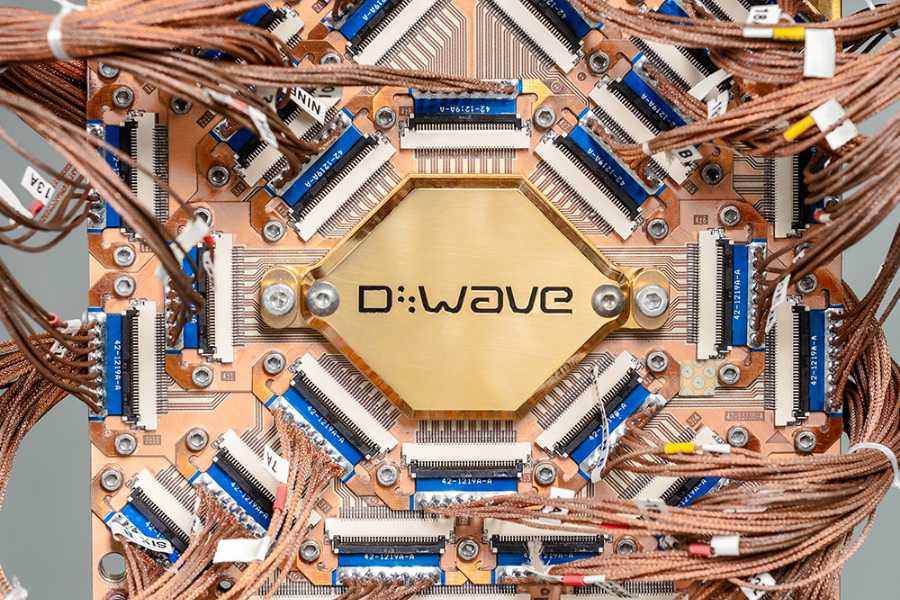
That matters because D-Wave has often been valued as a controversial pure play. Bulls see it as one of the few quantum companies with commercial deployments. Skeptics see a company with tiny revenue and heavy R&D needs. Washington’s proposed equity participation does not settle the science, but it changes the market’s probability model.
The trade became simple: if quantum is now treated like semiconductors, defense technology and AI infrastructure, then public pure plays may deserve a strategic premium.
The most important number was not $100 million. It was the gap between the award and the market reaction.
At the closing price of $25.74, a $100 million common-stock issuance would equal roughly 3.9 million shares, or about 1.06% of D-Wave’s market value, before final pricing and definitive terms. That makes the potential dilution manageable, but not irrelevant.
| D-Wave metric | Latest figure | Why it matters |
|---|---|---|
| QBTS closing price | $25.74 | Highest-impact public quantum move of the session |
| One-day move | +33.4% | Policy validation triggered a volatility expansion |
| Trading volume | ~119.1 million shares | Confirms a liquidity event, not a quiet repricing |
| Proposed CHIPS funding | $100 million | Strengthens balance-sheet and roadmap perception |
| Q1 2026 revenue | $2.9 million | Shows commercialization is still early and lumpy |
| Q1 2026 bookings | $33.4 million | Forward demand is stronger than reported revenue |
| Quarter-end cash and marketable securities | $588.4 million | Gives D-Wave runway to pursue the dual-platform strategy |
D-Wave’s Q1 results explain why the stock needed more than an earnings story. Revenue fell 81% year over year to $2.9 million because the prior-year quarter included a large system sale. Bookings, however, surged to $33.4 million, including a $20 million system sale to Florida Atlantic University and a $10 million two-year QCaaS agreement with a Fortune 100 company. Cash stood at $588 million.
That is the real bull case: not that D-Wave is already a conventional revenue compounder, but that bookings, government demand and cash runway may bridge the gap between today’s commercial annealing systems and tomorrow’s gate-model ambitions.
The answer is both.
It is a validation trade because D-Wave’s proposed award is tied to real R&D objectives, quantum hardware scaling and domestic technology supply-chain resilience. The CHIPS Act was designed to strengthen critical technology capacity, and quantum computing now sits inside that policy perimeter.
It is also a squeeze because the stock added far more market value in one session than the proposed funding itself. That does not make the rally irrational. It means investors repriced the probability that D-Wave survives, scales and becomes strategically relevant.
The risk is that the LOI is not final. D-Wave states the award remains subject to definitive documents, conditions and risks, including possible dilution and the possibility that negotiations do not conclude as expected.
That detail was underplayed in much of the fast-market coverage. Letters of intent can reshape expectations, but they are not cash in the bank.
Rigetti Computing rose 30.6% to $22.04 on the same quantum catalyst, with volume even heavier than D-Wave’s. RGTI traded about 148 million shares, reflecting the same sector-wide rush into U.S.-listed quantum pure plays.
Rigetti also signed a Commerce Department LOI for up to $100 million over three years, with the government expected to receive an equity stake consistent with the funding amount. The company said the award would support superconducting quantum R&D and help address scaling bottlenecks.
The Rigetti angle is more survival-sensitive. It reported Q1 revenue of $4.4 million, an operating loss of $26 million and cash plus investments of $569 million. Its 108-qubit Cepheus-1-108Q system is generally available through Rigetti QCS, Amazon Braket, Microsoft Azure Quantum and qBraid, giving RGTI stronger visibility in the gate-based quantum ecosystem.
The missing story is that quantum computing stocks are no longer trading only on product milestones. They are trading on sovereign capital allocation.
One ratio frames the asymmetry cleanly: D-Wave's $588 million cash position already exceeds the proposed $100 million award by nearly six times. The funding is not a rescue. It is a co-sign, and the market is paying a 33% premium for what a co-sign means when the co-signer is the U.S. federal government.
Still, this is not a blank check for QBTS stock. The next test is conversion: bookings into revenue, government intent into finalized funding, and technical roadmaps into systems that customers can use at scale. D-Wave Quantum stock has won the headline battle. The harder battle begins now.