Published on: 2026-07-02
The best value stocks in 2026 are cheap enough to attract attention and flawed enough to create hesitation. A low valuation can signal opportunity, or mark earnings the market no longer trusts. These 10 stocks have current cash flow, guidance, buybacks or margin recovery that challenge the size of the discount.
The S&P 500 trades near 20.1 times forward earnings, above its 5-year average of 19.9 and 10-year average of 19.0, leaving less room for stocks priced on hope rather than cash flow.
Low P/E alone did not qualify any stock. Each name needed 2026 evidence through cash flow, guidance, buybacks or margin recovery.
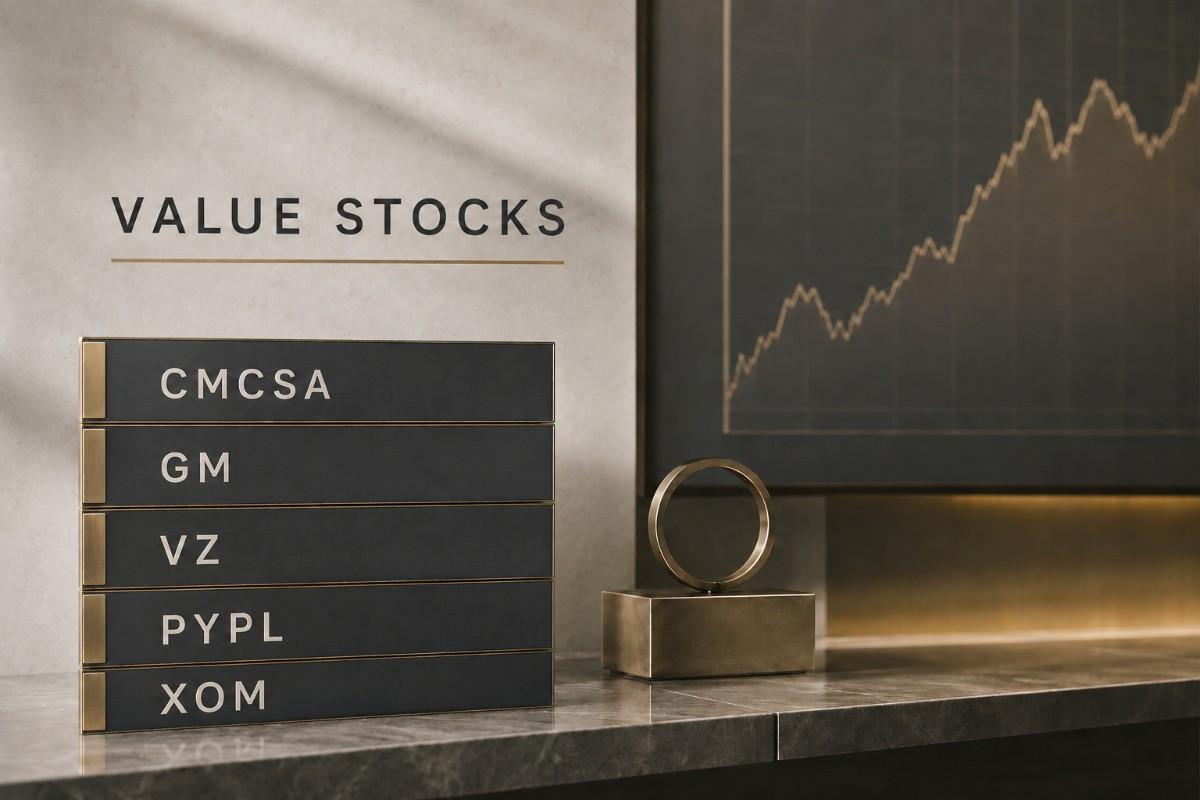
Comcast, General Motors, Verizon, Exxon Mobil and PayPal stand out because current cash flow or capital returns challenge the size of the discount.
Bristol Myers Squibb, Pfizer, Citigroup, American International Group and Salesforce remain value candidates only if 2026 execution keeps offsetting the risks already priced in.
The year-end test is guidance durability. If cash flow, margins and capital returns hold through the second half, the mispricing case strengthens.
Every stock below is cheap for a reason. The table shows whether current 2026 evidence is strong enough to challenge that reason.
| Stock | Why it may be mispriced | 2026 evidence | Risk to watch |
|---|---|---|---|
| Comcast | Cash flow above cable fears | $3.9B Q1 free cash flow | Broadband losses |
| General Motors | Buybacks support cheap earnings | $4.3B Q1 adjusted EBIT | Auto cycle |
| Bristol Myers | Patent risk may be overdone | $6.05 to $6.35 EPS guide | Pipeline execution |
| Verizon | Dividend backed by cash flow | $3.8B Q1 free cash flow | Debt |
| Citigroup | Returns keep improving | 13.1% tangible return | Credit risk |
| AIG | Underwriting supports value | 87.3% combined ratio | Catastrophe losses |
| Exxon Mobil | Cash returns offset oil risk | $9.2B distributions | Oil prices |
| Pfizer | Yield needs less doubt | $59.5B to $62.5B revenue guide | Dividend pressure |
| PayPal | Buybacks challenge payment doubts | $1.72B adjusted free cash flow | Margin pressure |
| Salesforce | AI fear may be overdone | $3.4B AI and data ARR | AI revenue durability |
The list breaks into two groups. Comcast, General Motors, Verizon, Exxon Mobil and PayPal have the cleaner cash-flow or capital-return support.
Bristol Myers Squibb, Pfizer, Citigroup, AIG and Salesforce need stronger execution through year-end before the discount looks fully mispriced.

Comcast still has one advantage the market is giving little credit for. The business keeps turning cable pressure into cash.
The stock trades at 6.73 times forward earnings and 4.16 times free cash flow, while Q1 2026 produced $3.9 billion in free cash flow and $2.5 billion of dividends and buybacks. Those numbers challenge the idea that broadband losses have already overwhelmed the company’s earnings power.
Broadband remains the pressure point. Cable fears are already in the price, so the signal to watch is whether free cash flow keeps covering dividends and buybacks without broadband losses worsening.
General Motors has something many cheap cyclicals lack. Cash is still reducing the share count while earnings remain strong.
The stock trades at 6.03 times forward earnings, shares outstanding fell 12.4% year over year, and Q1 2026 EBIT-adjusted reached $4.3 billion. Full-year EBIT-adjusted guidance also rose to $13.5 billion to $15.5 billion.
The auto cycle can still turn quickly. Financing costs, weaker demand and EV margin pressure can cut into earnings fast. GM’s discount looks more defensible if trucks and crossovers keep producing enough cash to fund buybacks without another guidance reset.
Bristol Myers is cheap for a clear reason. The patent cliff is real, and older drugs are losing exclusivity.
The stock stays on the list because the newer portfolio is doing more than filling space in a transition story. Q1 2026 revenue reached $11.5 billion, Growth Portfolio sales reached $6.2 billion, and non-GAAP EPS guidance stayed at $6.05 to $6.35.
The year-end test is simple. The Growth Portfolio must keep closing the gap left by older drugs, not just slow the decline for another quarter.
Verizon has one clear attraction. The dividend is still backed by cash flow.
The stock trades at 8.38 times forward earnings and 8.65 times free cash flow, less than half the broader market multiple. Q1 2026 free cash flow rose to $3.8 billion from $3.6 billion a year earlier, while adjusted EPS guidance increased to $4.95 to $4.99.
Unsecured debt stood at $142.5 billion at the end of Q1. Free cash flow after network investment matters more than the headline yield. Yield alone will not carry the case.
Citigroup has already moved, so the easy turnaround discount is gone. The cleaner question is whether higher returns can last long enough to justify more trust.
The stock trades at 12.48 times forward earnings and 1.42 times tangible book value, below the Financials sector’s 15.0 times forward P/E. Q1 2026 delivered $5.8 billion in net income, $24.6 billion in revenue and a 13.1% return on tangible equity.
Credit risk and restructuring doubts keep pressure on the valuation. Citi is execution-dependent because the next proof point is whether that 13.1% return can hold without a jump in credit costs.
AIG has a clearer value case because underwriting has improved, not because insurance stocks are automatically cheap.
The stock trades at 9.34 times forward earnings and 1.01 times book value. Q1 2026 adjusted after-tax income per share rose 80% to $2.11, Core Operating ROE reached 12.2%, and the General Insurance combined ratio improved to 87.3%.
Catastrophe losses or adverse reserve moves can still damage the case quickly. Book value matters more when underwriting quality holds through a full loss cycle, not just one clean quarter.
Exxon Mobil has the balance sheet many energy value names lack. Debt-to-equity sits at 0.18, giving the company more room to return cash through the cycle.
The stock trades at 10.77 times forward earnings, below the Energy sector’s 12.6 times forward P/E. Q1 2026 earnings reached $4.2 billion, operating cash flow reached $8.7 billion, and shareholder distributions totalled $9.2 billion through dividends and buybacks.
Oil prices and refining margins still decide how much of that cash return looks repeatable. Exxon’s value case depends on operating cash flow funding shareholder returns without leaning too hard on the balance sheet when the commodity cycle weakens.
Pfizer has a yield that attracts attention and a reset that still creates doubt. The stock trades at 8.40 times forward earnings, with a dividend yield above 7%.
Q1 2026 revenue rose to $14.45 billion, and full-year guidance stayed at $59.5 billion to $62.5 billion in revenue and $2.80 to $3.00 in adjusted diluted EPS. The guidance keeps the stock on the watchlist, though it does not erase the pressure around pipeline productivity.
Pfizer is execution-dependent. Pipeline progress and guidance stability need to arrive together before the yield looks like value rather than stress.
PayPal still has a powerful lever in its favour. Free cash flow is funding buybacks while the stock trades at a compressed multiple.
The stock trades at 8.13 times forward earnings and 7.06 times free cash flow, with shares outstanding down 7.1% year over year. Q1 2026 adjusted free cash flow reached $1.72 billion, and share repurchases totalled $1.5 billion.
Transaction-margin pressure remains the threat. PayPal needs buybacks to come with better account quality and steadier transaction margins, not just a lower share count.
Salesforce brings a different kind of value case. The argument is multiple compression, not old-economy cheapness.
The stock trades at 11.71 times forward earnings and 9.12 times free cash flow, a sharp reset for a software company still raising revenue guidance. Agentforce and Data 360 annual recurring revenue reached about $3.4 billion, up more than 200% year over year, while full-year revenue guidance rose to $45.9 billion to $46.2 billion.
Salesforce is execution-dependent because AI fear created the discount, and AI revenue now has to defend it. The value reset holds only if Agentforce demand becomes durable enough to support the new multiple, not just impressive enough to headline the quarter.
Value in 2026 is no longer just a hunt for low multiples. The market is pricing doubt with more precision, especially where cash flow looks durable but the business carries a visible flaw.
The common thread across this list is distrust. Cable decline, patent cliffs, debt, credit risk, oil volatility, margin pressure and AI disruption are not hidden risks. They are already in the price.
The opportunity exists where current evidence pushes against that doubt. The danger is buying a low multiple before knowing whether the earnings are discounted or damaged.
The list used five filters. Each stock needed a valuation discount, current 2026 evidence, cash-flow or capital-return support, a year-end signal to watch and a specific risk that could weaken the case.
Stocks were excluded when the case relied mainly on popularity, dividend yield, sector reputation, low P/E without earnings support or adjusted figures without sufficient cash-flow context.
Berkshire Hathaway was excluded because quality alone did not create a direct mispricing case. AT&T was excluded because yield lacked a cleaner debt and free-cash-flow setup. Global Payments was excluded because adjusted earnings did not fully offset the GAAP loss and execution risk.
A value trap begins where the low multiple reflects earnings damage rather than market overreaction.
Second-half 2026 earnings will decide whether these stocks are mispriced or merely cheap. Cash flow, margins and capital returns need to hold while the market continues to price in uncertainty. If guidance breaks, the discount was not an opportunity; it was a warning.
The market is not short of cheap stocks. It is short of cash flows it still believes.