Published on: 2026-04-01
Pfizer's recent rally indicates increased investor confidence in the company's business segments beyond its diminishing pandemic-related revenues.
Investor sentiment has improved in response to clearer corporate guidance, stronger operational execution, and increased activity within Pfizer's late-stage drug development pipeline.
This upward movement appears to represent a revaluation of Pfizer as a defensive large-cap pharmaceutical company, rather than a speculative price surge.
The primary challenge ahead is whether Pfizer can translate its pipeline momentum into sustained earnings growth.
While the Nasdaq and Dow are both in correction territory, and the S&P 500 is grinding through its worst streak of weekly losses since 2022, PFE stock quietly reached its highest price in a year.
On Tuesday, March 31, PFE stock achieved a new 52-week high, driven by positive analyst commentary and a series of favorable pipeline developments. Shares reached an intraday peak of $28.30, surpassing the previous high of $27.92.
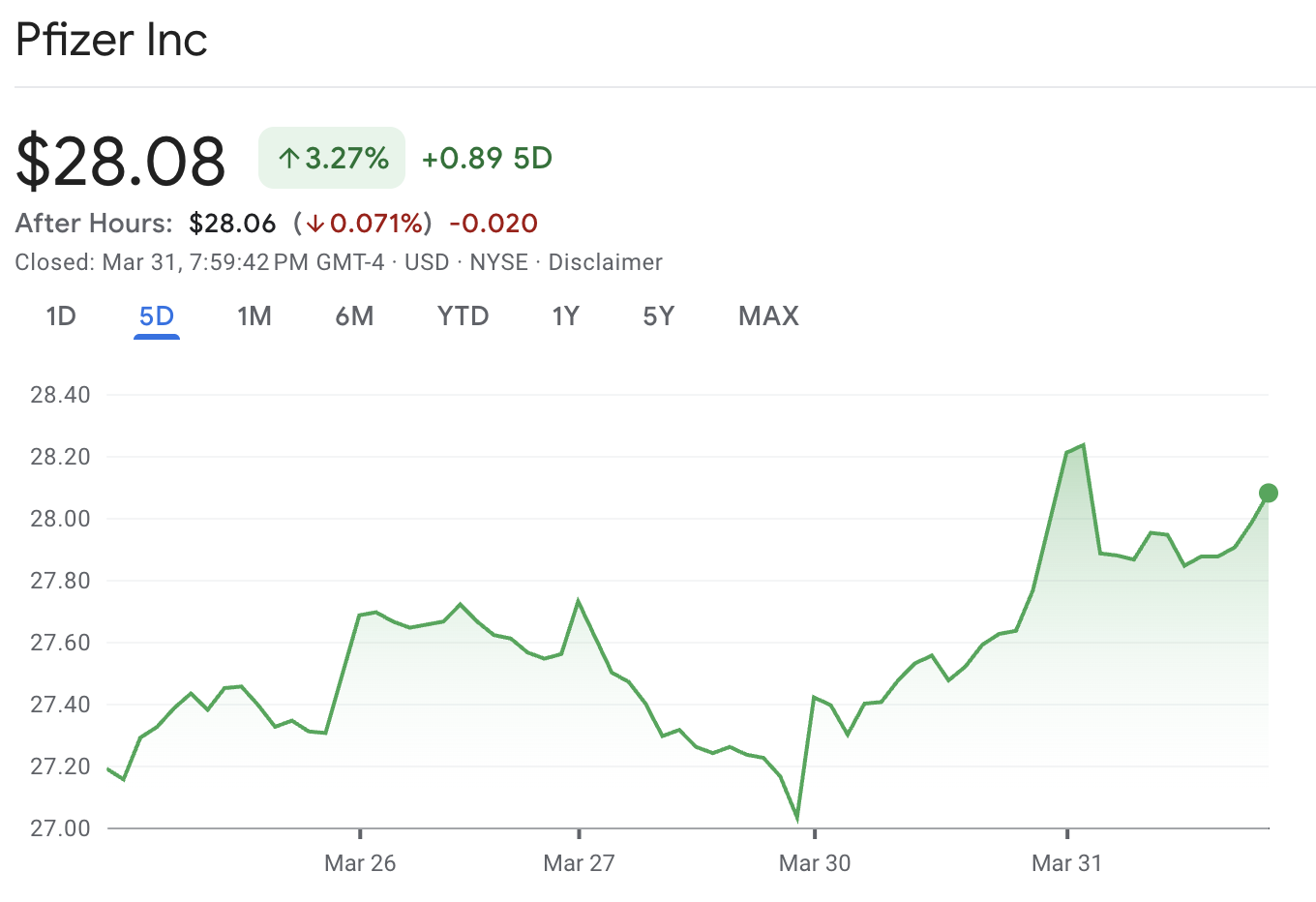
Given Pfizer's efforts throughout 2024 to counter perceptions of a post-COVID decline, this milestone is significant.
The key consideration is whether this development signals the start of a genuine revaluation or merely reflects defensive positioning in a risk-averse market environment.
The most immediate catalyst for the stock's movement is macroeconomic rather than company-specific. PFE has demonstrated resilience in recent trading sessions, maintaining levels near the upper end of its 52-week range despite broader market volatility.
 Trading volume remains robust, indicating sustained interest from institutional investors attracted by Pfizer's defensive characteristics and appealing dividend yield.
During periods of rotation from growth stocks to defensive assets, large-cap pharmaceutical companies often experience increased capital inflows.
Pfizer, characterized by a low beta of approximately 0.41, consistent cash generation, and a stable dividend, currently aligns well with defensive investment criteria.
On March 19, Pfizer reported that its PARP inhibitor Talzenna, when combined with Xtandi, significantly improved radiographic progression-free survival in the Phase 3 TALAPRO-3 trial for select patients with metastatic prostate cancer.
Talzenna sales increased by 81.5% year over year, reaching $49 million in the fourth quarter of 2025. This growth contributed to broader momentum within Pfizer's oncology portfolio, which also includes Padcev and Lorbrena.
Pfizer's $10 billion acquisition of Metsera provided access to PF-08653944, an ultra-long-acting GLP-1 candidate.
Preliminary 2026 data indicate that this compound may enable monthly dosing, potentially disrupting the current weekly injection market dominated by Eli Lilly and Novo Nordisk.
Following the failure of its oral candidate danuglipron, many investors had dismissed Pfizer's obesity drug ambitions.
However, the potential for monthly dosing, if validated in late-stage trials, would represent a significant differentiator in a market currently reliant on weekly injections.
Full-year 2025 financial results demonstrated resilience in Pfizer's non-COVID product segments. Total revenues reached approximately $62.6 billion, with non-COVID revenues increasing by 6% on an operational basis.
Fourth-quarter 2025 revenues totaled $17.6 billion, and adjusted earnings per share for the year were $3.22, exceeding certain analyst expectations.
Pfizer has provided guidance for full-year 2026 revenues in the range of $59.5 billion to $62.5 billion, which is essentially unchanged from 2025. Adjusted diluted earnings per share are projected to be between $2.80 and $3.00.
Excluding the effects of COVID-related products and loss of exclusivity, Pfizer anticipates approximately 4% operational revenue growth at the midpoint of its guidance.
| Metric | Data |
|---|---|
| 52-Week High | $28.30 |
| 52-Week Low | $20.92 |
| Dividend Yield | ~6.19% |
| 1-Year Total Return | ~17.54% |
| Market Cap | ~$158.9 billion |
| 2026 Revenue Guidance | $59.5B to $62.5B |
| Forward EPS Guidance | $2.80 to $3.00 |
| Next Earnings Date | May 5, 2026 |
Pfizer's positive outlook is accompanied by a structural caveat that warrants careful consideration by investors.
Pfizer has acknowledged an expected year-over-year revenue headwind of approximately $1.5 billion in 2026 due to the loss of exclusivity, on top of declining COVID-19 revenues.
Several major products are approaching or entering patent expiry in the late 2020s, including Eliquis, Ibrance, Xtandi, and Prevnar 13.
As one Wall Street analyst noted: "The Seagen and Metsera deals provide long-term firepower in high-growth areas, but near-term patent cliffs and waning COVID revenues are keeping a lid on expectations."
This constitutes the central argument for bearish sentiment. While the pipeline is substantive, the timeline for bridging revenues is constrained, and the execution risk associated with managing over twenty pivotal trials concurrently is considerable.
The dividend has consistently provided support for PFE stock, even during periods of multi-year declines.
Pfizer continues to appeal to income-focused investors, offering a dividend yield of 6.19%. The stock appears undervalued at current price levels and maintains a strong financial health rating.
In an environment characterized by elevated and volatile 10-year Treasury yields, a dividend yield near 6.2% from a company of Pfizer's scale and cash generation represents a compelling income opportunity.
The stock has retained institutional ownership even during periods of disappointing earnings guidance.
PFE stock demonstrates a constructive technical outlook, having closed at $28.08 on March 31, 2026, with an intraday and 52-week high of $28.30.
The stock is trading above its 20-day EMA of $27.71, 50-day EMA of $27.47, and 200-day EMA of $27.06. This positioning confirms a bullish trend across short-, medium-, and long-term time frames.
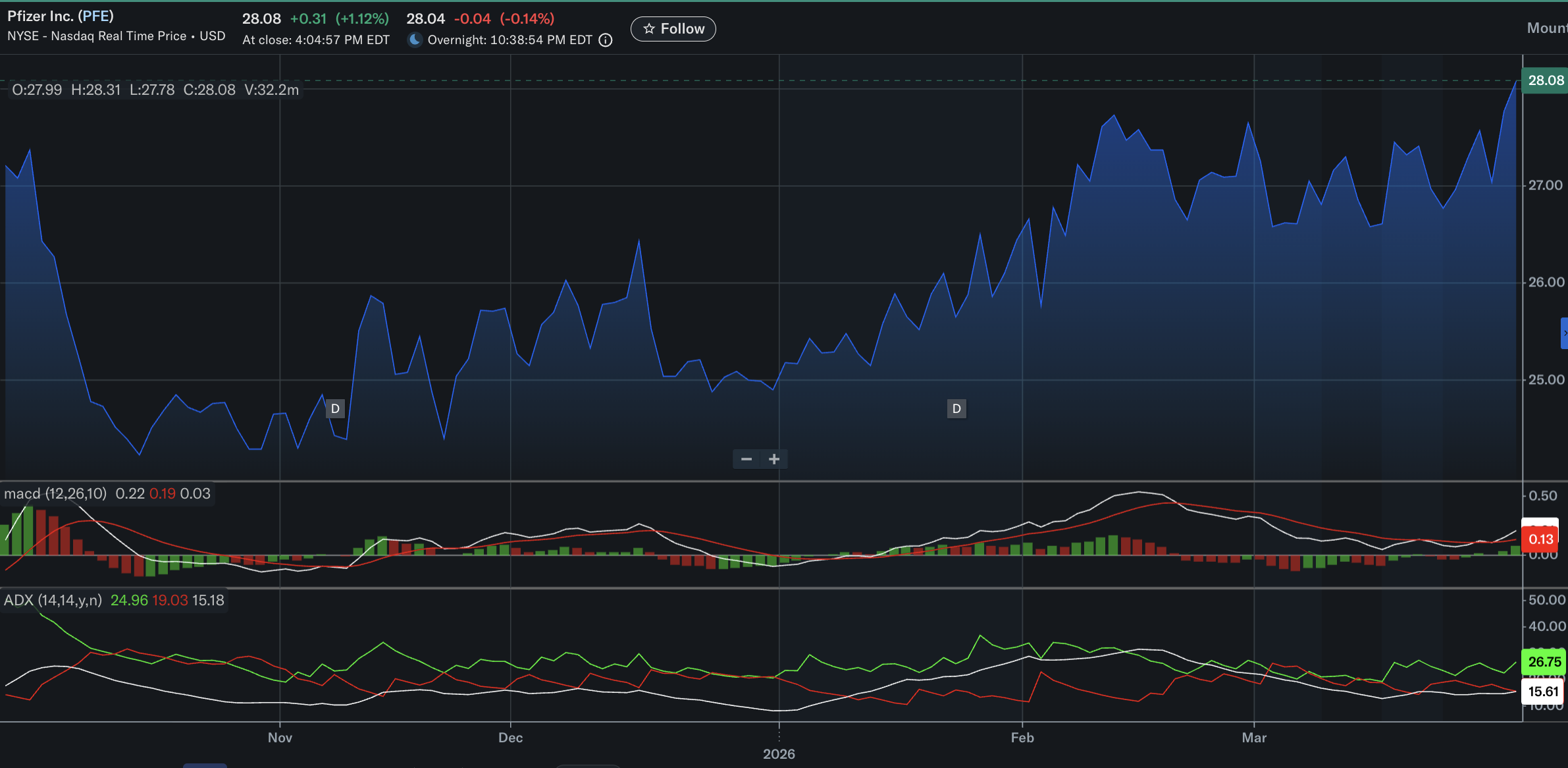
| Indicator | Reading | Signal |
|---|---|---|
| RSI (14) | 64.35 | Bullish, not extreme |
| MACD (12,26) | 0.20 | Buy |
| EMA 20 | 27.71 | Price above, bullish |
| EMA 50 | 27.47 | Price above, bullish |
| EMA 200 | 27.06 | Long-term uptrend intact |
| Breakout High | 28.30 | Near-term test level |
| Classic Pivot | 27.88 | Key reference |
| Classic S1 / S2 / S3 | 27.83 / 27.77 / 27.72 | First support ladder |
| Trend | Bullish | Above major averages |
| Momentum | Positive | Strong, not yet extreme |
Provided that PFE stock remains above the $27.47 to $27.06 moving-average support zone, the bullish technical structure is likely to persist.
A decline below this area would undermine the breakout and refocus attention on the ability of buyers to sustain the recent upward movement.
No. Pfizer has reached a 52-week high, but not an all-time record. The current price movement indicates renewed momentum, though it does not restore the stock to its pandemic-era peak.
Yes. Pfizer declared a $0.43 quarterly dividend for the first quarter of 2026, continuing its longstanding record of regular dividend payments.
Pfizer has scheduled its first-quarter 2026 conference call for May 5, 2026. This event will serve as the next significant milestone for investors monitoring the recent breakout.
Mostly yes. Pfizer remains a large-cap pharmaceutical company with significant cash flow and dividend support, but its stock now also carries pipeline-driven upside and patent-risk sensitivity.
The suitability of PFE stock depends on individual investment strategies. At current valuations, with a nearly 6% dividend yield and a pipeline advancing toward key 2027 and 2028 catalysts, Pfizer is well-positioned for income-focused and long-term value investors.
PFE stock's recent 52-week high is attributable to a combination of stable corporate guidance, improving non-COVID growth, significant late-stage pipeline activity, and renewed market interest in cash-generative healthcare companies.
Currently, the stock's resilience near recent highs suggests that some investors anticipate eventual returns from Pfizer's oncology and obesity initiatives, despite 2026 guidance indicating a transitional year rather than rapid growth.
Whether PFE can hold and extend these gains depends on two things: the continued absence of positive risk appetite in the broader market and whether Pfizer's pivotal trial calendar delivers results that move the needle on the long-term earnings outlook before the patent cliff pressure intensifies in 2027.
Disclaimer: This material is for general information purposes only and is not intended as (and should not be considered to be) financial, investment or other advice on which reliance should be placed. No opinion given in the material constitutes a recommendation by EBC or the author that any particular investment, security, transaction or investment strategy is suitable for any specific person.