Published on: 2026-06-30
BRK.A is the most expensive stock in 2026, trading at $743,510 as of the latest June 29, 2026, data snapshot, while Berkshire’s Class B stock trades near $496. The gap comes from Berkshire’s unusual share structure, where Class A shares preserve scarcity and voting power while Class B shares provide cheaper access.
A $740,000 stock price may seem shocking, but Berkshire is not expensive in the way many readers expect.
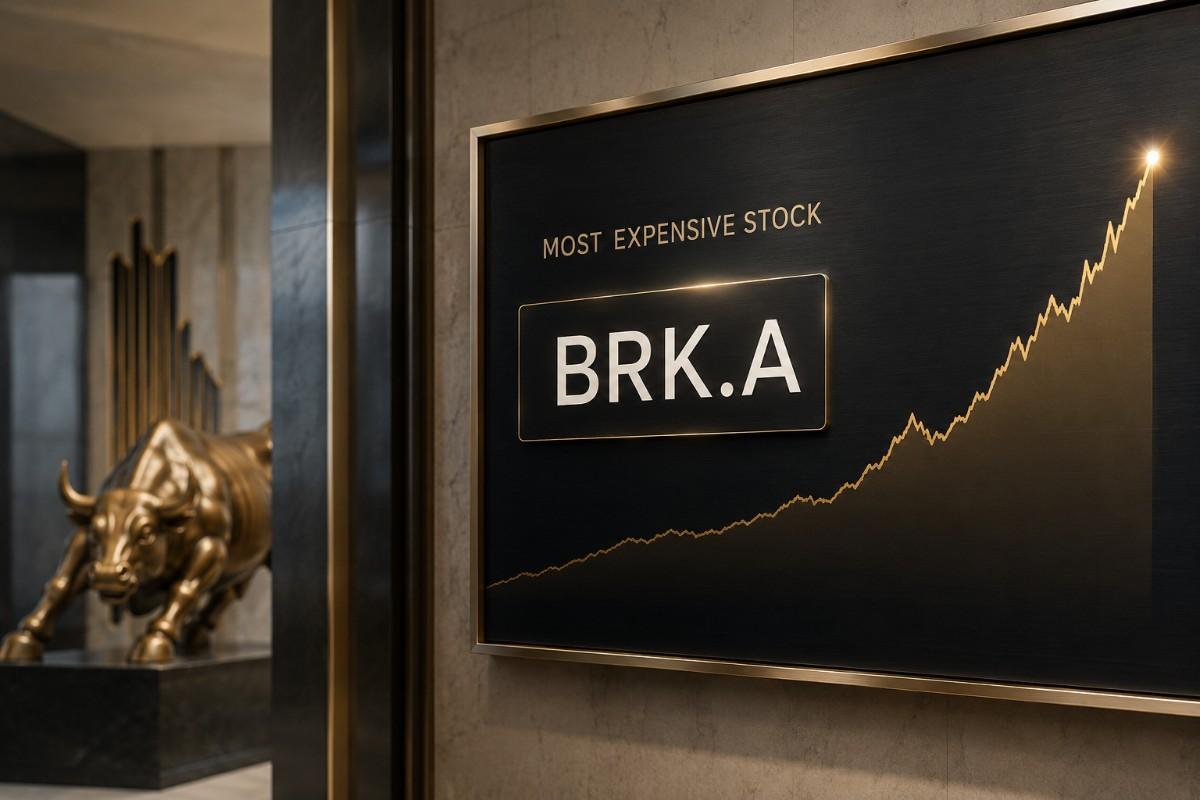
BRK.A trades above $740,000, more than 100 times the price of NVR, the next major U.S. stock in the ranking.
Berkshire had 1,437,903 Class A-equivalent shares outstanding at March 31, 2026, giving each share an unusually large slice of the company.
BRK.B trades near $496, giving lower-cost Berkshire exposure without the same voting power or Class A scarcity.
Berkshire’s P/E ratio is near 14.3, showing that the highest share price does not automatically mean the richest valuation.
A Class A stock split is the clearest event that could remove BRK.A from the top spot, since no current U.S. rival trades close enough to catch it naturally.
BRK.A holds the top spot by a margin no other U.S. stock comes close to matching.
| Question | Answer |
|---|---|
| Most expensive stock | Berkshire Hathaway Class A |
| Ticker | BRK.A |
| Price level | $743,510 as of June 29, 2026 |
| Lower-cost share class | BRK.B, near $496 |
| Main reason | Class A scarcity and voting power |
| Biggest confusion | Share price is not valuation |
| Main event that could change the answer | A Berkshire Class A stock split |
BRK.B solved affordability without changing what keeps BRK.A rare.
BRK.A does not lead by a normal market margin. The next highest-priced U.S. stocks trade in the low thousands, while Berkshire remains above $740,000 a share.
The current ranking shows how unusual the lead has become.
| Rank / Stock | Price, as of June 29, 2026 | P/E |
|---|---|---|
| 1. Berkshire Hathaway Class A (BRK.A) | $743,510 | 14.26 |
| 2. NVR (NVR) | $6,821 | 16.66 |
| 3. Seaboard (SEB) | $4,591 | 7.58 |
| 4. AutoZone (AZO) | $3,154 | 21.68 |
| 5. White Mountains Insurance (WTM) | $2,091 | 5.19 |
NVR is the closest major U.S. name on the list, yet BRK.A trades at more than 100 times its share price. The ranking is not just wide. It is structurally different.
BRK.A is not at a record today. Its all-time closing high was $809,350 on May 2, 2025, putting the current $743,510 price about 8% below that peak.
Berkshire’s Class A shares remained expensive because the company preserved the original share class rather than splitting it like most large public companies. A large business divided across a limited A-equivalent share base creates a high price per share.
The share count turns the price from mystery into math. Berkshire reported 1,437,903 Class A-equivalent shares outstanding at March 31, 2026, so each share represents a large claim on the company’s earnings, assets, and voting base.
The shock is the single-share cost. One BRK.A share costs more than many homes, yet Berkshire’s earnings multiple sits near 14.3, below many lower-priced growth stocks. The unit is rare; the valuation is far less extreme than the headline number suggests.
BRK.B gives lower-priced exposure to Berkshire, but it does not carry the same voting power or scarcity. One Class B share has 1/1,500th of Class A’s economic rights and 1/10,000th of its voting rights.
| Feature | BRK.A | BRK.B |
|---|---|---|
| Price | $743,510 | About $496 |
| Economic rights | Full Class A share | 1/1,500th of Class A |
| Voting rights | 1 vote | 1/10,000th of Class A |
| Conversion | Into 1,500 BRK.B | No conversion into BRK.A |
The one-way conversion keeps BRK.B useful for access while preserving Class A’s scarcity. BRK.B tracks the economics, but it does not carry the same control.
The confusion starts when share price gets mistaken for company value. A company with a $50 stock can be worth more than a company with a $5,000 stock if it has far more shares outstanding.
Share price shows the cost of one share. Market cap shows the size of the company. P/E shows how expensive the earnings are.
BRK.A trades above $740,000 with a P/E near 14.3. AutoZone trades near $3,154 with a higher P/E near 21.7, while NVR trades near $6,821 with a P/E near 16.7. BRK.A looks shocking on a quote screen, but its earnings multiple does not scream excess.
Berkshire’s cash position adds a forward-looking layer without changing the answer to the main query. At March 31, 2026, Berkshire held about $397.4 billion in cash, cash equivalents, and short-term U.S. Treasury bills, while operating earnings rose to $11.346 billion from $9.641 billion a year earlier.
The cash story matters because scarcity alone cannot carry the next decade. Berkshire still needs to turn earnings, float, and liquidity into future per-share value. For the most expensive stock question, though, the ranking remains about share structure first and cash deployment second.
A near-term replacement looks unlikely. NVR, the closest major U.S. stock in the ranking, trades around $6,821, while BRK.A trades more than 100 times higher.
The fastest reset would come from Berkshire itself. A Class A split would change the ranking overnight. A deep BRK.A decline or years of weak capital deployment could narrow the gap, but neither would quickly erase the structural lead.
Global names do not change the answer. Lindt & Sprüngli registered shares remain among the world’s highest-priced equities, but BRK.A still sits far above the next major public-company share price in U.S. dollar terms.
Berkshire Hathaway Class A, ticker BRK.A, is the most expensive stock in 2026. It trades at $743,510 per share as of the latest June 29, 2026 data snapshot, far ahead of high-priced names such as NVR, Seaboard, AutoZone, and White Mountains Insurance.
BRK.A is expensive because Berkshire never split its Class A shares like most large public companies did. A $1 trillion-plus company spread across 1,437,903 Class A-equivalent shares creates an unusually high price per share.
No. BRK.A has the highest share price, not necessarily the largest market value. Share price measures one unit of stock. Market capitalization measures the whole company. That difference creates most of the confusion.
Yes. BRK.B trades near $496 and gives lower-cost exposure to Berkshire. It carries 1/1,500th of Class A’s economic rights and far lower voting power, so it gives access without making it the same as BRK.A.
BRK.A remains the most expensive stock in 2026 because Berkshire kept Class A rare while using BRK.B to widen access. The $740,000 price tag grabs attention, but the lesson is more practical: share price, company size, and valuation are different signals. BRK.A is expensive by price because it was built to be rare, not because every dollar of value is priced to perfection.