Published on: 2026-02-05
Updated on: 2026-02-05
Software stocks are selling off because investors suddenly see a real threat to the way many business software companies make money. The trigger was a fresh set of enterprise plugins tied to Anthropic's "Cowork" product, including a legal workflow tool designed to automate contract review, NDA triage, and compliance work.

On Tuesday, February 3, 2026, during the U.S. trading session, a new automation release from Anthropic triggered a rapid selloff across various sectors.
The selloff impacted software, data services, financial services, and asset managers, resulting in an estimated $285 billion in market value losses. The price action then travelled across regions, pressuring Asia-listed IT services and software names on Wednesday, February 4, 2026.
The key point is not that software stock is "over." The main point is that markets are determining where pricing power lies, especially as AI can handle clerical and compliance tasks across various files, browsers, and connected enterprise systems.
Anthropic has been building Cowork, an "agent-like" desktop product built around Claude, designed to plan and execute multi-step work, not just answer questions. The new feature allows teams to install role-based apps for departments such as legal, finance, sales, and support.
Anthropic's plugin is explicit about practical workflows such as contract review, NDA triage, compliance processes, and legal briefings. It includes structured commands for clause-by-clause review and routing decisions, and it is intended to be configurable to an organization's playbook and risk tolerances.
It also emphasizes connectivity. The page references connecting document management, chat, and project tracking tools via MCP to provide richer context, while stating that licensed attorneys should review outputs.
Markets have lived with "AI copilots" for two years. What grabbed attention was the framing of automation that finishes tasks, not just assists with drafts.
In short, Claude Cowork is more efficient at completing clerical tasks than conversational chatbots. When markets see a model provider delivering "finished workflows," investors often expect more specialized tools to follow.
| Instrument | What it represents | Latest price | Session move | Intraday low |
|---|---|---|---|---|
| IGV | U.S. software sector ETF | $83.84 | -1.83% | $81.57 |
| XSW | U.S. software & services ETF | $155.64 | -0.66% | $150.84 |
| QQQ | Nasdaq 100 proxy | $605.75 | -1.75% | $600.52 |
Even after the initial shock, sector proxies stayed heavy into the latest U.S. close.
The intraday low in IGV is a helpful tell. It shows the market briefly pushed into a deeper drawdown before stabilizing, which is typical when positioning is crowded, and liquidity is thinner than investors assume.
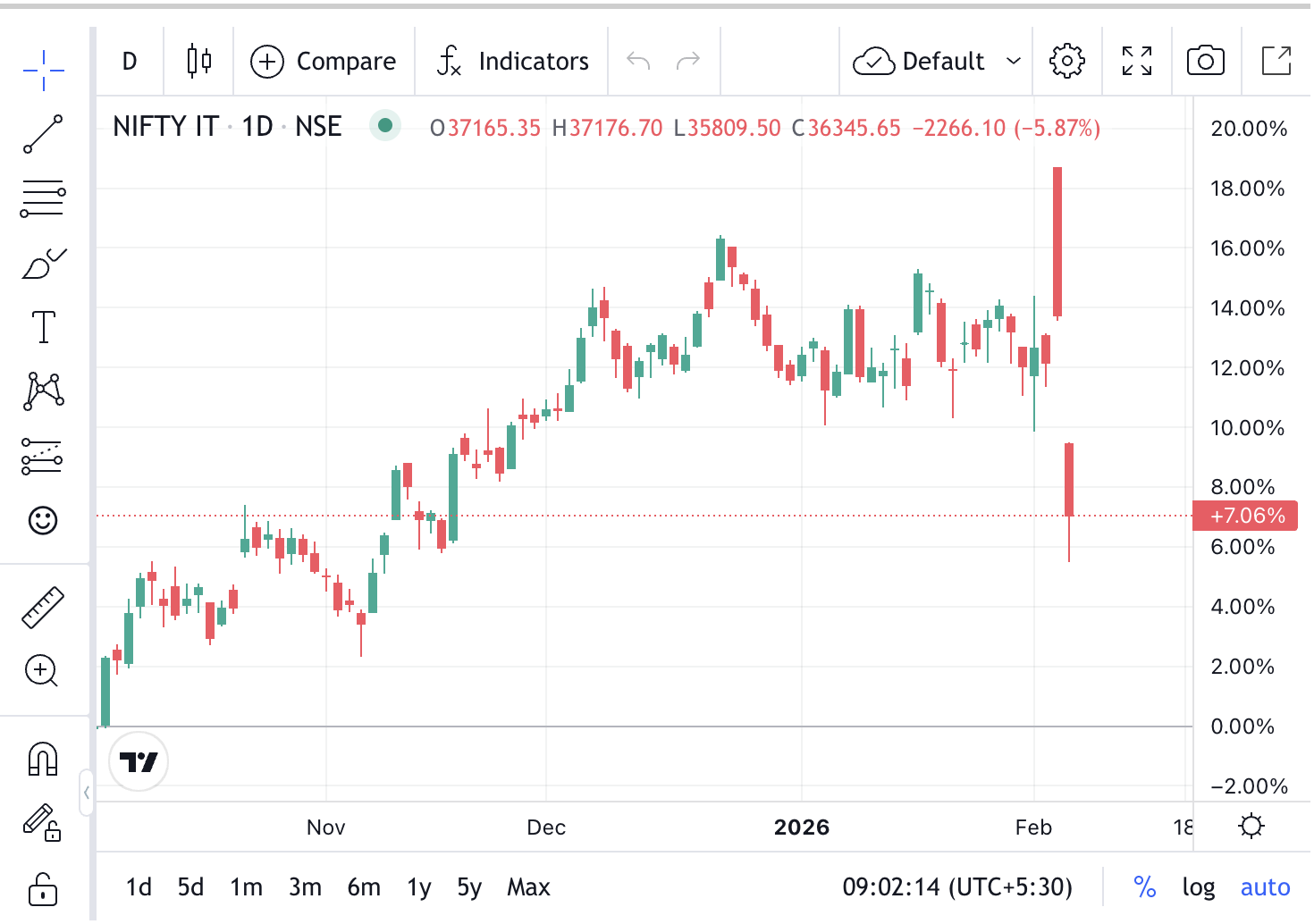
The selloff did not remain in U.S. tickers.
On February 4, 2026, the Nifty IT index in India fell 5.87% intraday, its steepest decline since March 23, 2020, as major exporters posted significant losses.
The move also spread across India, Japan, China, and Hong Kong, as investors reacted to the idea that AI could reduce demand for traditional software tools and related services.
This matters because global IT services trade partly on long-duration cash flows. When markets question whether those cash flows face a structural headwind, the de-risking can be fast.

Most enterprise software generates revenue by integrating seamlessly into existing workflows. The UI becomes the habit, the habit becomes the renewal, and the renewal supports premium multiples.
Agent tools challenge the UI-centric model. If an AI agent can read, write, and route work across files, browsers, and connected systems, the visible application may resemble a database with permissions rather than a workspace.
This is why some desks treated the Anthropic release as a sector-level multiple event rather than a single-stock headline.
Many business software products are priced per user, per month. This model is most effective when individuals use logins. AI agents challenge that logic because one agent can complete work that used to take several people.
That fear is strongest in:
Legal and compliance workflows
Research and drafting tools
Routine analysis and reporting
Internal "knowledge work" where the output is text, tables, and summaries
Even if AI does not entirely replace platforms, it can alter the number of seats customers require.
Markets quickly targeted firms that sell high-margin data and research products. In Europe, several data and software names fell sharply after the news:
| Company | Reported move | Close-to-close move | Why it was hit |
|---|---|---|---|
| Thomson Reuters (Nasdaq-listed) | -18% | -15.67% | Legal research and workflow exposure. |
| RELX | -14% | -14.3% | Legal and information services exposure |
| London Stock Exchange Group | -13% | -12.8% | Data and analytics exposure |
| Wolters Kluwer | -13% | -12.7% | Legal and compliance tools exposure |
| Sage | -10% | -9.8% | Enterprise software sensitivity to AI tools |
| Pearson | ~-8% | -7.74% | Content and learning tools seen as AI-sensitive |
| Experian | -7% | -6.75% | Data services and scoring tools exposure |
Additionally, Goldman Sachs' basket of U.S. software stocks is down 6% on the day, and the Nasdaq 100 is down as much as 2.4% intraday.
This is why traders described it as a "software stock" selloff, even though not every name is a classic SaaS company. The common thread is information, workflow, and pricing power.
According to the Bloomberg-reported write-up carried by Mint, only 71% of software companies in the S&P 500 had beaten revenue expectations so far this earnings season, compared with 85% for the overall tech sector.
When the fundamentals are mixed, it takes less to trigger a significant de-risking move.
The most significant selloffs often combine genuine changes with reactive positioning.
For example, some Wall Street analysts viewed the downturn as fear-driven rather than fundamentally justified, pointing to the idea that disruption will be uneven and that adaptation will separate winners from losers.
There is also a critical counterargument from inside the AI ecosystem. For instance, NVDA CEO Jensen Huang pushed back on the premise that AI will replace software tools, arguing that AI relies on tools rather than reinventing them from scratch.
Investors do not need to "pick a side" today. They need to determine which companies can leverage AI to achieve higher retention, faster expansion, or better unit economics.
Listen for specifics, not slogans.
Do management teams talk about seat compression?
Do they describe AI as a paid tier, a bundle, or an included feature?
Do they guide to a temporary margin reset to fund AI buildout?
The market will start rewarding proof that mission-critical systems remain hard to displace.
Renewal rates and net retention.
Implementation backlogs.
Customer references tied to governance, audit, and security.
The deeper worry is not a single plugin. The concern is that the distribution layer is shifting toward model providers and connectors.
If customers increasingly start work within an agent layer, then the app layer must either become the best system of record or the best set of tools the agent uses.
Ironically, legal and compliance automation can strengthen incumbents that already have trust, permissions, and audit logs.
Anthropic's legal plugin itself flags that outputs should be reviewed by licensed attorneys, which highlights the continuing need for governance and accountability.
It is a set of Cowork plugins designed to automate department workflows, including a "Legal' plugin that targets contract review, NDA triage, and compliance tasks.
Investors are concerned that model providers are advancing into finished workflows, which could put pressure on SaaS pricing and margins, particularly for products that resemble thin layers built on AI models.
It can be both. The threat is real in the long run, but adoption takes time, and specialized vendors still argue that they offer integrations and workflow depth that plugins cannot instantly replace.
No. Even NVDA's CEO argued the idea that AI replaces software tools is misguided, because AI depends on tools rather than rebuilding them.
In conclusion, software stocks are selling off because the market is repricing a simple risk: AI agents may reduce the need for multiple paid software seats and may weaken the moat of products that sit too close to the model layer.
Anthropic's Cowork plugins, especially the legal workflow tool, made that risk feel immediate, so investors moved first and asked questions after.
The next phase will be more selective. Stocks with deep proprietary data, sticky integrations, and clear ROI for customers can still hold up. Businesses that offer paid workflows based on generic AI outputs must quickly prove their added value.
Disclaimer: This material is for general information purposes only and is not intended as (and should not be considered to be) financial, investment or other advice on which reliance should be placed. No opinion given in the material constitutes a recommendation by EBC or the author that any particular investment, security, transaction or investment strategy is suitable for any specific person.