Published on: 2026-06-10
Salesforce stock traded near $175.35 on June 9, down about 3.9%, closer to its 52-week low than its high and off more than 30% year to date.
The company reported fiscal Q1 2027 revenue of $11.13 billion, up 13% year over year, with non-GAAP EPS of $3.88 that beat the $3.13 consensus.
Agentforce reached $1.2 billion in annual recurring revenue, still modest against FY27 revenue guidance of about $46 billion.
The m3ter acquisition adds metering and rating infrastructure for usage-based and outcome-based AI pricing inside Agentforce Revenue Management.
The layoffs show Salesforce trimming selected costs while continuing to buy assets tied to AI, data, content, and billing.
The next test for CRM is whether Agentforce and consumption billing can grow large enough to move companywide revenue.
Salesforce stock (NYSE: CRM) fell about 3.9% on June 9, 2026, to roughly $175.35, leaving the shares closer to their 52-week low of $163.52 than the $276.80 high and down more than 30% so far this year.
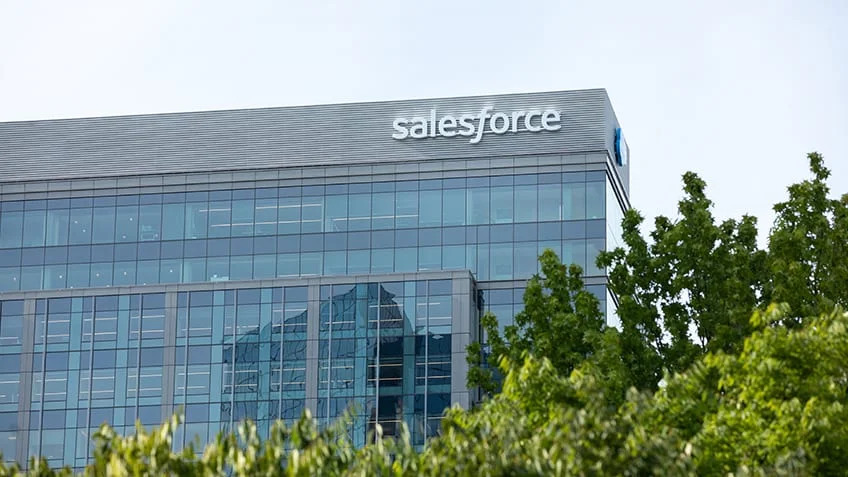
The decline coincided with two developments. Salesforce carried out a fresh round of layoffs, confirmed in part by a state filing, while announcing a deal to acquire m3ter, a usage-based billing platform.
The two events fit together. They point to a company preparing to charge for AI by consumption alongside its seat-based subscriptions, and adjusting both its cost base and its product stack to support that shift.
Business Insider reported that Salesforce cut fewer than 1,000 roles at the start of June, citing people familiar with the matter. The company has not formally disclosed the round.
A California WARN notice provides the clearest confirmed figure: 86 positions in the state, spanning sales, general administration, and technology and product roles. Further cuts were reported outside California.
Reporting placed the reductions across three areas:
Agentforce, the company’s flagship AI agent product
MuleSoft, its integration software
Marketing Cloud
This is the second reported round of Salesforce layoffs in 2026, after the company cut fewer than 1,000 roles in January. The largest recent reduction came in late 2025, when Salesforce cut roughly 4,000 customer support roles; CEO Marc Benioff has said AI agents now handle a growing share of support work, taking that team from about 9,000 people to around 5,000.
Cutting staff tied to a product the company markets as a growth engine looks contradictory on its own. The m3ter deal is what makes the logic legible.
m3ter is a London-based metering and rating platform built for consumption-based monetization. Its software ingests product usage data, applies pricing rules, and automates billing across CRM, ERP, and quote-to-cash systems.
Salesforce plans to fold it into Agentforce Revenue Management. Terms were not disclosed, and the deal is expected to close in the second quarter of Salesforce’s fiscal 2027.
The acquisition solves a billing problem. When an AI agent resolves service cases, completes sales tasks, or executes workflows, Salesforce needs a way to measure that activity and charge for it. Seat licenses do not capture consumption. m3ter supplies the metering layer that does.
Without it, enterprises on usage-based models would stitch together third-party billing tools or build custom integrations. With it, Salesforce keeps more of the AI monetization chain inside its own platform.
That context reframes the layoffs. Salesforce is trimming a cost base built for seat-based selling while buying the parts needed to sell AI by consumption. The cuts and the acquisition are two ends of the same transition.
The m3ter deal does not stand alone. It followed the June 1 agreement to buy Contentful and the roughly $8 billion Informatica acquisition that closed in late 2025, all while Salesforce kept repurchasing stock under a $50 billion buyback approved earlier this year.
Read together, the deals build a stack: Informatica supplies the data layer, Contentful the content layer, and m3ter the billing layer. Each extends Agentforce a step further from a standalone product toward an AI operating system that spans data, content, workflow, and the ability to charge for all three.
The layoffs and the buyback are the other half of that plan. One holds down costs, the other supports earnings per share, and together they let Salesforce fund the rebuild without surrendering the margins that have kept investors patient.
Salesforce reported fiscal Q1 2027 revenue of $11.13 billion, up 13% year over year. Non-GAAP EPS reached $3.88, well ahead of the $3.13 consensus, and non-GAAP operating margin set a record at 34.8%. Full-year FY27 revenue guidance sits at roughly $45.9 billion to $46.2 billion.
Agentforce is gaining traction, but scale is the market’s concern. Salesforce reported $1.2 billion in Agentforce ARR and close to $3.4 billion in combined Agentforce and Data 360 ARR. Real progress, but small against a revenue base above $45 billion.
That gap explains the share-price reaction. Investors are not dismissing the AI strategy. They are asking whether AI revenue can scale fast enough to reset Salesforce’s overall growth rate.
Q2 FY27 later supplied a stronger demand signal, with Salesforce cRPO growth accelerating to 14% even as investment gains distorted the headline EPS beat.
| Metric | Figure | Market Read |
|---|---|---|
| CRM price, June 9 | ~$175.35, down 3.9% | Shares remain under pressure |
| 52-week range | $163.52 to $276.80 | Trading near the lower end |
| Fiscal Q1 2027 revenue | $11.13 billion, up 13% | Growth still positive |
| Non-GAAP EPS | $3.88 vs. $3.13 expected | Clear earnings beat |
| Non-GAAP operating margin | 34.8%, a record | Profitability remains a support |
| Agentforce ARR | $1.2 billion | Fast-growing but small in context |
| FY27 revenue guidance | $45.9B to $46.2B | AI has not yet reset the growth profile |
| June layoffs | Fewer than 1,000 reported; 86 confirmed via California WARN | Cost base is being reshaped |
The contrast in the table is the whole story. Salesforce is profitable, cash-generative, and growing, yet the stock is being judged against a harder question: can AI become a genuine new growth engine, not only a productivity tool?
CRM has shed roughly a third of its value over the past year, the market's way of doubting that AI can power Salesforce's next revenue cycle the way seat-based software powered the last one.
That leaves two levels worth watching. The 52-week low near $163.52 is the floor; a sustained break beneath it would say investors are bracing for a deeper reset in growth.
The $185 to $190 zone is the first ceiling; reclaiming it would say buyers are ready to look past the layoffs and price in Agentforce growth, the buyback, and steady margins instead.
The catalysts, though, are in the results, not the chart. The next two or three earnings reports will tell investors more than any product launch: how fast Agentforce ARR is growing, whether usage-based billing is gaining early traction, whether margins hold, and whether AI engagement is turning into revenue Salesforce can actually count.
The shares fell as investors weighed a fresh round of layoffs against continued uncertainty over AI monetization, within a softer session for AI-linked stocks. The m3ter acquisition supports the company’s AI billing strategy, but the market still wants proof that usage-based AI revenue can scale fast enough to lift total growth.
m3ter is a metering and rating platform for usage-based billing. Salesforce is acquiring it to support consumption-based and outcome-based pricing inside Agentforce Revenue Management, letting customers measure and bill AI-related usage without leaving the Salesforce platform.
In part. Some reductions, especially in customer support, follow productivity gains from AI agents, but the latest round also reflects broader restructuring. The fuller picture is a company reshaping a seat-based cost base while investing in AI infrastructure/
Not yet. Agentforce ARR of $1.2 billion is meaningful, but Salesforce guides to roughly $46 billion in FY27 revenue. Agentforce needs sustained growth before it can materially shift the company’s trajectory.
Agentforce ARR growth, usage-based billing adoption, non-GAAP operating margin, and whether CRM can reclaim the $185 to $190 range. Those will show whether the AI strategy is becoming a financial catalyst or remains mainly a narrative.
The June 9 selloff reflects more than a weak session. Salesforce is restructuring around a shift in how enterprise software is priced: layoffs reducing seat-based costs, a $50 billion buyback supporting EPS, and the m3ter and Contentful deals adding infrastructure for usage-based AI monetization.
The strategy is coherent; the payoff is unproven. Agentforce ARR of $1.2 billion is real but small inside a revenue base above $45 billion. Until consumption revenue grows enough to move the overall growth rate, the gap between Salesforce’s AI narrative and its financial results stays open, and that gap is what the stock is trading on.
Salesforce fiscal Q1 2027 results (revenue, EPS, margin, Agentforce ARR, FY27 guidance) and the m3ter acquisition announcement (June 8, 2026).
Prior context: Contentful agreement (June 1, 2026), Informatica acquisition close (late 2025), and the $50 billion buyback authorization (2026).