Published on: 2026-04-09
China imported over 790 tons of silver in early 2026, its fastest eight-year start. Heavy backwardation in Shanghai's front-month market signals urgent physical demand, not speculation.
Silver’s industrial foundation has strengthened. In 2024, industrial demand reached a record 680.5 million ounces, with electronics and electrical demand rising to 465.6 million ounces, driven by AI hardware, grid investment, and advanced electronics.
AI is just one factor in silver demand. Research from the Silver Institute and Oxford Economics ties future demand to data centers, semiconductors, EVs, charging infrastructure, and solar energy. Data center and AI demand will support industrial use through 2030.
The US added silver to its 2025 critical minerals list, and the IEA reports that China leads refining for 19 of 20 tracked strategic minerals, averaging a 70% market share.
The Silver Institute projects a sixth consecutive market deficit in 2026. However, industrial fabrication is expected to decline by 2% to about 650 million ounces, as PV thrifting and substitution offset some AI and data center-driven demand.
| Metric | Latest reading | Why it matters |
|---|---|---|
| China silver imports, Jan-Feb 2026 | More than 790 tons | Fastest two-month import pace in eight years |
| February 2026 China silver imports | Nearly 470 tons | Record for that month |
| Global silver industrial demand, 2024 | 680.5 Moz | Fourth straight annual record |
| Global silver market deficit, 2024 | 148.9 Moz | Fourth consecutive annual deficit |
| Combined silver deficit, 2021-2024 | 678 Moz | Equal to about 10 months of 2024 mine supply |
| Forecast global silver supply, 2026 | 1.05 billion ounces | Supply is rising, but only modestly |
| Forecast silver mine production, 2026 | 820 Moz | Mine growth remains limited |
| Forecast silver market deficit, 2026 | 67 Moz | Sixth straight annual deficit |
| Forecast industrial fabrication, 2026 | Around 650 Moz | Down 2 percent due mainly to PV thrifting |
*Table note: Figures compiled from Bloomberg reporting and Silver Institute releases.
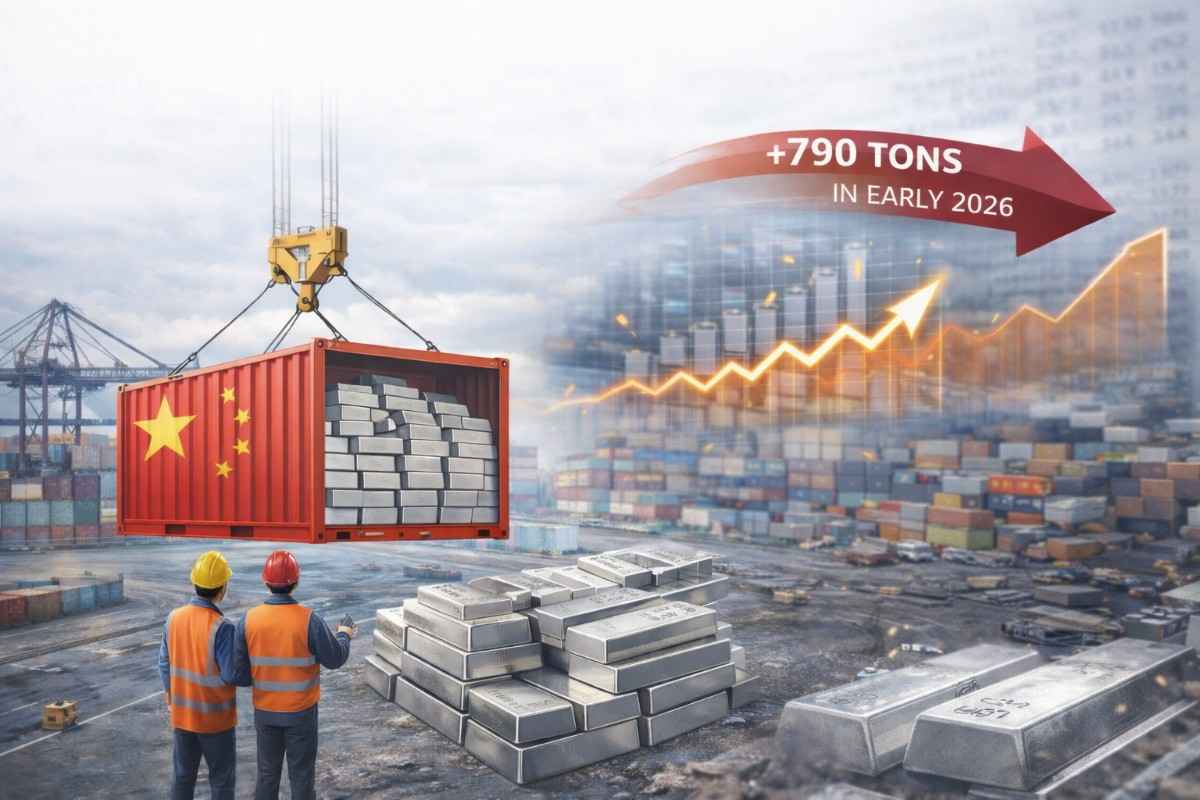
Our analysis suggests that 'strategic accumulation' best describes China’s silver imports. Evidence indicates urgent buying within China’s industrial and investment sectors: imports surged, local inventories tightened, and nearby prices exceeded deferred prices. This pattern typically signals a shortage of prompt metal in the real economy.
This does not necessarily mean Beijing is operating a formal silver reserve program. Notably, China exported approximately 5,100 tons of silver in 2025, the highest level in at least 16 years.
This challenges the notion that China is restricting exports and cornering the market. Instead, China is large enough to act as both a major exporter and an aggressive buyer when domestic shortages arise.
In summary, China’s actions reflect how its industrial sector now treats silver as indispensable, unwilling to risk relying on unpredictable global supplies.
Silver has always served as a monetary and industrial metal. AI now strengthens its industrial role. The Silver Institute reports that data centers and AI will drive industrial demand through 2030. Its research shows global IT power capacity expanded from 0.93 gigawatts in 2000 to nearly 50 gigawatts in 2025, a 53-fold increase.
This expansion demands more servers, electrical connections, cooling systems, and high-performance electronics. All of these increase demand for silver-bearing components.
Oxford Economics draws the same conclusion. It calls silver a "next-generation metal" for its role in data centers, AI systems, EVs, and solar energy. Silver demand now depends on digital and energy infrastructure, not just manufacturing or jewelry.
Critical-mineral competition often focuses on lithium, cobalt, graphite, gallium, or rare earths. However, when a metal becomes essential to power systems, electronics, semiconductors, data centers, and advanced manufacturing, it gains strategic significance. Silver’s addition to the US critical minerals list in 2025 confirms its growing policy importance.
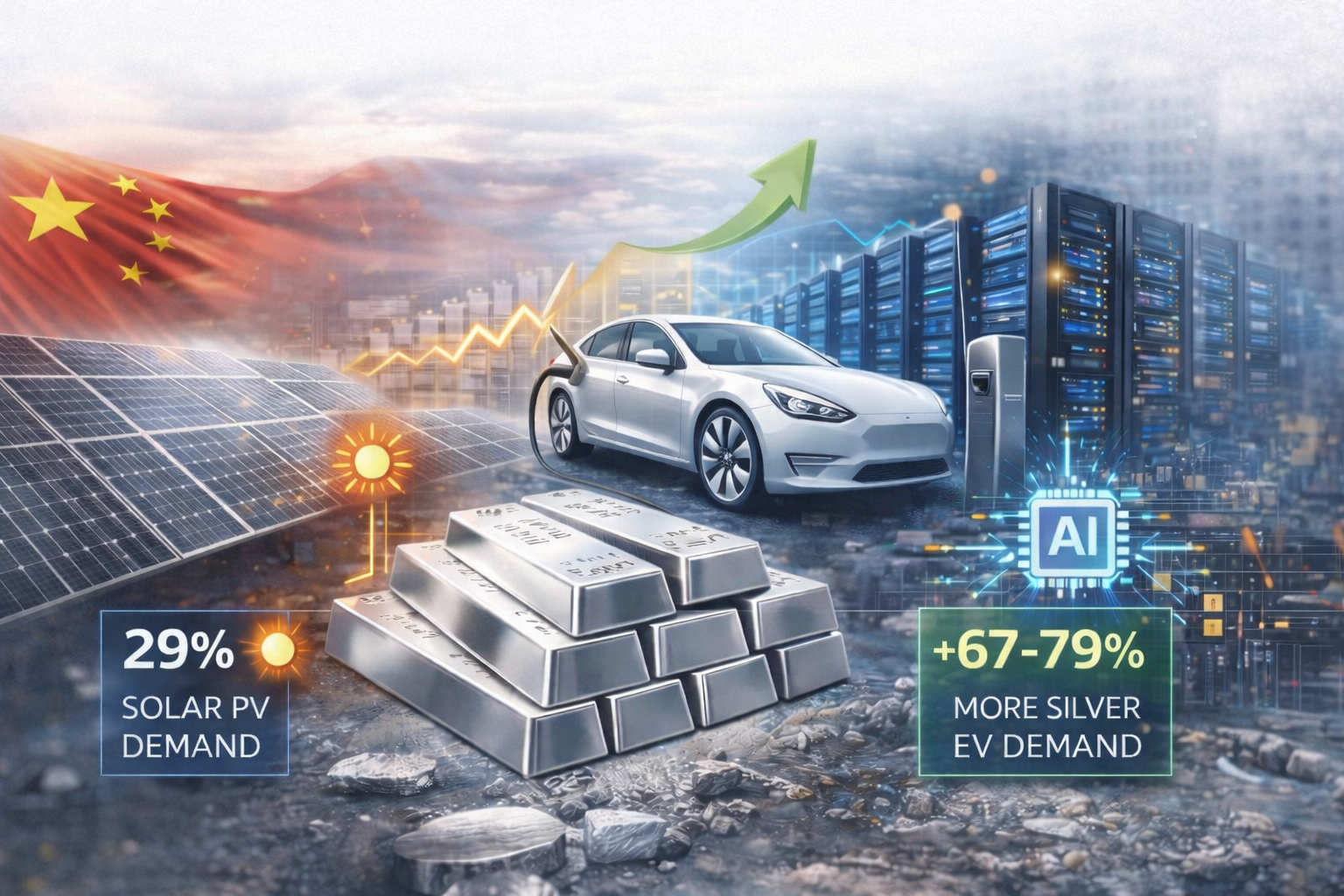
Most bullish analyses identify the trend but miss the mechanism. The key change is not just higher consumption, but a shift in demand toward sectors with greater strategic value and lower tolerance for supply disruptions.
In 2024, solar PV accounted for 29% of silver’s industrial demand, up from 11% in 2014. Battery-electric vehicles use 67-79% more silver than internal combustion vehicles. Data centers and AI are also increasing demand from digital infrastructure. China contributed the largest share of industrial gains in 2024, with a 7% increase.
This represents a different commodity narrative. It is less about a temporary consumption surge and more about silver’s deeper integration into critical systems such as energy, mobility, computing, and grid resilience. As silver becomes embedded in these sectors, its strategic value rises, even without significant annual demand growth.
The most relevant historical comparison is not the 1980 squeeze, which was driven by speculation and manipulation, but the period from 2010 to 2011, when silver performed strongly due to rising industrial and investment demand.
In 2010, the average silver price rose 38% to $20.19, global investment increased 40% to 279.3 million ounces, and industrial demand grew 20.7% to 487.4 million ounces. In 2011, the average price reached a record $35.12 as investment remained at historic highs.
That is the pattern silver is leaning more towards today. Silver can become volatile when used both as an industrial input and as a financial hedge. China's current buying matters because it sits at exactly that intersection. Industrial users want metal for manufacturing. Investors want exposure to deficits, inflation risk, and geopolitical uncertainty. When both channels tighten together, silver can reprice quickly.
However, history also warns against linear thinking. Persistent deficits since 2021 did not produce a straight-line price move because above-ground inventories, recycling, and substitution all acted as buffers.
That is why the more credible conclusion is not that history guarantees another 2011. It is that history supports a regime of higher strategic importance and higher volatility when industrial and investment demand reinforce each other.
The Silver Institute expects the market to remain in deficit in 2026 for a sixth consecutive year, but industrial fabrication is still forecast to decline 2% to around 650 million ounces.
However, this does not undermine the broader bullish thesis; it refines it. Silver’s risk-adjusted potential comes from its irreplaceable role in many high-value applications, while supply growth remains limited. Global silver supply is forecast to rise only 1.5% in 2026 to 1.05 billion ounces, with mine production up just 1% to 820 million ounces.
Recycling is expected to increase by 7%, surpassing 200 million ounces for the first time since 2012. While this will help, it will not eliminate the market deficit.
Therefore, the core thesis is that silver is becoming increasingly important, as the sectors driving its demand are now critical to national industrial capacity.
China’s recent silver purchases underscore a key shift: silver is now vital to industrial growth, especially due to new demand from AI and data centers. This has made it a core topic in discussions of critical minerals policy.
This does not validate every bullish claim. PV thrifting, substitution, recycling, and volatile investor flows remain important factors.
The evidence now shows silver is transitioning from a dual-use precious/industrial metal to a strategic industrial asset, its significance growing with electrification and digitalization.
Disclaimer: This material is for general information purposes only and is not intended as (and should not be considered to be) financial, investment or other advice on which reliance should be placed. No opinion given in the material constitutes a recommendation by EBC or the author that any particular investment, security, transaction or investment strategy is suitable for any specific person.