Published on: 2026-05-20
Updated on: 2026-05-20
Currency depreciation is a fall in the value of one currency relative to another currency in the foreign exchange market. A depreciating currency buys less of another currency than it did before.
Currency depreciation is common in floating exchange rate systems, where currency prices are mainly determined by market supply and demand. Traders, investors, central banks and multinational companies monitor depreciation because it can affect trade, inflation, capital flows and investment returns.
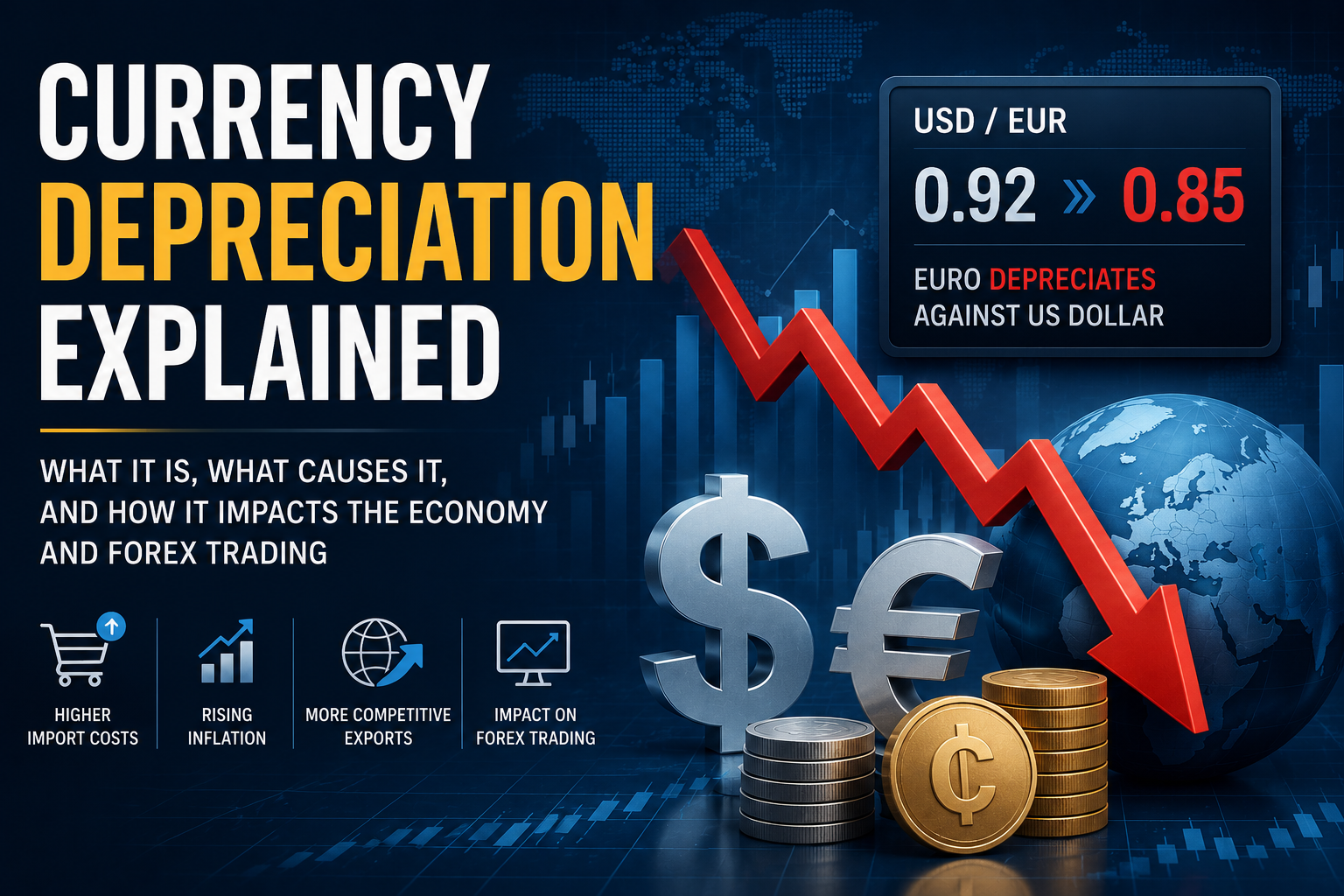
Currencies move when demand for one currency changes relative to another. If investors become less confident in a country’s economy, policy outlook or financial stability, demand for its currency may fall. When demand weakens, the currency can depreciate.
Common causes of currency depreciation include:
Higher inflation than trading partners
Lower or falling interest-rate expectations
Weak economic growth
Political or policy uncertainty
Rising government debt or fiscal concerns
Trade deficits or weaker export demand
Capital outflows
Stronger demand for safe-haven currencies such as the US dollar
Interest rates are important in forex markets because investors often compare expected returns across countries. Higher expected rates can support a currency by attracting capital, while lower expected rates can reduce demand. However, exchange rates do not move only because of interest rates. Inflation expectations, growth data, central bank credibility and global risk sentiment can also drive currency moves.
Depreciation may occur gradually over months or suddenly after major data releases, policy decisions, political events, or financial shocks.
Assume a European company imports oil priced in US dollars. If the euro weakens against the dollar, the company must spend more euros to buy the same amount of oil.
Before depreciation:
1 EUR = 1.10 USD
After depreciation:
1 EUR = 1.00 USD
If oil costs USD100, the importer originally needed about EUR91. After the euro depreciates, the importer needs EUR100 for the same purchase.
This raises the importer’s cost. If many businesses face similar increases, some of those costs may be passed on to consumers through higher prices.
At the same time, European exports may become cheaper for foreign buyers. This can support exporters because overseas customers can buy European goods at lower relative prices.
Currency depreciation affects consumers, businesses, investors and financial markets.
Imported goods and services become more expensive because buyers need more local currency to pay foreign suppliers. The effect can be stronger in countries that rely heavily on imported fuel, food, technology or raw materials.
Depreciation can add to inflation by raising import prices. The effect is not always immediate or complete. It depends on factors such as the country’s import share, the currency used in trade contracts, business margins, competition and whether companies pass higher costs to consumers.
A weaker currency can help exporters because locally produced goods become cheaper for foreign buyers. This may improve export demand and support growth in export-oriented industries.
Forex traders watch depreciation trends because currency weakness often reflects broader changes in economic sentiment. Traders use inflation reports, employment data, interest-rate decisions, central bank statements and risk indicators to assess whether depreciation may continue or reverse.
Currency depreciation can reduce foreign investors’ returns when profits or asset values are converted back into a stronger currency. However, a weaker currency may also make local assets cheaper for foreign buyers. Whether depreciation attracts or discourages investment depends on whether investors see it as temporary mispricing or a sign of bigger economic risk.
Currency depreciation and devaluation both describe a fall in currency value, but they happen in different exchange-rate systems.
Depreciation is market-driven. It usually occurs in floating exchange rate systems, where currency prices are determined by supply and demand.
Devaluation is policy-driven. It occurs when a government or central bank deliberately lowers the official value of a currency under a fixed or managed exchange rate system.
For traders, the difference matters because the cause, timing and market reaction can vary. Depreciation may reflect changing market expectations, while devaluation is usually a deliberate policy action.
Assuming currency depreciation is always bad. Consumers and importers may face higher costs, but exporters and tourism-related businesses can benefit from a weaker currency.
Confusing short-term exchange-rate volatility with depreciation. Exchange rates fluctuate daily, but depreciation usually refers to a sustained decline over a longer period.
Reading an exchange-rate quote the wrong way. If USD/EUR rises, the US dollar has strengthened against the euro, while the euro has depreciated against the US dollar. The direction depends on which currency is the base currency and which is the quote currency.
Inflation: A sustained increase in the general price level of goods and services over time.
Exchange Rate: The value of one currency compared with another currency in global markets.
Devaluation: A deliberate reduction in a currency’s value by a government or central bank.
Interest Rates: The cost of borrowing money or the return earned on savings and fixed-income investments.
Trade Deficit: A situation where a country imports more goods and services than it exports.
Currency depreciation can be positive or negative, depending on who is affected. Exporters may benefit from stronger foreign demand, while consumers and importers may face higher prices for imported goods and services.
A currency may depreciate due to high inflation, lower interest rate expectations, weak economic growth, political uncertainty, capital outflows, or reduced investor confidence.
Forex traders monitor depreciation to identify possible trading opportunities and risks. A weak currency may continue falling if economic data worsens or if central banks signal looser policy. It may recover if expectations improve or if the market has already priced in the weakness.
Depreciation is a market-driven fall in currency value, usually under a floating exchange rate. Devaluation is a deliberate policy action that lowers the official value of a currency under a fixed or managed exchange-rate system.
No. Depreciation can raise import prices and add inflation pressure, but the final effect depends on how much the country imports, how trade is invoiced, how firms set prices and whether businesses pass higher costs to consumers.
Currency depreciation is a key concept in forex trading and global economics. It shows that one currency has weakened relative to another, often because of changes in inflation, interest rate expectations, growth, trade flows, or investor confidence.
A weaker currency can raise import costs and add inflation pressure, but it can also make exports more competitive. For traders and investors, understanding depreciation helps explain exchange-rate movements, market sentiment and the economic forces behind currency trends.