Published on: 2026-05-21
Updated on: 2026-05-21
NVIDIA remains the quickest way for the market to gauge demand for artificial intelligence (AI). Traders look at its data centre revenue, margins, orders, and guidance first to see how the AI cycle is performing.
However, the focus is shifting to a slower, more practical issue.
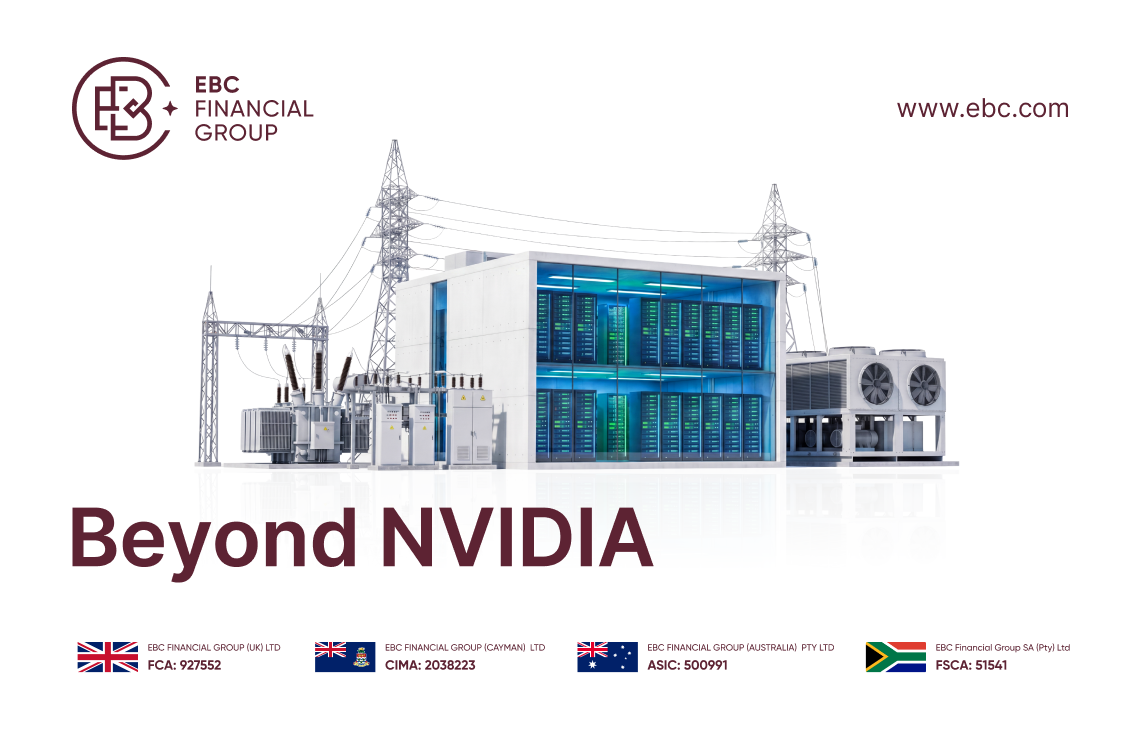
You can order a chip before a site is ready, but a data centre needs electricity, grid access, cooling, backup power, permits, and long-term power agreements before it can operate.At this stage, the AI trade shifts from semiconductor demand to whether the physical infrastructure can keep pace.
Traders already know AI uses more power. The tougher question is whether the market is starting to include power, utilities, grid equipment, natural gas, and nuclear in the AI build-out, or if it is still mainly focused on chips.
A strong NVIDIA report can still boost the entire sector, but it does not show if the trade has broadened. The real test is what happens next: do gains spread to companies and assets linked to power supply? If they do, the market is treating AI as a true infrastructure cycle. If not, chip earnings are driving everything, which is a more fragile setup than it appears.
AI is shifting from just computing power to infrastructure. Chips are still the starting point, but access to power is becoming a bigger challenge.
Electricity demand is now a key market signal. Utility spending, data centre leases, grid investments, and fuel demand help indicate if AI spending is translating into real, physical demand.
The risk is investing too soon in a long-term trend. Power demand is real, but valuations, regulations, grid delays, funding costs, and fuel prices can still impact the trade.
The AI trade has three main layers.
It started with compute: chips, servers, cloud demand, and model training. The market focused on this first because the earnings connection was clear. NVIDIA’s data centre revenue gave investors quick, actionable numbers.
Now, the focus is shifting to power: electricity supply, natural gas backup, nuclear, utilities, and long-term power contracts.
Delivery connects these layers: grid connections, transformers, transmission, cooling, engineering, and data centre construction.
Power and delivery are harder to value because they depend on regulation, planning approvals, capital cycles, and construction schedules, which can frustrate short-term traders. But this also makes them useful signals. If AI spending is turning into a broader infrastructure cycle, the evidence will show up over time in electricity-demand forecasts, utility spending plans, data centre contracts, grid-equipment orders, and energy-linked assets.
The market is asking a practical question: can the power system keep up with AI demand? The signals are not always clear. Natural gas is often the first place where the AI power argument gets confusing. Utilities are affected by regulation, and nuclear depends on policies and construction timelines that take years, not quarters. NASUSD can look strong even if only a few stocks are driving the gains.
The goal is not to call every power-related move an AI trade. Instead, it is to see if evidence is really building across NASUSD, utility spending, gas prices, nuclear-linked assets, and grid infrastructure all at once.
The May 2026 United States Energy Information Administration (EIA) Short-Term Energy Outlook forecasts United States (US) electricity consumption to keep rising, with commercial demand, including data centres, providing a major source of growth.
Capital is following this trend. Duke Energy has raised its five-year infrastructure plan to US$103 billion, with data centre demand clearly included in the load-growth discussion.Hut 8’s 15-year, 352-megawatt (MW) Beacon Point lease shows AI demand is directly tied to capacity and power access.
Utilities announce capital plans in stages, go through regulatory approval, and build over several years. A data centre lease shows the direction of demand more than the timing. It indicates where capacity is being reserved, but it does not speed up grid connections, solve permit risks, or lower financing costs.
NVIDIA can move the market within minutes of its earnings report. In contrast, a Duke Energy capital plan operates on a much longer timeline. It shows traders that AI electricity demand is being built into long-term infrastructure, which is important, but the earnings impact takes time to show up.
The risk here is paying now for capacity that will not be available for years.
An operator can announce a campus, secure tenants, and attract capital before the site has power. But without a grid connection, transformers, cooling systems, backup supply, and local approval, the project cannot operate, no matter how strong AI demand is.
As a result, powered sites are truly scarce. Land by itself is not enough. What matters is land with reliable electricity, reasonable costs, and the necessary approvals already secured.
The most reliable signals in the AI power trade are not the big demand headlines, but the more detailed ones: grid queues, transformer lead times, electrical equipment orders, and long-term power deals. These may be less exciting than a chip earnings beat, but they are harder to fake. Companies do not invest hundreds of millions in power agreements and grid upgrades unless they expect real demand.
The bottleneck affects both sides. Suppliers who provide key equipment or secure power access can benefit from scarcity. Data centre developers who expect rapid capacity growth face real challenges when grid delays slow progress. The gap between sites with power and those with only a plan is growing, and the market will eventually reflect that difference more clearly.
NASUSD, the US NASDAQ-100 Index, remains the main benchmark for tracking the AI trade.
A truly broadening trade does not rely only on NVIDIA and a few large companies. A stronger signal is when the index rises with gains spreading across software, cloud, electrical infrastructure, utilities, and power-related companies.
At first glance, things look better than they are. NASUSD can rise on the strength of just a few large stocks, making the whole index appear healthy. The rally is real, but it is fragile. If the trade relies too much on a few key companies, a single disappointing earnings report, margin warning, or weaker guidance can quickly put pressure on the entire AI sector.
NVIDIA’s results still set the tone, but what happens afterward tells you even more.
If a strong NVIDIA result also lifts utilities, grid equipment, and power-linked assets, it suggests investors are pricing in a longer infrastructure cycle that could last for years. If the rest of the power sector does not respond, the market is still mainly focused on compute. This is not necessarily negative, but it means the AI power thesis is still unproven.
Natural gas is the part of the AI power trade that gets exaggerated most often.
XNGUSD helps track the power-demand side of the trade, but it is not a direct AI asset. Short-term natural gas prices are driven by weather, storage levels, production, liquefied natural gas exports, pipeline constraints, and seasonal demand, and these factors will continue to matter regardless of what is happening in AI data centres.
Context is important whenever the price changes. A rally caused by a heatwave is about temperature, not AI. A sell-off due to storage is about short-term supply, not data centres. Gas may get an AI headline, but it still trades on the same factors as before.
The signal is more useful when gas prices move in line with other power-demand indicators, such as rising EIA demand forecasts, utility earnings calls mentioning data centre load, new gas-fired capacity being planned, and XNGUSD reacting more to power-demand headlines than to storage or weather reports.
Do not treat a change in gas prices as an AI signal unless there is also evidence of load growth in utilities, power forecasts, and data centre activity. AI may play a role in the long-term power-security discussion, especially if gas-fired generation supports reliable data centre supply. Still, not every gas price move is related to AI.
Data centres require electricity that is always available, at high load, and without interruptions. This is a baseload issue, and nuclear energy is a baseload solution, which is why it is relevant here.
URA.P, the Global X Uranium exchange-traded fund (ETF), lets traders see if the market is rewarding this part of the theme. If AI demand increases concern about reliable power supply, URA.P attracts traders who want a baseload hedge instead of a short-term earnings boost.
Timing is the main challenge. Data centre demand is increasing now, but new nuclear capacity depends on policy support, permits, financing, construction, safety reviews, and grid connection, a process that takes years, not months. Even restarting or extending the life of existing plants requires capital and regulatory approval.
As a result, URA.P is more useful as a long-term sentiment indicator than a short-term demand signal. If it rises with AI infrastructure news, the market is rewarding baseload reliability. If it lags while chip stocks rally, nuclear is not getting the same support as compute, and traders should not assume otherwise.
Nuclear energy is part of the AI power discussion, but it does not solve the immediate issue of power access.
Utilities are more directly affected by physical power constraints than any broad technology index.
XLU.P, the Utilities Select Sector SPDR Fund, helps show whether utilities are being seen as part of the AI infrastructure trade or just as defensive, rate-sensitive stocks priced based on bond yields.
The link between AI demand and utility earnings is not straightforward. Load growth must turn into approved investments, which then become recoverable spending. This spending needs to support earnings without causing enough customer bill increases to trigger regulatory pushback. Each step depends on regulators and capital costs, not just the number of data centres being built.
Higher yields make this process more difficult. Utility and infrastructure projects require a lot of capital. When yields rise, funding costs increase and defensive income stocks face real competition from bonds.
So, XLU.P’s signal should be interpreted in the context of interest rates and regulation, not just load-growth headlines. If it is strong alongside data centre power deals and rising electricity demand forecasts, it suggests utilities are being rewarded for their role in AI infrastructure. If it is weak during strong AI power headlines, it may mean investors accept the load-growth case but are concerned about valuation, funding, or regulatory risks, each of which needs a different response from traders.
The warning sign is when NASUSD leadership is narrow. If NVIDIA and a few chip stocks are driving the index while utilities, grid equipment, and power-linked assets lag, the case for a broadening trade is not holding up.
The second warning comes from natural gas. If XNGUSD continues to trade mainly on weather, storage, and production data, with little reaction to power-demand headlines, it remains a seasonal and macro instrument, not a reliable AI confirmation tool.
Regulation can slow progress more quickly than the demand curve suggests. Data centres put real pressure on local grids, water supply, and customer bills. If permitting slows or grid-connection queues get much longer, revenue timelines are delayed and valuations based on rapid capacity growth become harder to justify.
Funding costs affect the entire trade. Utilities, grid operators, and infrastructure suppliers all rely on large capital programs. Higher yields make growth more expensive to finance and less appealing to equity investors.
Return on investment is the key question in every capital spending cycle. If large tech companies keep investing heavily in AI infrastructure without clear revenue growth, the market shifts away from companies that benefit from capital spending and back toward those with strong margins. Real power demand still exists, but high valuations can still fall.
A Broadening AI Trade
AI demand begins to appear beyond just chip earnings: NASUSD participation widens, utility spending increases, data centre leases grow, and grid-equipment orders improve. The index remains strong as leadership spreads to power, utilities, and infrastructure-related companies.
The risk here is that NVIDIA and a few chip stocks continue to drive most of the index gains while other sectors lag.
Power Bottleneck Becomes the Main Trade
Grid delays, power-supply limits, long-term electricity contracts, or fuel demand become the main focus for the market. Liquified Natural Gas (XNGUSD) reacts more to power-demand headlines. URA.P and XLU.P remain strong as the market values reliable power and grid investment.
The risk here is that grid queues get shorter, new supply comes online, or large tech companies lower their capital spending guidance, reducing the urgency around power access.
Priced-for-Perfection Unwind
AI infrastructure stocks have moved too far ahead of actual earnings. The market begins to question whether all that spending will turn into revenue quickly enough. NASUSD becomes less stable, infrastructure winners change rapidly, and focus shifts back to margins, funding costs, and return on investment.
The reversal signal is clear evidence that AI power demand is turning into contracted revenue and earnings growth, which would remove the case for an unwind.
The signal to act on is not just another AI demand headline. It is when you see broader NASUSD participation, utility spending commitments like Duke’s, contracted physical capacity like Hut 8’s, stronger grid-equipment orders, and power-linked assets moving for solid reasons, not just because of headlines.
When all these factors come together, the market could be treating AI as a multi-year infrastructure cycle, not just another chip earnings trade.
Until then, the real question is not whether AI needs more power, but whether that demand is turning into contracts, grid investment, equipment orders, and earnings that the market can actually value.