Published on: 2026-05-25
A forward premium occurs when a currency pair’s forward exchange rate is higher than its current spot exchange rate. In other words, the base currency is priced higher for future delivery than for immediate settlement.
For example, if EUR/USD is trading at 1.1000 in the spot market and 1.1200 in the three-month forward market, the euro is trading at a forward premium against the US dollar.
A forward premium does not guarantee that the currency will rise in the future spot market. It only shows that the agreed exchange rate for future delivery is currently above the spot rate. In forex, forward premiums are mainly linked to interest-rate differentials, although hedging demand and market conditions can also influence pricing.
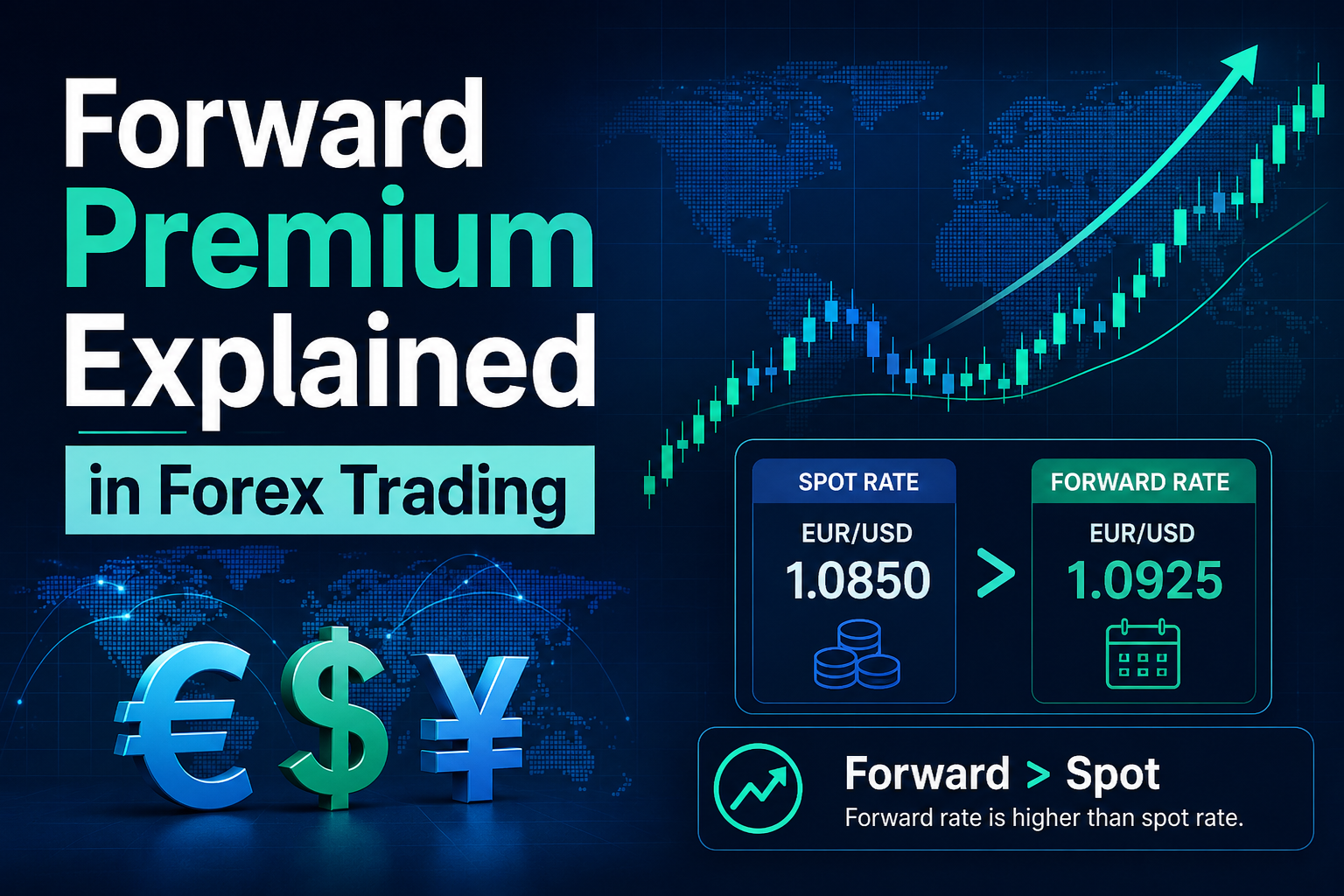
A forward contract is an over-the-counter agreement to exchange one currency for another at a set rate on a future date. The forward rate is the exchange rate written into that contract. If that forward rate is higher than the current spot rate, the currency pair is trading at a forward premium.
For example:
Current EUR/USD spot rate: 1.1000
Three-month forward rate: 1.1200
In this case, EUR/USD is trading at a forward premium because the forward rate is above the spot rate.
That does not mean EUR/USD will definitely be 1.1200 in three months. It only means that 1.1200 is the rate agreed today for settlement in three months.
When the contract matures, the actual spot rate could be:
above the forward rate
below the forward rate
close to the forward rate
This is why a forward premium should be understood as a pricing relationship, not a guaranteed forecast.
The main driver of a forward premium is the interest-rate differential between the two currencies. Under covered interest rate parity, the currency with the lower interest rate usually trades at a forward premium, while the currency with the higher interest rate usually trades at a forward discount.
For example, if US interest rates are higher than those in the euro area, EUR/USD will often trade above its spot rate in the forward market. In that case:
The euro is at a forward premium
The US dollar is at a forward discount
This relationship exists because the forward market accounts for the return from holding one currency rather than the other. Other factors can also affect forward pricing, including:
corporate and institutional hedging demand
short-term funding conditions
cross-currency basis in stressed markets
shifts in monetary policy expectations
The basic forward premium formula is:

If the result is positive, the currency pair is trading at a forward premium. If the result is negative, it is trading at a forward discount.
Suppose:
Spot rate = 1.1000
Forward rate = 1.1200
Then:
((1.1200 - 1.1000) / 1.1000) × 100 = 1.82%
This means the currency pair is trading at a 1.82% forward premium. Some analysts also annualise the figure to compare forwards with different maturities. For a three-month contract, a rough annualised equivalent would be about 7.27%.
Forward premiums help traders and institutions understand how the market prices future currency delivery.
They matter for several reasons:
Interest-rate analysis: Forward premiums reflect the effect of interest-rate differentials between two currencies.
Hedging costs: Companies that hedge future foreign-currency payments or receipts need to know whether the forward market is pricing the currency above or below spot.
Carry trade analysis: Carry traders monitor forward pricing because interest-rate spreads affect the economics of holding one currency against another.
Market context: Forward premiums can help explain why the forward rate differs from the current spot rate, especially during periods of changing central bank policy.
A forward premium is useful information, but it should not be treated as a standalone prediction of where spot prices will go next.
A forward premium and a forward discount are opposite concepts.
Understanding both concepts is important because forex markets constantly reprice currencies based on relative interest rates and funding conditions.
These terms are related, but they are not the same.
Forward premium is the percentage by which the forward rate is above the spot rate.
Forward points are the numerical adjustment added to or subtracted from the spot rate to get the forward rate.
For example, if EUR/USD spot is 1.1000 and the forward rate is 1.1200, the pair has:
a forward premium of 1.82%
forward points of 0.0200, or 200 pips in a four-decimal quotation
In practice, many forex dealers quote forward contracts in forward points rather than quoting the full forward rate first.
A currency trading at a forward premium can still fall in the spot market later. The forward rate is a contract price, not a promise about future market direction.
Forward pricing is largely driven by interest-rate differentials and hedging activity, not just trader opinion.
A currency can be described as being at a premium or discount depending on how the pair is quoted. That is why it is important to look at the full currency pair, not just one currency in isolation.
Forward contract: A private agreement to buy or sell an asset at a future date at a predetermined price.
Forward discount: A situation where the forward exchange rate is lower than the current spot rate.
Spot exchange rate: The current market exchange rate for immediate settlement.
Interest rate parity: A principle that links exchange rates and interest-rate differentials.
Forward points: The number of points added to or subtracted from the spot rate to calculate the forward rate.
Carry trade: A strategy that seeks to profit from interest-rate differences between currencies.
No. A forward premium does not guarantee future price appreciation. It only means the forward rate is currently above the spot rate.
Forward premiums are caused mainly by interest-rate differentials between two currencies. Hedging demand, funding conditions and market stress can also affect forward pricing.
Yes. It helps traders, hedgers, and investors assess future pricing, hedging costs, and the effects of interest-rate differentials.
The spot price is the current exchange rate for immediate settlement. A forward premium measures the difference between the forward rate and the spot rate.
No. Forward premium is a percentage measure, while forward points are the numerical adjustment between the spot rate and the forward rate.
Forward premium is a core forex concept that explains why a forward exchange rate can be higher than the current spot rate. It does not tell traders where the future spot price will definitely go. Instead, it shows how the market is pricing future delivery today, mainly based on interest-rate differentials.
For traders, investors, and companies that hedge currency exposure, understanding the forward premium helps make sense of forward pricing, carry dynamics, and hedging costs across different currencies.