Published on: 2026-05-22
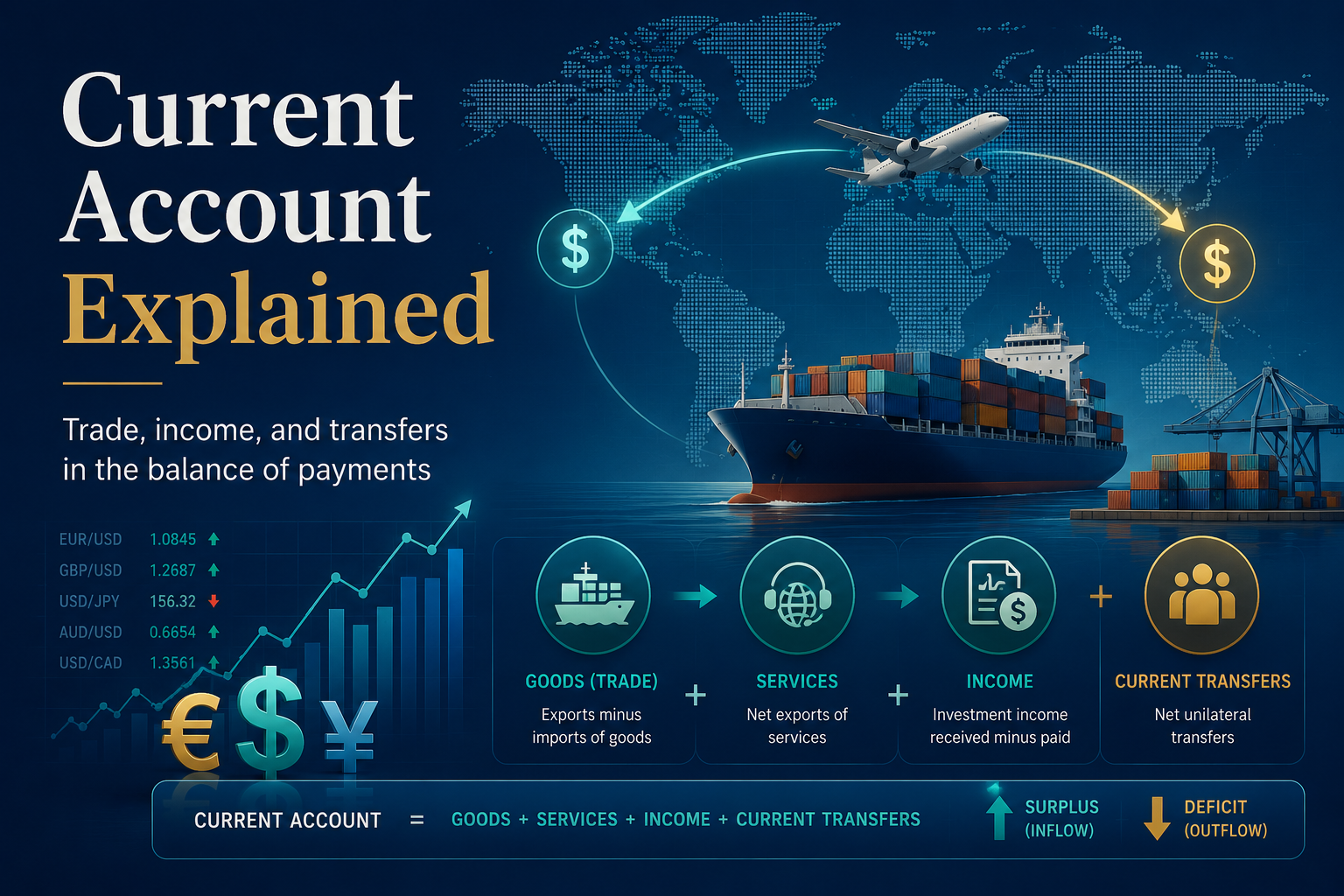
A current account is a main part of a country’s balance of payments. It records transactions between residents of one economy and the rest of the world involving goods, services, primary income, and secondary income.
In simple terms, the current account shows whether a country is earning more from overseas trade and income than it is paying to other countries.
The current account includes:
Trade in goods
Trade in services
Primary income, such as investment income and wages earned across borders
Secondary income, such as remittances, foreign aid, and pensions
When incoming payments exceed outgoing payments, the country records a current account surplus. When outgoing payments exceed incoming payments, the country records a current account deficit.
Economists, governments, investors, and forex traders monitor the current account because it helps show how an economy interacts with global markets.
Countries exchange goods, services, income, and transfers.
Exports bring money into a country, while imports send money out. Income earned from overseas assets can increase the current account balance, while payments made to foreign investors can reduce it.
The current account is usually divided into four main components:
Goods trade
Services trade
Primary income
Secondary income
For example:
Exporting cars increases the current account balance.
Importing oil reduces the current account balance.
Receiving dividends from overseas investments increases primary income.
Sending remittances abroad reduces secondary income.
A current account surplus can indicate that a country is earning more from the rest of the world than it is spending abroad. A current account deficit can indicate that a country is spending more abroad than it earns from overseas sources.
Assume Country A records the following annual figures:
Goods exports: USD500 billion
Goods imports: USD550 billion
Services surplus: USD40 billion
Net primary income: USD15 billion
Net secondary income outflow: USD10 billion
Current account balance:
USD500B − USD550B + USD40B + USD15B − USD10B
= −USD5 billion
Country A therefore, records a current account deficit of USD5 billion. Although its goods trade balance was negative, the services surplus and primary income helped reduce the overall deficit.
The current account is an important indicator of a country’s external position, trade performance, and economic links with the rest of the world.
A current account surplus can support demand for a country’s currency because foreign buyers may need that currency to purchase exports or local assets. However, a surplus does not guarantee a stronger currency. Exchange rates are also affected by interest rates, inflation, capital flows, central bank policy, and market sentiment.
A stable current account balance may support investor confidence by signalling steady trade flows and manageable external financing needs.
A persistent current account deficit may show that a country relies heavily on imported goods, foreign income payments, or external financing. This is not always negative, but it can become a concern if the deficit is large, long-lasting, or funded by unstable capital flows.
Forex traders monitor current account data because it can affect currency demand, inflation expectations, interest rate expectations, and wider views of economic stability.
A current account surplus means a country earns more from the rest of the world than it spends internationally. A current account deficit means a country spends more abroad than it earns from overseas trade, income, and transfers.
Surpluses are often associated with export-driven economies, high overseas income, or high national savings. Deficits are common in economies with strong domestic demand, high imports, or significant foreign income payments.
The current account and trade balance are related, but they are not the same. The trade balance measures the difference between exports and imports of goods and services. The current account is broader, as it includes primary and secondary income.
This means a country can have a trade deficit but still have a smaller current account deficit if it earns high income from overseas investments or services.
One common mistake is confusing the current account with a bank current account. In economics, the term refers to part of a country’s balance of payments, not a personal or business banking product.
Another mistake is assuming that current account deficits are always harmful. Some countries run deficits while attracting stable foreign investment and maintaining economic growth.
A third mistake is treating the current account as equivalent to the trade balance. The trade balance is only one part of the current account.
Balance of Payments: A record of economic transactions between residents of one economy and the rest of the world.
Trade Balance: The difference between exports and imports of goods and services.
Trade Deficit: A situation where imports exceed exports.
Currency Depreciation: A decline in the value of one currency relative to another currency.
Foreign Exchange Reserves: Foreign currency assets held by central banks to support monetary and financial stability.
Exchange Rate: The value of one currency compared with another currency in the foreign exchange market.
Primary Income: Cross-border income from labour, investments, interest, dividends, and profits.
Secondary Income: Cross-border transfers made without a direct exchange, such as remittances and aid.
A current account records a country’s trade in goods and services, primary income, and secondary income with the rest of the world over a specific period.
A current account deficit usually occurs when imports and outgoing income or transfers exceed exports and incoming income or transfers.
The current account is important in forex trading because it can influence currency demand, market confidence, inflation expectations, and views on future monetary policy.
The trade balance measures the difference between exports and imports of goods and services. The current account also includes primary and secondary income, providing a broader view of a country’s external transactions.
No. A current account deficit is not always bad. It may be sustainable if it is supported by stable investment, strong growth, and productive use of external financing. It may become a risk if it is large, persistent, or dependent on short-term capital inflows.
The current account is a key measure of a country’s economic relationship with the global economy. It tracks trade flows, primary income, and secondary income to show whether money is flowing into or out of a country through regular international transactions.
For traders and investors, the current account helps explain currency demand, external stability, and long-term economic trends. A surplus or deficit should not be judged in isolation, but it remains an important signal in forex and macroeconomic analysis.



World's Best Broker