Published on: 2026-05-25
Updated on: 2026-05-25
Dollar-denominated bond yields for African sovereigns reached 9% in 2024, the highest among emerging regions and up from 7% in 2007, according to the OECD Africa Capital Markets Report 2025. Emerging Asia paid 4.7%, and Latin America paid 6.5% over the same period. Sub-Saharan Africa’s average coupon on international issuances hit 11.6% in early 2024, a spread of 8.5 percentage points above the US Treasury benchmark.
The UNDP’s 2023 study found that credit rating subjectivity costs African sovereigns $75 billion annually: $28 billion in excess interest above what nations with comparable fundamentals pay elsewhere, and $46 billion in financing that never reaches African markets at all. That figure is more than 2.5 times total bilateral aid to Sub-Saharan Africa, which stood at $29.2 billion in 2025.
Only four African countries hold investment-grade ratings from the Big Three: Botswana, Mauritius, Morocco, and South Africa. The other 80% of rated sovereigns are classified as speculative or high-risk. African countries pay 1.5 percentage points more in interest than nations elsewhere with identical debt ratios, growth rates, and inflation levels. 32 African countries now spend more on debt service than on healthcare.
The African Credit Rating Agency (AfCRA), headquartered in Mauritius and backed by the African Union, is expected to issue its first sovereign rating by June 2026. For fixed-income investors, African sovereign bonds priced at a 4.3 percentage-point premium over comparable Asian markets represent one of the largest unresolved pricing gaps in global emerging markets today.
Eleven of the world’s fifteen fastest-growing economies in 2025 are African. Sub-Saharan Africa grew at 4.1% in 2025, and the IMF projects 4.4% in 2026. The African Development Bank expects 41% of African economies to grow at 5% or above this year, nearly double the global average.
And yet Africa pays more to borrow than any other region on earth.
Dollar-denominated bond yields for African sovereigns reached 9% in 2024, according to the OECD’s Africa Capital Markets Report 2025. Asian emerging markets pay approximately 4.7%. Latin America pays approximately 6.5%.
Four countries, Angola, Cameroon, Kenya, and Nigeria, issued bonds at yields above 10% in 2024. Cameroon’s seven-year dollar bond was priced at 10.75%. Congo Republic offered double-digit yields in private placements.
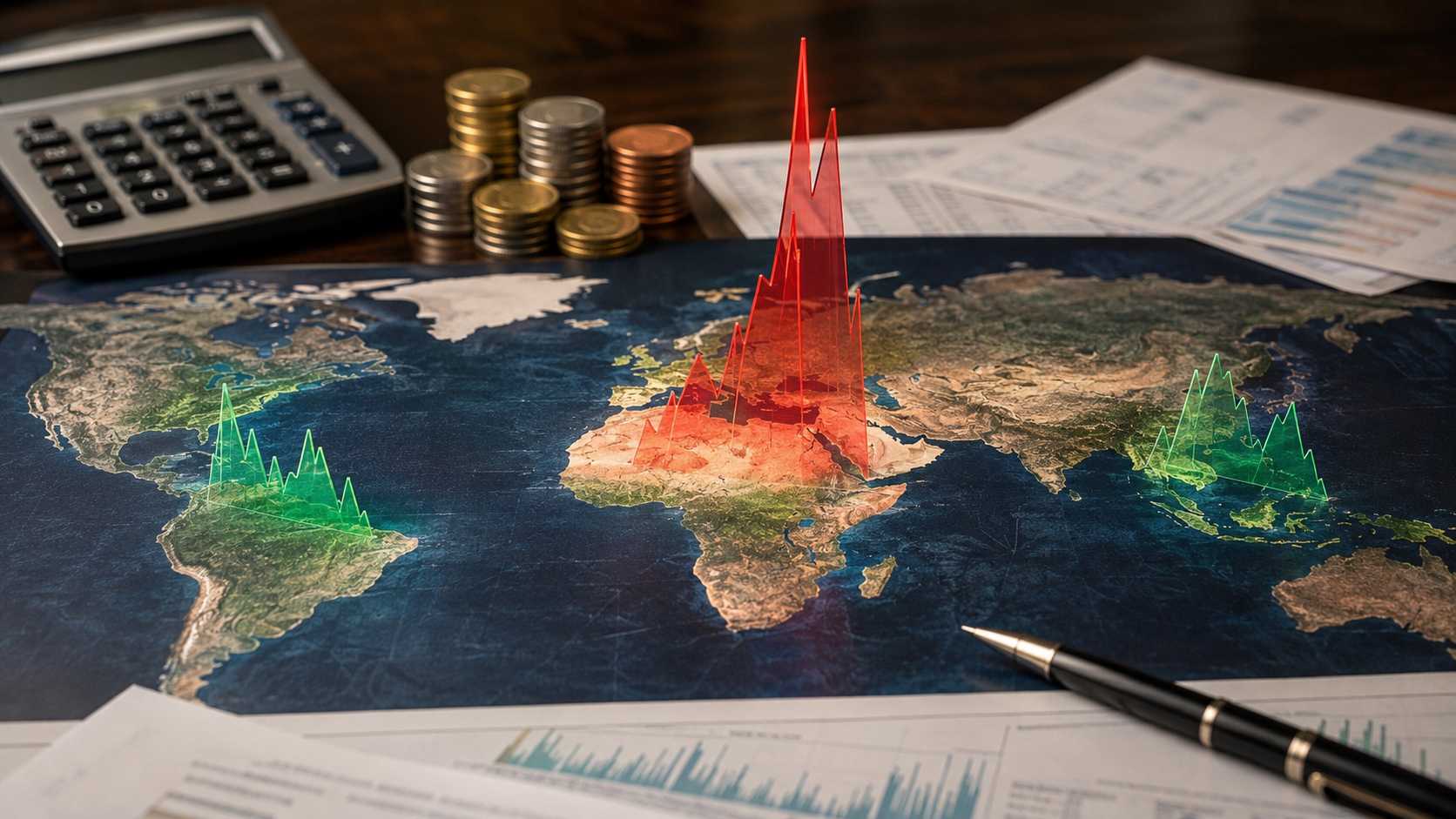
The gap between Africa’s growth trajectory and the price it pays for capital is costing the continent $75 billion a year. That gap is getting wider, not narrower.
The UNDP’s 2023 study produced a figure cited by the African Union, the World Economic Forum, the Africa Finance Corporation, and finance ministers across the continent. African countries lose an estimated $75 billion annually to the “Africa premium” embedded in credit ratings.
The breakdown is precise. $28 billion flows out as excess interest on existing debt, where African sovereigns pay measurably more than nations with comparable macroeconomic profiles.
Nearly $46 billion represents capital that investors chose not to deploy into African markets at all. Not because growth prospects were absent, but because risk classifications made the allocation look imprudent under standard investment mandates.
Total bilateral Official Development Assistance to Sub-Saharan Africa stood at $29.2 billion in 2025. The annual premium Africa pays exceeds that figure by more than 2.5 times. Kenya’s President William Ruto quantified one piece of this at the AfCRA launch in Addis Ababa: improving Africa’s credit rating by a single notch could unlock $15.5 billion in additional financing.
One upgrade. More than half of the continent’s entire annual aid inflow.
The OECD confirmed that Africa has consistently paid the highest yields on dollar-denominated bonds of any region since at least 2010. Between 2014 and 2023, Africa averaged around 7% while emerging markets elsewhere held below 5%. In 2024, Africa’s average widened to 9% as other regions stayed below 7%.
For perspective: India, a lower-middle-income country like many African issuers, borrows internationally at roughly 5% to 6% in dollars. The Philippines, with a GDP per capita close to Kenya’s, borrows at approximately 5%. The OECD found that lower-middle-income African countries paid roughly one full percentage point more than income-category peers elsewhere for foreign currency bonds between 2022 and 2024, even after controlling for credit rating.
S&P Global projects Africa’s sovereign external repayments will exceed $90 billion in 2026. At 1.5 percentage points above what comparably rated nations elsewhere pay, the excess interest embedded in that $90 billion runs into billions in avoidable annual outflows.
| Country | Latest Eurobond Yield | Credit Rating (Moody’s) | 2026 External Repayments |
|---|---|---|---|
| Cameroon | 10.75% | B2 | $1.2B |
| Angola | 10%+ | B3 | $4.8B |
| Nigeria | 8.6–9.1% | B3 | $4.5B |
| Congo Republic | 10%+ (private) | Not rated | $0.9B |
| Egypt | ~8.0% | Caa1 | $15.2B |
| Kenya | 8.3–9.95% | B3 | $2.1B |
| Senegal | ~9.5% | Ba3 | $1.5B |
| Côte d’Ivoire | ~8.5% | Ba2 | $2.3B |
| Ethiopia | Post-default | Caa3 | $1.8B |
| Ghana | Post-restructuring | Ca | $2.5B |
| South Africa | ~7.9% (10Y local) | Ba2 | Upgrade watch |
| Botswana | Low / stable | A3 | Investment-grade |
| Mauritius | Low / stable | Baa2 | Investment-grade |
| Morocco | Moderate | Ba1 | Near investment-grade |
Sources: OECD Africa Capital Markets Report 2025, IMF Regional Economic Outlook October 2025, Finance in Africa 2025, S&P and Moody’s public rating sheets.
| Sub-Region | Countries Most Affected | Primary Driver of Premium | Estimated Annual Cost |
|---|---|---|---|
| West Africa | Nigeria, Ghana, Senegal, Côte d’Ivoire, Cameroon | Largest issuers; FX risk, oil dependence, governance overlays | ~$20–25 billion |
| East Africa | Kenya, Ethiopia, Uganda, Tanzania | High debt-service burden, slow ratings responsiveness to reform | ~$12–15 billion |
| Southern Africa | Angola, Zambia, Mozambique | Resource-state premium, past defaults, limited investment-grade access | ~$12–14 billion |
| North Africa | Egypt, Tunisia | High debt loads, IMF program dependencies, political transitions | ~$8–10 billion |
| Central Africa | DRC, Congo Republic, Chad | Sparse rating coverage, conflict overlays, limited capital market access | ~$6–8 billion |
| Pan-African foregone lending | All rated sovereigns | Investors deterred from frontier allocation by speculative classification | ~$46 billion |
Sub-region estimates based on the proportional share of African sovereign Eurobond issuance. UNDP/Brookings 2023–2024 methodology.
Moody’s, S&P Global, and Fitch Ratings collectively rate approximately 95% of global sovereign and corporate debt. As of early 2026, 32 African countries hold at least one Big Three rating.
Only four are investment-grade. The remaining 28 are speculative or high-risk, a classification that holds across countries with very different fiscal trajectories, reform histories, and economic structures.
The Big Three built their analytical frameworks around what advanced financial systems produce: long data series, deep capital market liquidity, standardised institutional records, and decades of bond issuance history. Most African economies generate data at different frequencies, through different channels, and with different coverage gaps. When quantitative inputs are thin, qualitative judgment fills in.
Assessments of governance, political stability, and institutional strength become the deciding factors. Those assessments carry the deepest geography bias, and the UNDP study is precise in its conclusion: two countries with identical debt-to-GDP ratios, external reserves, inflation trajectories, and GDP growth rates receive different ratings and pay different borrowing costs, largely based on where they are located.
The OECD’s own language is notable. The elevated yields Africa pays “cannot be explained by income levels alone.” When the data institution underlying sovereign debt analysis says that income classification does not explain the gap, the remaining explanation is perception.
In February 2026, S&P Global published its Africa Credit Rating Trends 2025 report. Burundi was labelled as Uganda. Sudan and South Sudan, separated in 2011 after decades of civil conflict, appeared as a single country.
S&P has rated Uganda’s sovereign debt for over 18 years and has maintained an office in South Africa since 2008. Corrections came in early March, weeks after publication, only after public criticism from the African Peer Review Mechanism. No formal acknowledgment followed about what the errors revealed.
Researchers who flagged the mistakes drew the comparison plainly. A credit trends report on Europe that merged North and South Korea or labelled Germany as France would have generated immediate public corrections and formal apologies. The reputational stakes would have left no other response viable.
For investors pricing risk across 54 sovereign issuers using that report, the question becomes unavoidable: how much analytical precision is actually behind the qualitative overlays that move a country from B to B+ and shift its borrowing cost by 150 basis points?
High borrowing costs at 9%, compared with 5% to 6% in Asia, force governments to allocate more revenue to debt service and less to capital investment. Egypt’s interest-to-revenue ratio sits at approximately 70% in 2026, one of the highest in the world. Angola directs 66% of government revenue to debt repayments.
32 African countries spend more on external debt service than on healthcare. 25 spend more on debt service than on education.
When infrastructure investment stalls, when healthcare systems underfund, when education budgets are squeezed, the macroeconomic fundamentals that rating agencies measure in the next review come in weaker than those of peer economies that borrowed at 5%. Weaker fundamentals feed back into ratings. Ratings hold or worsen.
Borrowing costs stay elevated. The same premium that constrained public investment gets reinforced by the constrained public investment it caused.
Kevin Urama, Chief Economist at the African Development Bank, put a number on the total spread: African countries pay approximately 500% more in loan interest when borrowing from private capital markets compared to multilateral development banks. The African Development Bank lends at concessional rates, in part because the institution was designed to absorb developing-market risk. The private market, priced by the Big Three, charges a multiple that is not supported by Africa’s actual default history.
The $108 billion annual infrastructure financing gap the AfDB has identified is the tangible output of two decades of capital priced above what the underlying risk warranted.
Roads are not financed. Power plants were not built. Ports not expanded.
Each gap is a compounding cost on future productivity, future tax revenue, and future credit metrics.
The African Credit Rating Agency was launched at an African Union event in Addis Ababa. Kenya’s President Ruto stated the political case plainly: “Global credit rating agencies have not only dealt us a bad hand, but they have also deliberately failed Africa. They rely on flawed models, outdated assumptions, and systemic bias, painting an unfair picture of our economies and leading to distorted ratings, exaggerated risks, and unjustifiably high borrowing costs.”
AfCRA is registered in Mauritius following a competitive selection process completed in September 2025. It is structured as a private-sector-led, independent entity, specifically not government-owned, to protect its assessments from being dismissed as political instruments. Its first sovereign rating is expected by June 2026, revised from an original late-2025 schedule.
Three architectural differences separate it from the incumbents. AfCRA will employ Africa-based analysts using region-specific datasets and reform trajectory assessments calibrated for African economic structures.
It will begin with local-currency debt ratings, covering the 60% of Africa’s marketable sovereign debt denominated in local currencies, where the data gap with the Big Three is most severe. Governance structures will incorporate long-term development metrics alongside traditional fiscal indicators, acknowledging that major infrastructure projects look very different in year one than in year seven.
The credibility challenge deserves honest treatment. Chatham House published a detailed critique in November 2025, arguing that AfCRA’s ratings are likely to be more optimistic than those of the Big Three and will face skepticism for that very reason. The concern is legitimate: an agency created by African institutions that consistently rates African sovereigns more favorably than Moody’s, S&P, and Fitch will not gain traction with institutional investors who have built compliance frameworks around Big Three assessments over decades.
Misheck Mutize, lead credit ratings expert at the African Peer Review Mechanism, has addressed this repeatedly: AfCRA is not being established to produce favorable ratings. The test is accuracy, not advocacy. Whether its first ratings are accepted alongside Big Three assessments in investor analysis will determine whether the agency changes anything that matters.
Sovereign bond pricing in international markets is determined by the marginal investor. When all significant institutional buyers anchor their risk assessment to the same three ratings, the spread between Africa and Asia becomes a monopoly output. One set of institutions produces the pricing signal; every buyer responds to that same signal.
A credible second assessment changes that. If AfCRA rates a Nigerian or Kenyan sovereign differently from Moody’s, large investors running comparative emerging-market allocations face a genuine analytical question about which assessment better reflects current risk. That question introduces competition for accuracy, and competition for accuracy narrows perception gaps over time without requiring regulatory intervention.
The more immediate effect may come in local-currency markets. A deeper, more credibly rated local-currency bond market reduces the sovereign’s dependence on dollar issuance, removes foreign exchange risk from debt service calculations, and gradually shifts the financing architecture away from the conditions that make the 9% versus 4.7% comparison relevant in the first place.
Nigeria’s November 2025 Eurobond attracted $13 billion in orders against a $2.35 billion issuance, a record oversubscription that reflects investor appetite well above what a B3 sovereign rating implies. Ghana completed its debt restructuring and returned to market access.
Kenya reduced its debt-to-GDP ratio from 70.1% to 68.3% through fiscal consolidation despite elevated borrowing costs. South Africa’s ten-year bond yield reached 7.89% in February 2026, its lowest since 2015, after the government signalled public debt would peak this fiscal year for the first time in seventeen years.
S&P projects Africa’s average real GDP growth at 4.5% in 2026, with fiscal deficits narrowing to around 3.5% of GDP on average. The African Development Bank confirmed that positive credit rating actions outnumbered downgrades in the second half of 2024.
The reform work is visible in the data. The ratings response has been consistently slow.
The unresolved question is timing. Africa’s sovereign external debt repayments are projected to exceed $90 billion in 2026. Twenty-five countries remain in debt distress or at high risk under the IMF-World Bank Debt Sustainability Framework, up from nine in 2012.
AfCRA’s first ratings arrive in that environment. Building the credibility needed to move market pricing takes years. The countries that most need relief from corrected pricing face their heaviest repayment obligations while that credibility is still being built.
Africa pays 9% to borrow while Asia pays 4.7%, and the gap is wider than economic fundamentals justify. That premium costs $75 billion a year, more than 2.5 times the continent’s total foreign aid inflows, draining resources from infrastructure, healthcare, and education that drive the growth figures the rating agencies say they are measuring.
Three firms control 95% of the global ratings market and have classified 80% of Africa’s rated sovereigns as speculative, even as the continent posts the fastest growth of any major region, brings inflation down, and attracts record investment. The reform data is there. The pricing has not caught up.
AfCRA’s first sovereign rating in June 2026 will not overturn a three-decade monopoly overnight. But it is the first time a credible institutional alternative has entered this market, arriving at the moment when Africa’s reform record is already visible in bond order books, even if it is not yet visible in credit ratings.
For fixed-income investors with a horizon beyond the next quarterly review, the spread between African and Asian sovereign bonds of comparable underlying quality is a pricing gap that grows harder to sustain with every oversubscribed issuance and every reform cycle the Big Three are slow to recognise. A continent paying $75 billion a year for the privilege of being assessed by institutions that cannot reliably identify its countries on a map has waited long enough for that competition to arrive.