Published on: 2026-05-25
Updated on: 2026-05-25
A forward contract is a private agreement between two parties to buy or sell an asset at a fixed price on a future date. The purpose is to reduce uncertainty around future prices. Exchange rates can move quickly, commodity prices can react to supply shocks, and interest-rate expectations can change after economic data or central bank decisions. Instead of waiting for the market price at a later date, both parties agree on the price today and settle the transaction later.
Forward contracts are used across foreign exchange, commodities and institutional finance. Companies often use them to manage future costs or revenues. Traders and investors may use them to position for expected price movements.
Unlike spot trading, where settlement happens almost immediately, a forward contract is based on future delivery or future settlement. Once the agreement is made, both parties are normally obligated to complete the contract, even if the market price later moves against them.
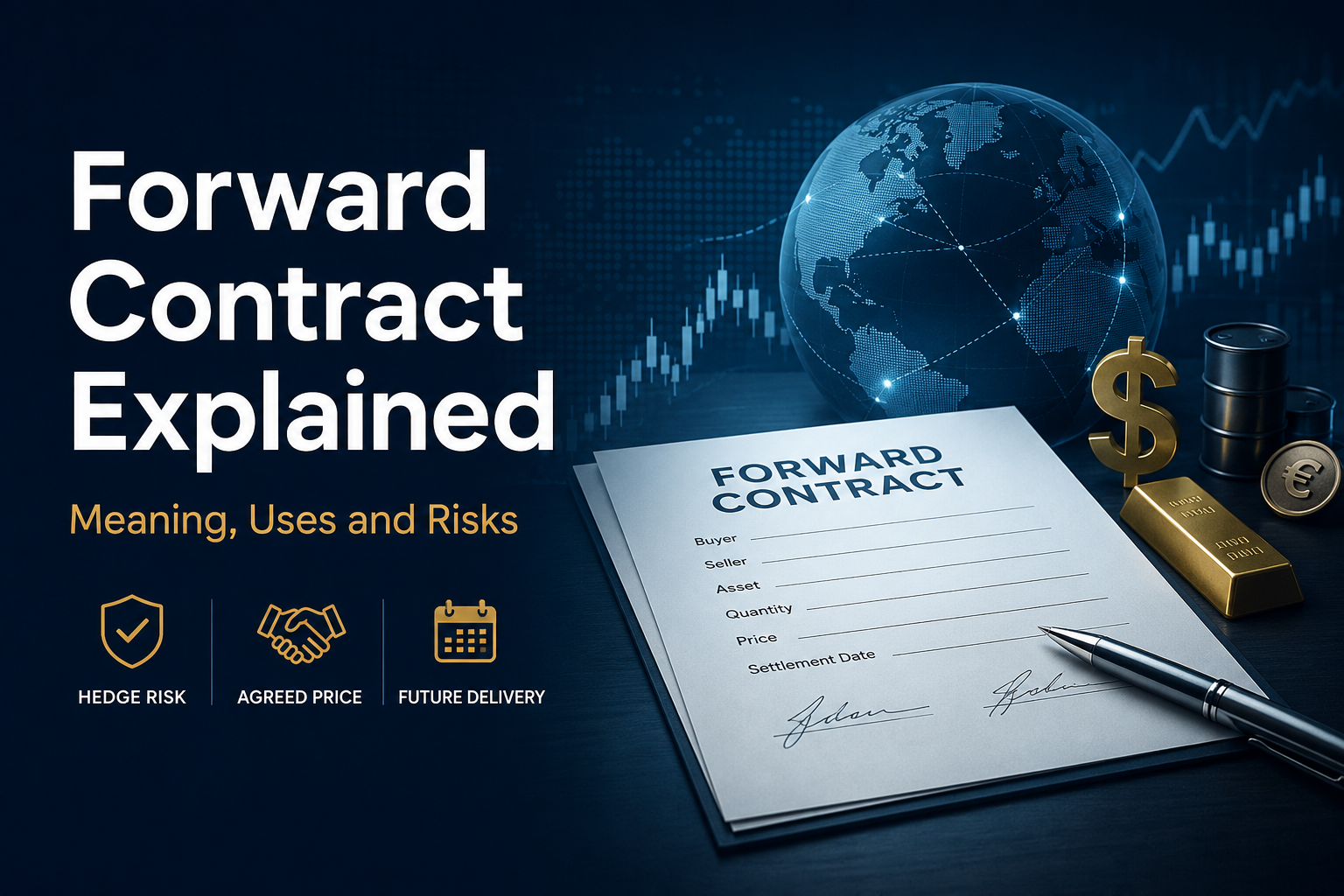
A forward contract locks in a future transaction price before the settlement date. Suppose a trader believes gold prices will rise over the next two months because markets expect lower US interest rates.
The trader enters a forward contract to buy gold at $2,300 per ounce in two months.
At settlement, gold has risen to $2,450 per ounce. Because the trader agreed to buy at $2,300, the contract has a positive value for the buyer. The difference between the agreed price and the market price represents the potential gain, before any fees, financing costs or settlement terms.
If gold falls to $2,200, the trader faces a loss because the agreed purchase price is now above the market price.
This is why forward contracts require disciplined risk management. They can reduce uncertainty, but they can also create losses when market prices move against the agreed position. The value of a forward contract depends mainly on the difference between the agreed forward price and the market price at settlement.
In hedging, the goal is risk reduction rather than profit. A company with future foreign-currency payments may use a currency forward to stabilise costs. An exporter expecting foreign-currency revenue may use a forward contract to protect the value of that revenue. A commodity producer may lock in a future selling price to reduce exposure to price declines.
In speculation, the goal is to profit from an expected market move. A trader may use a forward contract when they expect the future price of a currency, commodity or other asset to move in a specific direction.
For example, if traders expect the Federal Reserve to cut interest rates, they may anticipate a weaker US dollar or stronger gold prices. A forward contract can give exposure to that expected move before the future settlement date.
Forward contracts can be useful during volatile periods caused by inflation data, central bank policy, supply disruptions or geopolitical events. However, the same volatility can also increase losses if the market moves in the opposite direction.
One of the main advantages of a forward contract is price certainty. A business, trader, or investor can lock in a future price rather than remain fully exposed to market swings.
Forward contracts are also flexible. Since the terms are privately negotiated, both parties can customize the asset, size, date and settlement terms to match a specific exposure.
Another advantage is hedging efficiency. A company with a known future payment or revenue can use a forward contract to align the hedge with the exact timing and size of that exposure.
For institutions, this flexibility can be valuable because their risks may not match standardised exchange-traded contracts.
Forward contracts carry several important risks.
The most significant is counterparty risk. Because forward contracts are private OTC agreements, there is usually no exchange clearing house guaranteeing the transaction. If one party defaults, the other may incur a financial loss.
Market risk is also important. If the market price moves sharply against the agreed position, losses can be substantial because the contract remains binding.
Liquidity risk is another concern. Since forward contracts are customised, there may be no active secondary market. Closing or changing the contract before settlement may require negotiation with the original counterparty.
Forward contracts may also be harder to value than exchange-traded futures because they are private agreements and may not have transparent market prices.
For inexperienced traders, these risks can escalate quickly during volatile market conditions.
Forward contracts and futures contracts both involve agreeing on a price for a future transaction. The difference is in how they are structured and traded.
In simple terms, a futures contract is a standardised, exchange-traded contract, while a forward contract is a customised private agreement.
Futures Contract: A standardised derivative contract traded on a regulated exchange.
Hedging: A strategy used to reduce exposure to financial risk.
Spot Market: A market where assets are bought and sold for near-immediate settlement.
Derivative: A financial instrument whose value is based on an underlying asset, such as a currency, commodity, index or interest rate.
Currency Risk: The risk of loss caused by movements in exchange rates.
Counterparty Risk: The risk that the other party in a financial contract may fail to meet its obligations.
No. Forward contracts are widely used in foreign exchange, commodities, bonds and interest-rate markets. They are especially useful when future price uncertainty can affect costs, revenues or investment returns.
Companies use forward contracts to stabilise future costs or revenues. Importers, exporters and multinational firms often use currency forwards to manage exchange-rate risk.
Yes. Traders can use forward contracts to speculate on future market movements. If the market moves in the expected direction, the contract may become profitable. If the market moves against the position, the trader may face a loss.
Forward contracts carry counterparty risk, market risk, liquidity risk and valuation risk. Since they are private agreements, losses can be significant if the market moves unexpectedly or one party fails to meet its obligations.
A forward contract is privately negotiated and customisable. A futures contract is standardised and traded on an exchange. Futures contracts usually have higher liquidity and lower counterparty risk because they are cleared through an exchange clearing house.
Forward contracts remain one of the most important tools in global financial markets because they allow participants to manage future uncertainty before it becomes a problem.
Whether it is a multinational company protecting itself from currency swings or a trader positioning ahead of a major macroeconomic event, forward contracts provide a way to lock in pricing before markets shift.
Their flexibility makes them powerful, especially in volatile environments shaped by central bank policy, inflation expectations and geopolitical risk. However, that same flexibility also introduces greater responsibility. Since forward contracts are private agreements with binding obligations, they require disciplined risk management and a clear understanding of market exposure.



World's Best Broker