Published on: 2026-03-23
Updated on: 2026-03-23
The trading week has kicked off with what can only be described as a brutal liquidation across the Asia-Pacific region. On Monday, March 23, 2026. investors woke up to a sea of red as Asian market indices suffered one of their most harrowing sessions in recent history. From the high-tech boards in Tokyo to the heavy industrial hubs of Seoul and the financial skyscrapers of Hong Kong, the narrative was identical: a frantic, wide-scale flight from risk.
The catalyst for this collapse wasn't just "geopolitical tension"—it was a direct, existential threat to the world's most critical energy artery. Over the weekend, the standoff between the United States and Iran entered a terrifying new phase, centering on the Strait of Hormuz. With a 48-hour "obliteration" ultimatum now hanging over the global economy, the region's biggest players are bracing for a massive, sustained energy shock.
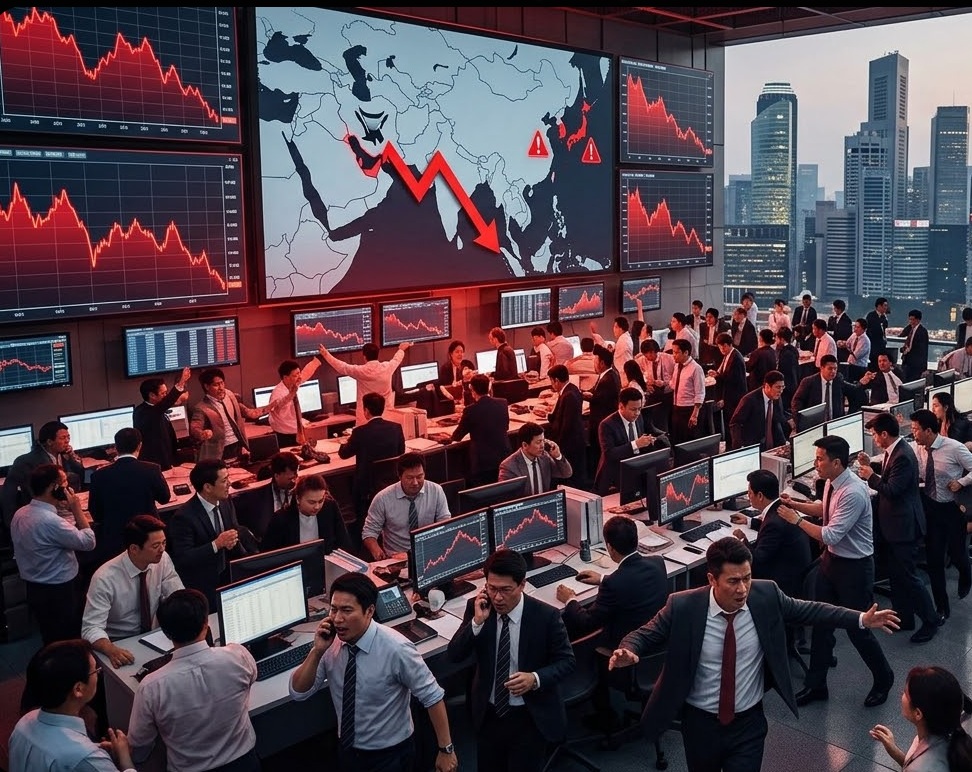
Japan and South Korea, arguably the two most energy-vulnerable nations on the planet, were the first to see their Asian market indices crumble. Traders were reacting to a blunt ultimatum from U.S. President Donald Trump, who warned that the U.S. would target Iranian energy infrastructure unless the Strait of Hormuz was fully reopened by Tuesday morning.
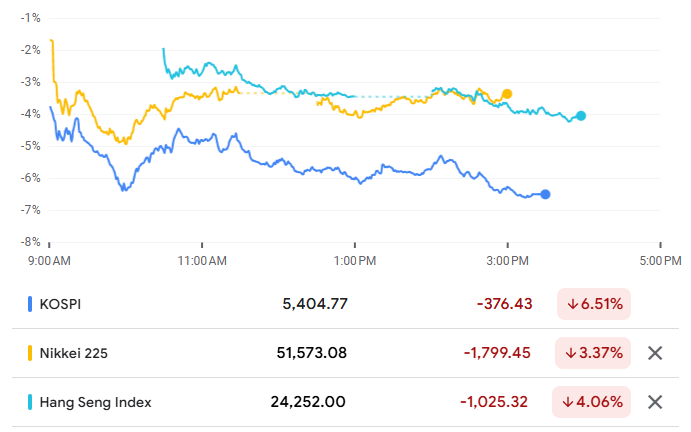
The Nikkei 225 plummeted as much as 5.1% in early trade—its largest intraday drop in years—before slightly stabilizing to settle with a 3.8% loss. The index is currently fighting to hold the 51.360 level. For a market that had recently been enjoying record-breaking highs, this wasn't just a dip; it was a total reality check. Heavyweights like Toyota and Mitsubishi UFJ saw massive sell orders as the "weak Yen" advantage was instantly wiped out by the fear of $120 oil.
The situation in Seoul was even more dramatic. The KOSPI index dove more than 5.1%, falling toward 5.485 points. At one point, the selling was so aggressive that the Korea Exchange had to trigger a circuit breaker for its futures market to prevent a complete technical collapse.
Why Korea is feeling the most pain:
The Energy Trap: South Korea imports nearly 100% of its oil. With Brent crude spiking over $112, the country's manufacturing-heavy economy is looking at a massive spike in production costs.
The Tech Squeeze: Semiconductor giants Samsung Electronics and SK Hynix both saw their shares hacked by nearly 5%, as investors fear Middle Eastern instability will ripple through global high-tech supply chains.
Mainland China and Hong Kong were far from immune to the contagion. The Shanghai Composite fell about 2.1%, hitting a three-month low near 3.870. Meanwhile, the Hang Seng Index in Hong Kong tumbled 3.3% to settle around 24.440. This downward pressure on Asian market indices highlights the deep interdependence between Eastern manufacturing and Middle Eastern energy.
For Beijing, the threat is twofold. As the world's largest buyer of Persian Gulf oil, any blockage in the Strait of Hormuz is a direct threat to its industrial stability. Furthermore, the crisis has forced the delay of a high-stakes trade summit between Washington and Beijing, leaving traders worried that economic progress will be sidelined by a hot war.
In a move that has left many retail investors stunned, gold is failing to act as a safety net. Despite the drums of war, gold has continued its steep decline, currently trading near $4.373 - $4.400. While this might seem counterintuitive, it's a classic symptom of a market-wide liquidity crisis.
The Cash Crunch: When stocks drop 5% in a single morning, institutional traders face "margin calls." They need cash immediately, and since gold is highly liquid, they sell it to cover their losses in the equity market.
The Mighty Dollar: The U.S. Dollar has become the only true safe haven today. A surging dollar makes gold (priced in USD) much more expensive for global buyers, naturally driving the price down.
Hawkish Fed Fears: Rising oil prices are stoking inflation fears. Investors now expect the Fed to keep interest rates high—or even raise them—to combat energy-driven inflation. Since gold doesn't pay interest, it loses its appeal when yields are high.
The reason Asian market indices are in such a tailspin boils down to a single geographic chokepoint. The Strait of Hormuz handles roughly 20% of the world's oil and liquefied natural gas (LNG).
The 48-Hour Clock: President Trump's ultimatum has created a "ticking clock" scenario that most trading algorithms simply aren't programmed to handle.
Iran's Retaliation: Tehran has already warned that if their power plants are touched, they will target energy and IT infrastructure belonging to the U.S. and its allies.
Logistics Chaos: Over 200 vessels are currently anchored outside the Strait, unable to move as war-risk insurance premiums have become unaffordable.
As we approach the Tuesday deadline, the fate of Asian market indices is entirely in the hands of the diplomats—or the generals. If the 48-hour window closes without a resolution and military strikes begin, analysts warn that we could see a further 20% drawdown in regional equities as the energy shock fully ripples through the system.
For now, the mantra on the floor is "liquidity over everything." Investors aren't looking for the best return anymore; they're just looking for a way to get out before the next headline breaks. The "Asian bloodbath" of March 2026 serves as a brutal reminder of how quickly a geopolitical spark can vaporize trillions in market value.
Disclaimer: This material is for general information purposes only and is not intended as (and should not be considered to be) financial, investment or other advice on which reliance should be placed. No opinion given in the material constitutes a recommendation by EBC or the author that any particular investment, security, transaction or investment strategy is suitable for any specific person.