Published on: 2026-05-04
Updated on: 2026-05-04
The U.S. has helium. What it lacks is strategic flexibility. Qatar’s 2026 disruption exposed a hidden AI supply-chain risk: helium security depends less on who has the gas underground and more on who can process, store, transport, and allocate it during a shock.
Key Takeaways
The U.S. is the world’s largest reported helium producer, but production leadership did not prevent a supply-chain shock.
Helium is a hidden AI-chip input because fabs use it to control wafer temperatures during semiconductor etching.
The Federal Helium System was sold in 2024, leaving the U.S. without its former public helium buffer.
Qatar’s disruption exposed the market’s dependence on liquid-helium logistics, specialized containers, and Persian Gulf shipping routes.
Helium’s exclusion from the new U.S. critical-minerals reserve framework shows a policy gap, not a geological shortage.
The helium shock is not about the U.S. running out of helium underground. It is about whether helium can be processed, stored, transported, and allocated fast enough when a major supplier goes offline.
That matters for AI chips because fabs use helium to control wafer temperatures during semiconductor etching, and experts say current manufacturing processes lack an easy substitute. (1)
In 2025, the U.S. sold or used an estimated 81 million cubic meters of Grade-A and gaseous helium, more than any other reported producer. Qatar produced about 63 million cubic meters, while global helium production was about 190 million cubic meters. USGS also lists the U.S. government helium stockpile as “None.” (2)
That is the central weakness. The U.S. has helium production, resources, processing capacity, and private-sector expertise. What it no longer has is a government-controlled helium reserve that can serve as a public shock absorber during a geopolitical supply disruption.
One nuance matters: USGS notes that U.S. figures include helium extracted from Canada and purified to Grade-A helium in the United States. So “largest reported producer” does not mean the U.S. controls every molecule in the supply chain.
| Indicator | Figure |
|---|---|
| U.S. 2025 Grade-A and gaseous helium sales/use | 81 million cubic meters |
| Qatar 2025 helium production | 63 million cubic meters |
| Global 2025 helium production | 190 million cubic meters |
| U.S. government helium stockpile | None |
| U.S. recoverable helium resources | 8.49 billion cubic meters |
| U.S. helium use in controlled atmospheres, fiber optics, and semiconductors | 17% |
USGS data shows why the U.S. position is strong but not decisive. Helium demand is spread across semiconductors, MRI, aerospace, specialty gases, welding, leak detection, diving, and other uses. In a shortage, the problem becomes allocation, not just price.
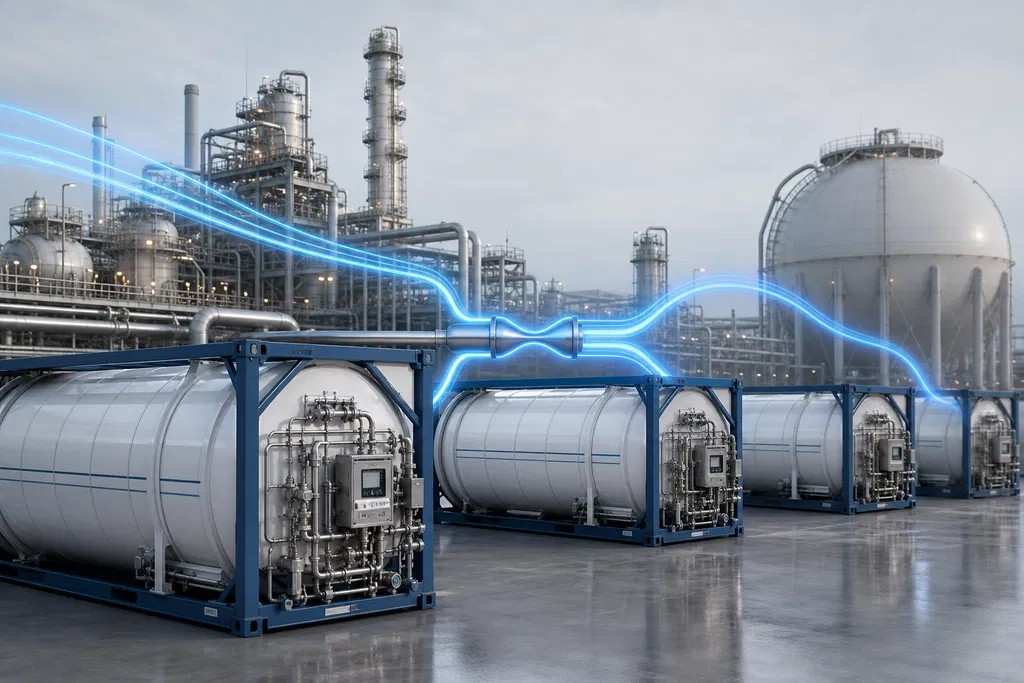
Helium is a small-cost but high-consequence input in semiconductor manufacturing.
Chipmakers use helium during etching, which removes material from silicon wafers to form transistor structures. The gas helps control wafer temperature, which is critical because advanced chipmaking depends on stable process conditions.
That is why helium is different from many industrial inputs. If it becomes tight, fabs may be able to rely on inventory or prioritize the most profitable production lines. But they cannot simply swap in another gas without changing validated manufacturing processes.
Qatar is not easily replaceable because it is not just a helium producer. It is a major liquid-helium supplier tied to a specific LNG production system, a specific geography, and a specialized container network.
QatarEnergy said it stopped production of LNG and associated products on March 2 after attacks on facilities in Ras Laffan and Mesaieed, then declared force majeure to affected buyers on March 4. (3,4)
The more damaging bottleneck was logistics. Liquid helium moves in specialized insulated containers. Gasworld reported that 200 specialist liquid-helium containers remained stranded in Qatar with no clear shipping route, although Air Liquide’s CEO said road exports were possible. (5)
| Constraint | Why it matters |
|---|---|
| Contracts | Buyers may be tied to specific suppliers and delivery terms. |
| Physical form | Crude, gaseous, Grade-A, and liquid helium are not interchangeable at every stage. |
| Containers | Liquid helium requires scarce specialized containers. |
| Geography | Qatari exports depend on routes out of the Persian Gulf. |
| Timing | Chip fabs need reliable deliveries, not abstract global supply. |
| Storage | Long-term helium storage requires specialized infrastructure. |
The U.S. production base helps. But it does not automatically solve a liquid-helium logistics shock affecting customers tied to Qatari supply.
The old federal helium system was created for public supply security. But the Helium Stewardship Act of 2013 required BLM to dispose of federal helium assets, and BLM completed the sale of the Federal Helium System to Messer on June 27, 2024. (6)
That does not mean the infrastructure disappeared. It means the federal government no longer controls it as a public supply-security tool.
Private contracts can work well in normal markets. But private inventories and commercial delivery agreements are not the same as a strategic reserve designed to respond to a geopolitical disruption.
In February 2026, EXIM announced Project Vault, a U.S. Strategic Critical Minerals Reserve structured as an independently governed public-private partnership. EXIM said its board approved a direct loan of up to $10 billion to support the initiative. (7)
Helium is not on the final 2025 Critical Minerals List. The Interior Department said the list contains 60 minerals considered vital to the U.S. economy and national security, and that are exposed to potential supply-chain risks. Helium is absent from that list, which is why PIIE argues it was not covered by Project Vault. (8)
PIIE argues that this exclusion left helium outside Project Vault despite its strategic importance to semiconductors, medical imaging, aerospace, and defense. Its argument is straightforward: helium is a gas, produced mostly as a natural-gas byproduct, difficult to store, and poorly suited to a conventional minerals stockpile. (9)
That makes helium a poor fit for a stockpile model built around metals. But if the policy framework cannot handle helium, the framework is incomplete.
A strategic helium reserve would not resemble a warehouse full of copper, lithium, or rare earth magnets.
Liquid helium boils off. Gaseous helium is difficult to contain. Long-term storage requires geological reservoirs, pipelines, salt caverns, or other specialized infrastructure. PIIE argues that a workable reserve would likely need to rotate inventory through commercial users rather than simply store it passively. (9)
| Reserve feature | Purpose |
|---|---|
| Geological storage | Hold helium over longer periods without relying only on short-duration containers. |
| Commercial rotation | Keep helium moving through real users instead of sitting idle. |
| Emergency allocation rules | Decide which sectors receive priority during a shortage. |
In a serious shortage, semiconductor fabs, hospitals, aerospace users, researchers, welders, and balloon suppliers are not equally critical. A reserve without allocation rules is not a strategy.
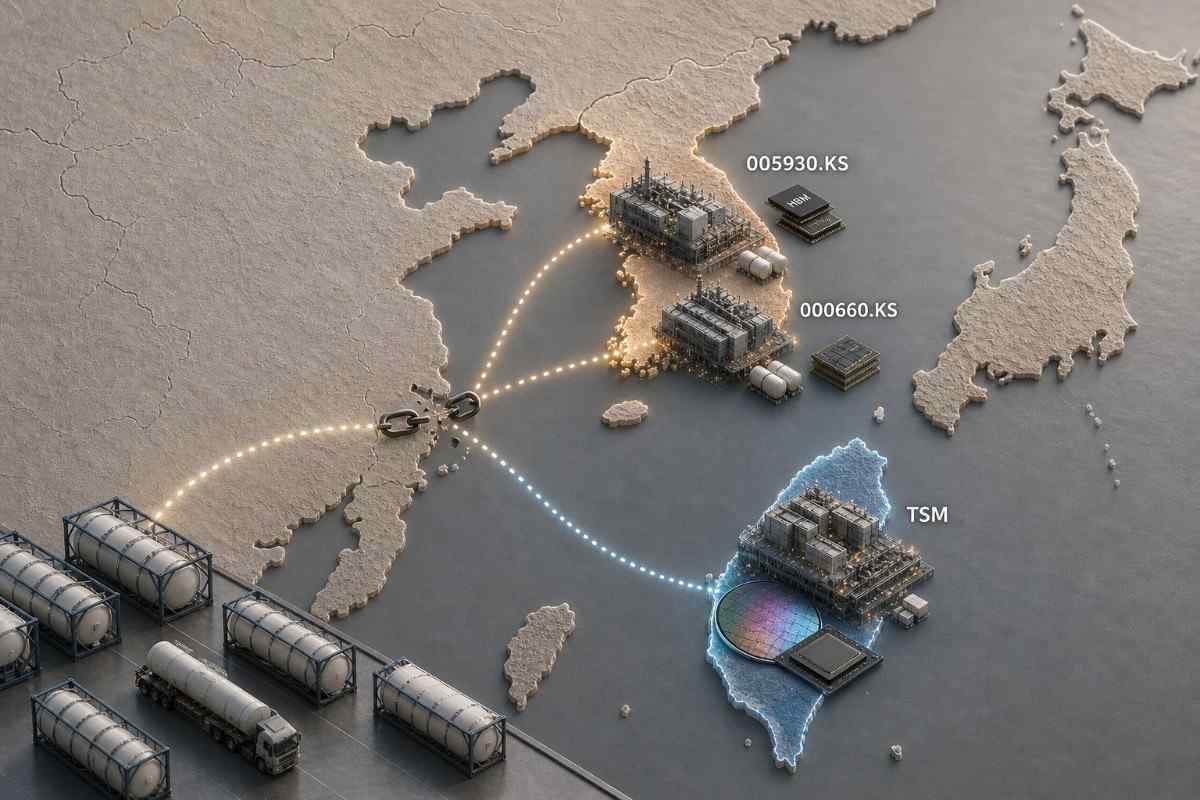
South Korea is the clearest near-term pressure point. Korea Times, citing the Korea International Trade Association, reported that South Korea relied on Qatar for 64.7% of its helium imports last year. (10)
That matters because South Korea is home to Samsung Electronics and SK Hynix, the world’s two largest memory-chip manufacturers. High-bandwidth memory, or HBM, is central to AI accelerators. Korea Times reported that domestic chipmakers’ helium stockpiles were expected to last about 6 months, making duration the key risk rather than an immediate shutdown.
Taiwan is a strategic risk rather than the most immediate case of exposure. TSMC told AP it did not expect a significant impact at the time of the report and would continue monitoring the situation. But Taiwan’s role in advanced logic chips means any disruption to critical fab inputs deserves market attention.
This is not a clean “AI chip production will collapse” story. That would be too simplistic.
The market risk is narrower but still important: helium is a low-visibility input that could become a bottleneck if supply, logistics, contracts, and storage tighten simultaneously. For chipmakers, the issue is less about helium’s cost and more about delivery certainty.
A fab does not need cheap helium in theory; it needs the right form of helium delivered on schedule. The clearest escalation signal would be chipmakers shifting from “monitoring supply” language to comments about inventory drawdowns, production prioritization, or supplier allocation.
AI hardware supply chains depend on more than GPUs, HBM, lithography tools, advanced packaging, and data-center power. They also depend on industrial inputs that rarely matter until they suddenly do.
The U.S. does not have a simple helium shortage. It has a helium-readiness problem.
The country leads in reported production and has a major resource base. But the Qatar shock showed that production leadership is not the same as supply-chain control. After the 2024 sale of the Federal Helium System and helium’s exclusion from the 2025 Critical Minerals List, America’s helium advantage is managed largely through private markets rather than a modern public strategy.
For AI supply chains, that is the warning. The next bottleneck may not be the most expensive input. It may be the one policymakers forgot to classify correctly.
(1) Associated Press, “Why the Iran war matters for the world’s helium supply,” 2026.
(2) U.S. Geological Survey, Mineral Commodity Summaries 2026: Helium and Rare Gases, February 2026.
(3) QatarEnergy, “QatarEnergy to stop production of LNG,” March 2, 2026.
(4) QatarEnergy, “QatarEnergy declares Force Majeure,” March 4, 2026.
(5) Gasworld, “Top 5 issues from a Hormuz premium,” 2026.
(6) Bureau of Land Management, “BLM completes sale of Federal Helium System,” June 27, 2024.
(7) EXIM, “EXIM Approves Project Vault Loan…,” February 2, 2026.