Published on: 2026-03-27
Updated on: 2026-03-27
You read the headline and think you know what should happen next. It summarises the content of the article and gives context, right? But then you check the chart and it moves in the opposite direction!
When this is your first foray into the world of Contracts for Difference (CFDs), it might seem like there is a hidden rule you have not uncovered. In a way, there is.
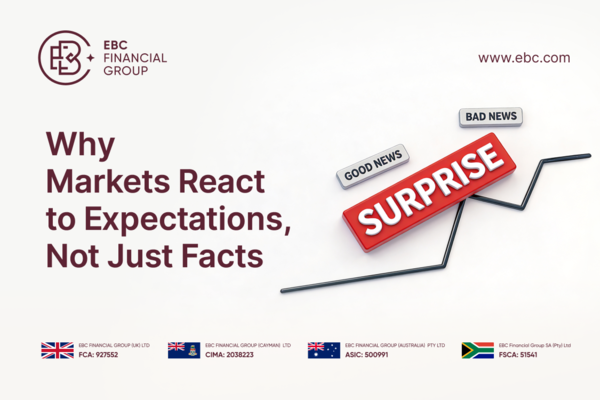
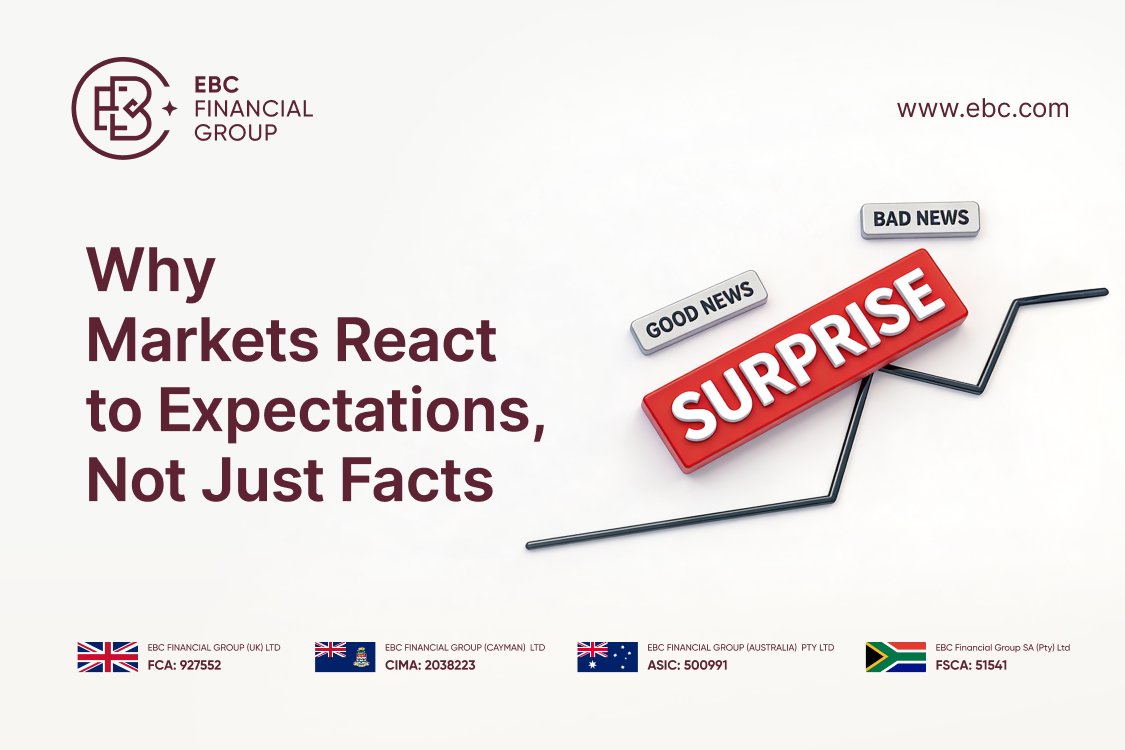
Facts on its own do not move markets. Rather, the market moves in anticipation of something, or when something unexpected happens. Prices change based on the difference between what actually happened and what people expected.
So instead of asking, “Is this news good or bad?” ask yourself: What did the market already expect, and what has changed now?
In trading, “the bar” simply means the market’s current expectation. Our Portuguese podcast helps you understand how experienced traders work out where that bar is, what counts as a real surprise, and why the obvious trade often fails.
Before an event, people make guesses backed by different assumptions. They place trades based on those guesses. When enough people do that, the price moves to reflect a shared expectation.
That means the price you see before the news is already a kind of group forecast.
When the real number, statement, or headline arrives, the market does a fast comparison:
Better than expected: price may rise.
As expected, price may vary very little.
Good, but not good enough: price might fall.
This is where many beginners get confused. You might see “good” news, but the market sees it as “not good enough compared to what was expected.”
Let’s use Gold versus the US dollar (XAUUSD) to illustrate and understand the three scenarios. Gold is useful because it is sensitive to changes in interest rates and the US dollar, thus moving quickly in reaction to those changes.
To make this practical, let’s look at three recent examples that show how the gap between expectations and reality drives market moves.
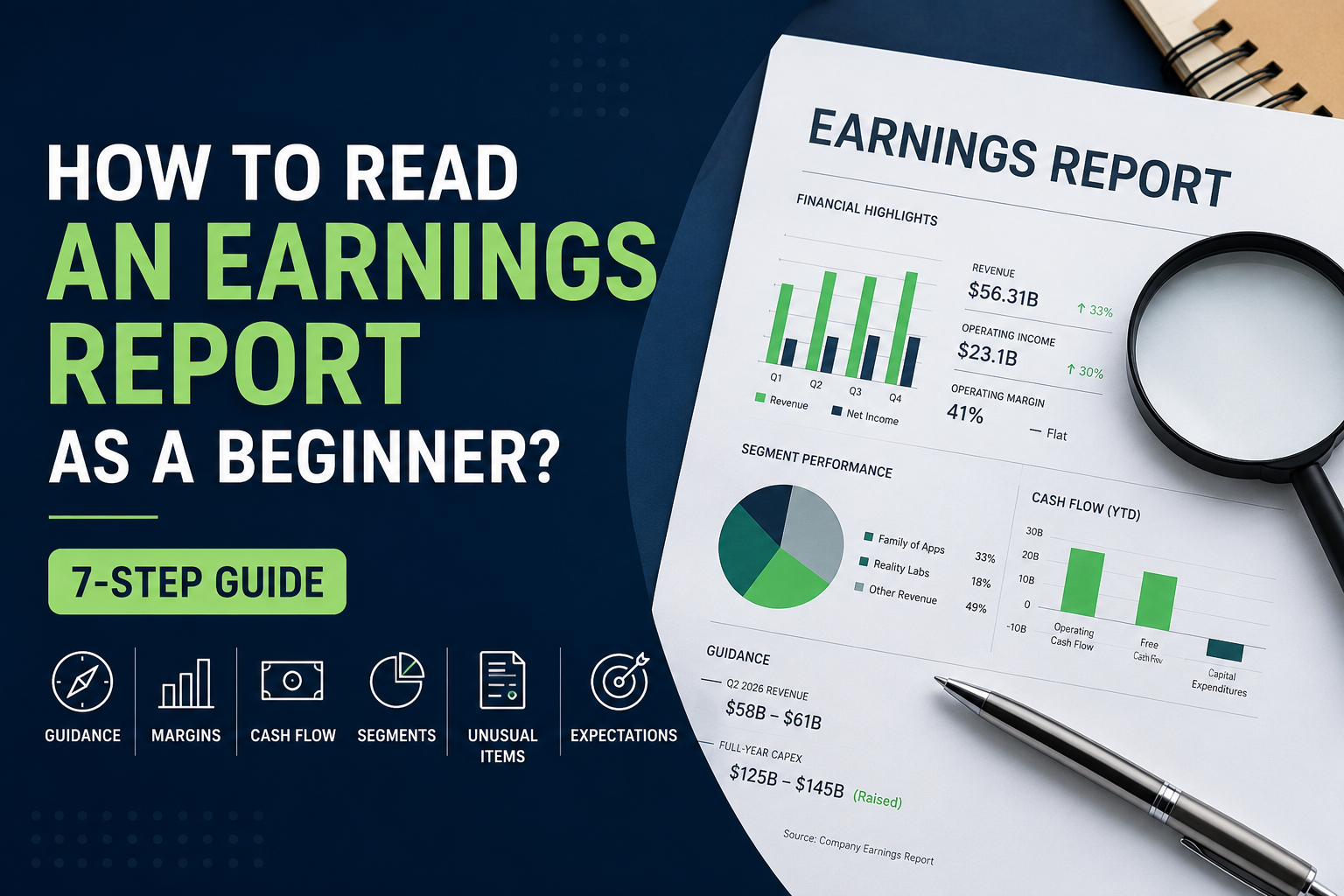
On 25 February 2026, NVIDIA published its fourth-quarter and full-year fiscal 2026 results. The numbers were impressive. Record quarterly revenue of $68.1 billion, and non-Generally Accepted Accounting Principles (GAAP) earnings per diluted share of $1.62.
After the results, NVIDIA’s share price jumped in after-hours trading, but the next day, it fell. The market did not reward the strong results as many expected. Many people explained this by saying investors were looking for something beyond growth. They began to focus on the costs of building AI ecosystems, rising competition, and what returns might look like if spending remains high.
This is the core expectations lesson from earnings season:
The market’s bar is not the same as the headline consensus.
The official forecast tells of the market’s aspirations. There is also an even higher standard set by market optimism and how people have positioned themselves before the event.
During times like this, beating expectations is not the end. It leads to new questions:
Did the company beat because demand is real and sustainable, or because the easy part of the cycle or trend is still playing out?
Is profit quality improving, or are costs and spending rising just as fast?
Is management guidance strong because it is confident, or because the market has already become too optimistic?
You do not have to be an equity expert to use this idea. Observe how the market reacts. More often than not when a major company beats expectations but its stock still drops, it usually means the market’s expectations have gone up and now it wants even more.
If you trade XAUUSD, you quickly learn something that feels unfair at first.
Gold prices can change a lot even if the economic data is only slightly different from expectations. This happens because gold often reacts to what people think will happen with interest rates in the future, not just the latest numbers.
A clear example was 12 February 2026. Gold fell hard, and the move accelerated after it broke below $5,000. Spot gold was down 2.8% at around $4,938 during the session.
The news was described as “strong US labour data” and “less hope of near-term rate cuts.” But for someone new to trading, the headline is not the most important part.
What matters most is the chain reaction that follows:
The data nudges expectations about the Fed.
That shifts interest rate pricing.
Yields and the US dollar respond.
Gold reacts because the opportunity cost changes.
Gold does not earn interest. So, when it looks like interest rates will stay high for a while, holding gold usually seems less appealing.
This is why many gold traders keep one eye on the US 10-year Treasury yield (10Y) as a quick scoreboard.
A second scoreboard is the “real yield”, which is a rough way of saying “yield after inflation”. You do not need to calculate it yourself. You can track the 10-year inflation-indexed yield here.
When yields rise and the US dollar strengthens, gold often struggles. When yields drop and the dollar weakens, gold usually gets a boost.
The point is not that gold always reacts the same way. The real lesson is that big economic events matter because they change what people expect will happen next.
Many believe that when geopolitical stress occurs, that’s the time to get into risk-off investments like gold.
Sometimes that rule works, but it can fail just when you are most sure it will hold.
A good example was 11 March 2026. The price of oil surged in reaction to the maritime attacks in the Strait of Hormuz. Gold dipped despite the clearly tense backdrop. The US dollar index (DXY) was even firmer.
That same day, the Bureau of Labor Statistics (BLS) published the February 2026 Consumer Price Index (CPI). CPI rose 0.3% month on month and 2.4% year on year. Both were broadly in line with expectations.
So why did gold not act like a typical “fear trade” this time?
Because the market also took into account both inflation and government policy.
When oil prices jump, traders worry that higher energy costs will lead to higher inflation, sustaining elevated interest rate. This can push yields and the US dollar up, making gold less attractive.
In other words, you can get two forces at once:
Some traders buy gold for safety when risk rises, which could push gold up.
But if the same headline also lifts oil and inflation worries, markets may expect higher interest rates. Higher rates and a firmer US dollar could hold gold down.
In this back-and-forth, policy concerns can sometimes outweigh market fears.
Look at three things during the first hour after the shock:
Oil direction and speed
US dollar direction
Yields direction
If oil jumps and both the dollar and yields go up too, the market is focused on inflation. If the dollar and yields drop while volatility rises, the market is more worried about fear and growth.
Ask yourself these three questions before trading based on a news story.
What was priced in?
Look at the last one to two weeks of price action.
Was the market already moving in anticipation? Did gold already rally into the event? Did a stock already surge into earnings? If the move already happened before the news, your “obvious trade” might be late.
What did the news change?
Not what did it “say”. What did it change?
Did it change the likely direction of rates? Did it change the growth outlook? Did it change the risk mood? Or was it just another data point that confirms what everyone already believed?
What is the next test?
Markets do not stop after one headline. They look ahead.
Ask: What is the next event the market will use to grade this new reality? Another inflation print, a jobs report, a central bank press conference, or the next bellwether earnings.
If you cannot answer these questions, you are not really trading the event—you are just reacting to it.
You do not need access to a trading desk to track expectations. Much of it is visible in everyday market data.
The rate path (yields)
Yields are like a live poll showing what the market expects next. When yields rise, financial conditions get tighter. When yields fall, things get easier.
A simple habit: when a big macro headline hits, look at the 10Y yield first.
The US dollar
The US dollar is often a quick way to check global market conditions. When the dollar strengthens, it can signal more stressful conditions and the opposite when it weakens.
This is important for gold because gold is priced in US dollars. If the dollar strengthens, it can push down gold prices, even if demand remains unchanged.
Volatility
Volatility is a measure of how much “protection” people are paying for.
A popular measure is the Cboe Volatility Index (VIX). You do not have to trade it—just watch to see if market stress is building before an event or easing afterwards.
Relative performance
This is a tool many people overlook.
Instead of watching one chart, compare two:
A bellwether stock versus its index during earnings week.
XAUUSD versus the US dollar.
Gold versus oil on geopolitical days.
Comparing how different assets move can often show what the market is really focused on.
If you want a simple routine, keep an eye on these:
The next major inflation release and the reaction in yields.
Jobs data, including revisions, not just the headline.
Central bank communication that shifts the expected timing of the next move.
US 10Y yield direction, especially sharp intraday moves.
US dollar trend: firming or easing.
Volatility into events: Is protection being bought ahead of the number?
Oil moves that change inflation expectations.
Equity reaction function during earnings: do rallies hold or fade?
Gold reaction function: is it trading fear, or yields and the dollar?
The next catalyst the market will grade.
You do not have to predict every headline correctly. The goal is to stop being caught off guard by how the market reacts.
See how traders frame expectations and catalysts in this EBC podcast episode: https://www.youtube.com/watch?v=5PuhR8E1kEE
Disclaimer & Citation
This material is for information only and does not constitute a recommendation or advice from EBC Financial Group and all its entities (“EBC”). Trading Forex and Contracts for Difference (CFDs) on margin carries a high level of risk and may not be suitable for all investors. Losses can exceed your deposits. Before trading, you should carefully consider your trading objectives, level of experience, and risk appetite, and consult an independent financial adviser if necessary. Statistics or past investment performance are not a guarantee of future performance. EBC is not liable for any damages arising from reliance on this information.