Published on: 2026-03-19
Updated on: 2026-03-20
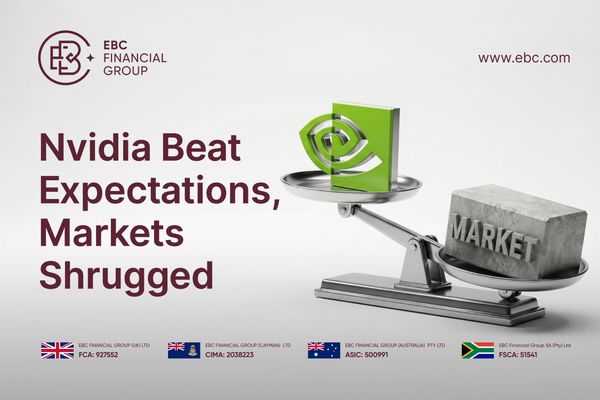
NVIDIA had another strong quarter, beating both revenue and earnings estimates and offering guidance above analysts' expectations for the next quarter. Still, the stock dropped in the next trading session, and other tech stocks also lost momentum. This wasn’t a contradiction. Instead, it showed that the market was distinguishing between strong results and those strong enough to surpass already high expectations.
This difference is especially important for NVIDIA. The company is no longer seen as just another semiconductor business. It is now a key player in the growth of artificial intelligence (AI), so investors are always thinking ahead, not just about the latest results. That is not to say that the numbers are not important. Rather, the bigger question is whether NVIDIA can consistently perform well enough to match the high hopes built into its stock price. That’s a tougher challenge than just beating estimates.
For the fourth quarter ended 25 January 2026, NVIDIA reported revenue of $68.1 billion, up 20% from the previous quarter and 73% from a year earlier. Data Centre revenue reached a record $62.3 billion, up 22% sequentially and 75% year-on-year. Full-year revenue rose to $215.9 billion, with Data Centre revenue at $193.7 billion. For a company already operating at an extraordinary scale, those are still very large growth numbers.
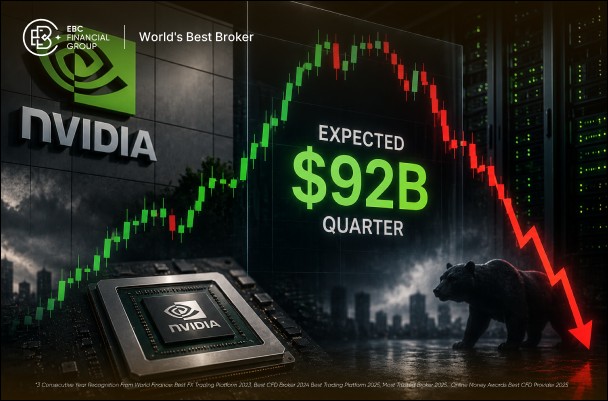
NVIDIA’s outlook was strong as well. The company expects first-quarter fiscal 2027 revenue to be around $78.0 billion, give or take 2%, and this forecast excludes any Data Centre compute revenue from China. NVIDIA also projected first-quarter gross margins of 74.9% on a GAAP basis and 75.0% on a non-GAAP basis. Since analysts had expected about $72.6 billion in revenue, this was a significant beat. Overall, there was little in the report that seemed disappointing.
This is why the stock’s reaction is so telling. If a weak report leads to a drop in share price, it’s easy to understand. But when a strong report is followed by a selloff, the market is sending a more subtle message. For NVIDIA, it wasn’t that the quarter was bad, but rather that the stock price already reflected even higher expectations. That’s a different kind of letdown.
Things change when a company becomes the leading example of a big trend. The official analyst consensus is no longer the only challenge. There’s also a second, albeit less obvious, hurdle made up of investor positioning, sentiment, and expectations. NVIDIA cleared the first hurdle but didn’t seem to clear the second. This gap might seem vague, but it’s important for stocks that many people own. A company can beat estimates and still not deliver the kind of surprise needed to boost sentiment and attract new investors.
This also explains why the market’s reaction seemed harsher than the numbers alone would suggest. For NVIDIA, simply beating expectations no longer changes the story. Investors now assume the company is strong. They want to see proof that NVIDIA’s business is expanding, that profits can stay high as things get more complicated, and that the next wave of AI spending will be as rewarding for shareholders as the first. The focus has shifted from proving there’s demand to proving that growth can continue to scale.
Earlier in the AI boom, the central question was whether there was real demand for accelerated computing. NVIDIA’s results have clearly shown that demand is both real and huge. Now, the tougher question is what kind of growth this will be as the industry matures. When a company shifts from selling parts to selling full systems and platforms, investors become more demanding. Revenue might keep rising quickly, but people are looking more closely at factors like profit margins, investment levels, and what it takes to stay ahead. In fiscal 2026, the company said its business model was transitioning from the Hopper HGX systems to the Blackwell full-scale data centre solutions. It also said the full-year gross margin fell to 71.1% on a GAAP basis from 75.0% a year earlier, partly due to that transition and partly due to a $4.5 billion charge tied to H20 excess inventory and purchase obligations. That does not diminish the business's strength. It does, however, show why the market is now watching margins and execution more carefully than before.
The same goes for capital expenditure (capex). NVIDIA said in its annual report that capex rose to $6.1 billion in fiscal 2026 from $3.4 billion in fiscal 2025, and that it expects capex to increase again in fiscal 2027. That is a perfectly logical pattern for a company building to very great demand, but it also changes how the market views the story. Once the investment bill rises, investors naturally become more interested in returns, durability, and cash-flow quality, not just in top-line expansion. The market is no longer asking whether NVIDIA is winning. It is asking what kind of business model victory looks like at an even larger scale.
Another reason the bar has risen is that the market now has more incentive to focus on concentration risk. NVIDIA’s annual report says sales to one direct customer accounted for 22% of total revenue in fiscal 2026, while another accounted for 14%, both primarily attributable to the Compute & Networking segment. That means more than a third of annual revenue came from just two direct customers. For a company growing this quickly, that is not necessarily a red flag in itself. However, it does make the market more sensitive to any shift in spending appetite among a small number of very large buyers.
Competition is another part of the picture. NVIDIA’s own filing says the market for its products is intensely competitive and likely to become even more so, with pressure from existing rivals, new entrants, custom-chip solutions, and large cloud companies designing internal hardware and software platforms. The company still has strong advantages in software, ecosystem depth, and scale, but that is exactly why competition matters at this point. When a stock is valued for sustained leadership, the market pays more attention to anything that could narrow that leadership, even at the margin.
The market’s reaction was clear. NVIDIA’s stock closed at $195.56 on February 25 and dropped to $184.89 on February 26, a fall of about 5.5%. During the same session, the Nasdaq Composite fell from 23,152.08 to 22,878.38, the S&P 500 slipped from 6,946.13 to 6,908.86, and the Philadelphia Semiconductor Index (SOX) dropped from 8,467.43 to 8,197.26. This wasn’t just a one-off dip for NVIDIA. The decline affected the whole AI and semiconductor sector.
That broad response matters because it suggests the market was reacting to more than a single earnings release. It looked more like a pause in a crowded theme, or at least a reminder that even the strongest company in the group may need to do more than post excellent numbers to keep the rally running at the same pace. NVIDIA’s quarter did not weaken the AI story. What seemed to weaken, at least temporarily, was the idea that every strong NVIDIA report must automatically lead to another leg higher in the stock and the surrounding sector.
GTC (GPU Technology Conference) 2026 in San Jose, running from 16 to 19 March, has become the next major checkpoint in NVIDIA’s story. With Jensen Huang’s keynote already delivered on 16 March, the focus has shifted from anticipation to what the event adds to the forward narrative. More than a routine company conference, GTC gives NVIDIA a platform to reinforce its product roadmap, AI infrastructure ambitions, and broader ecosystem lead. That matters because the latest earnings confirmed the business is still operating at a very high level, while the market reaction showed that strong results alone are no longer enough. What matters now is whether NVIDIA can keep extending its lead and turn that strength into durable growth.
NVIDIA didn’t fall short this quarter. It posted another set of strong numbers, gave guidance above expectations, and showed just how big the AI buildout has become. The quiet market reaction was about something else: the stock had already priced in a lot of optimism, and now investors want more than just another beat-and-raise. They want proof that NVIDIA’s scale, margins, customer base, competitive edge, and future returns can all keep up with its headline growth. That’s why the results were strong, but the reaction was muted. The standard has risen, and NVIDIA is now measured against that higher bar every time it reports.
Disclaimer
This material is for information only and does not constitute a recommendation or advice from EBC Financial Group and all its entities ("EBC"). Trading Forex and Contracts for Difference (CFDs) on margin carries a high level of risk and may not be suitable for all investors. Losses can exceed deposits. Before trading, carefully consider trading objectives, level of experience, and risk appetite, and consult an independent financial adviser if necessary. Statistics or past investment performance are not a guarantee of future performance. EBC is not liable for any damages arising from reliance on this information.