Published on: 2023-11-14
Updated on: 2026-05-06
Iran’s oil matters because it is never just an energy story. It is a reserve story, a sanctions story, a China story, and a Strait of Hormuz story all at once. Few producers combine such large underground resources with such restricted access to global markets. That makes Iranian crude unusually powerful: even when its exports are limited, its risks can still move prices.
Iran holds one of the world’s largest proven oil reserves. EIA data ranks the country as the world’s third-largest oil reserve holder in 2023, with Iran accounting for about 12% of global reserves and 24% of Middle East reserves.
Yet the market does not price reserves alone. It prices barrels that can be produced, financed, insured, shipped, and sold. That is where Iran’s oil becomes complicated. Sanctions have turned one of the world’s biggest resource holders into one of the market’s most important supply uncertainties.
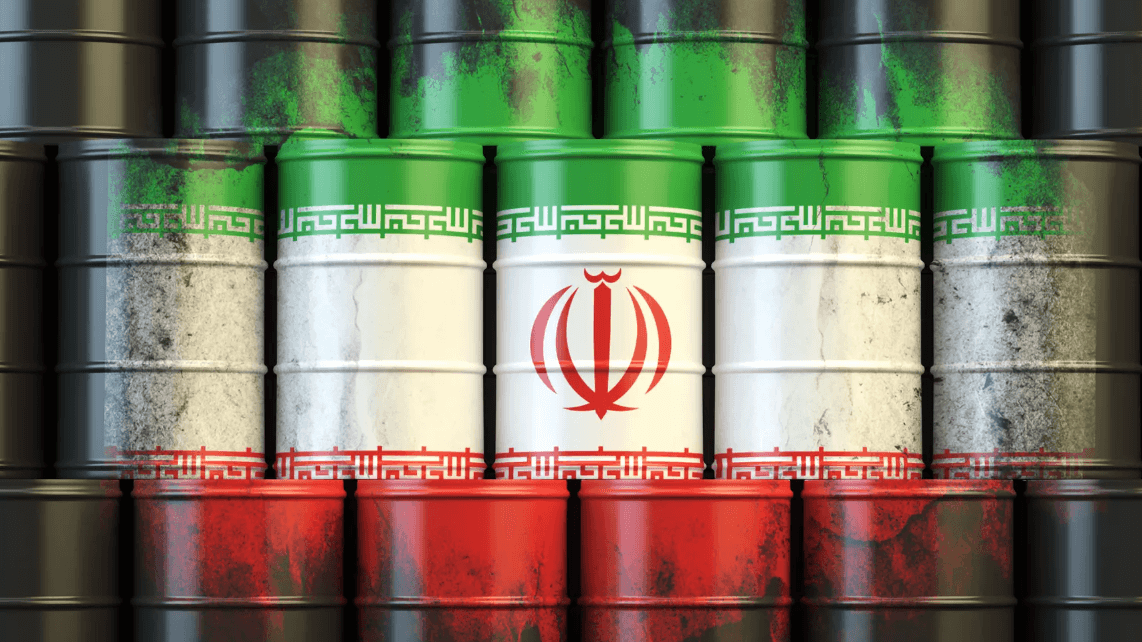
Iran controls one of the world’s largest oil reserves, but sanctions and underinvestment limit how much of that resource reaches the market.
Iranian crude production was about 3.06 million barrels per day in March 2026, down from 3.24 million barrels per day in February.
China dominates Iran’s oil trade, acquiring around 90% of Iran’s total oil exports, with independent “teapot” refiners playing a central role.
The Strait of Hormuz remains the main geopolitical amplifier, carrying around 20 million barrels per day of crude oil and oil products in 2025.
Iran’s oil affects global prices through three channels: actual exports, potential supply if sanctions ease, and risk premium when regional tensions rise.
Iran’s oil reserves are often described as the world’s fourth-largest, although current datasets can place the country third, depending on how reserves are counted. The exact ranking matters less than the market reality. Iran is a top-tier reserve holder with a production system operating below its full potential.
That gap between reserves and output is the heart of the Iran oil story. A country with deep reserves normally attracts capital, technology, field redevelopment, and long-term export contracts. Iran has struggled to access those benefits because sanctions restrict foreign investment, shipping services, insurance, banking, and energy technology.
EIA estimates Iran’s total petroleum and liquids production averaged about 4.0 million barrels per day in 2023, including almost 2.9 million barrels per day of crude oil. It also estimates that Iranian crude output could rise to about 3.8 million barrels per day within six months if oil sanctions were lifted. That potential matters because oil markets are forward-looking. Oil traders do not only price today’s barrels. They also price the possibility that restricted supply may return, or that existing supply may be disrupted.
Iran’s oil influence is greater than its export volume due to its geography. The Strait of Hormuz sits between Iran and Oman and links the Persian Gulf to the Gulf of Oman, the Arabian Sea, and Asian import markets. It is one of the world's most important energy chokepoints.
In 2025, nearly 20 million barrels per day of oil moved through the strait, including crude and refined products. The IEA estimates that about 25% of the world's seaborne oil trade transited Hormuz, with roughly 80% of those barrels heading to Asia.
This is why Iran can affect oil prices even when buyers are avoiding Iranian crude. A disruption near Hormuz not only threatens Iranian exports. It threatens barrels from Saudi Arabia, Iraq, Kuwait, Qatar, the UAE, and Bahrain. Saudi Arabia and the UAE have some pipeline routes that bypass the strait, but spare bypass capacity is limited. Most Gulf barrels still depend on safe tanker movement through the channel.
For oil traders, Hormuz is not a theoretical risk. It directly affects freight rates, insurance premiums, refinery planning, and Brent crude risk premiums. A headline involving Iran can therefore move prices before any physical barrel is lost.
Iran’s modern oil industry began in the early 20th century, when oil discoveries in the southwest turned the country into a major strategic prize. Foreign control over production and export rights made oil a central political issue long before today’s sanctions regime.
In 1951, Iran nationalised its oil industry under Prime Minister Mohammad Mosaddegh. The decision challenged British control through the Anglo-Iranian Oil Company and reshaped Iran’s relationship with Western powers. The 1953 coup that removed Mosaddegh left a political legacy that still shapes Iranian attitudes toward foreign pressure on energy policy.
Iran later became one of the founding members of OPEC in 1960, alongside Iraq, Kuwait, Saudi Arabia, and Venezuela. The purpose was clear: major producers wanted more control over pricing, output decisions, and resource sovereignty.
The 1979 Islamic Revolution again changed Iran’s energy relationship with the West. The Iran-Iraq War then damaged oil infrastructure through the 1980s. In later decades, sanctions linked to Iran’s nuclear programme restricted foreign investment, access to technology, financing, shipping, and insurance. These constraints still define how Iran’s oil reaches the market today.
Sanctions do not eliminate Iran’s oil exports. They change the way it moves.
Under normal conditions, crude oil exports rely on transparent buyers, banks, insurers, shipping companies, and port services. Iranian crude often moves through a less visible network involving intermediaries, ship-to-ship transfers, renamed cargoes, discounted pricing, and alternative payment structures. These channels keep some exports alive, but they reduce transparency and usually lower the price Iran receives.
The 2015 nuclear agreement temporarily improved Iran’s access to global oil markets. That changed after the U.S. withdrew from the agreement in 2018 and reimposed sanctions on Iranian oil. Since then, Iranian exports have depended heavily on buyers willing to manage sanctions risk.
Sanctions pressure has intensified against China-linked refining and shipping networks. OFAC has warned financial institutions about independent Chinese refineries, often called teapot refineries, because of their role in importing and refining Iranian crude. The result is a market where Iran can still sell oil, but not on the same terms as unrestricted producers.
China is now the core buyer in Iran’s oil export system. OFAC states that China acquires around 90% of Iran’s total oil exports, with teapot refineries buying most of those barrels. These refiners are concentrated mainly in Shandong Province and often seek discounted crude to protect margins.
For China, Iranian crude offers cost advantages and supply diversification. For Iran, China provides the largest practical outlet for exports under sanctions. This relationship is useful for both sides, but it is not risk-free. Refiners, shipping companies, port operators, and financial institutions can all face sanctions exposure if enforcement tightens.
This is the key update the old article missed. The issue is not that “no country dares to buy” Iranian oil. The issue is that the buyer base has narrowed sharply, and China has become the dominant channel. That makes Iran’s oil trade more concentrated, more opaque, and more sensitive to enforcement action.
Iran’s main oil-producing regions are concentrated in the southwest, especially Khuzestan and the West Karun area near the Iraqi border. Major fields include Ahvaz, Marun, Gachsaran, Aghajari, Azadegan, Yadavaran, and Yaran.
Many of these fields are mature. That means production depends on reinjection, redevelopment, drilling, and enhanced recovery techniques. Sanctions make this harder by limiting access to foreign capital and advanced technology. Domestic companies can support some projects, but they cannot fully replace the scale and technical depth of global energy firms.
Iran has also tried to reduce its reliance on traditional Gulf export routes. The Jask terminal and Goureh-Jask pipeline were designed to move oil east of the Strait of Hormuz. The project has strategic value, but its practical impact remains limited. EIA notes that although the pipeline has a nameplate capacity of 1.0 million barrels per day, it could transport only about 300,000 barrels per day as of mid-2024 and had not become a regular crude export route.
That means Kharg Island and Gulf shipping routes remain central to Iran’s oil system. Jask may reduce vulnerability over time, but it has not yet changed the core market equation.
Iran’s oil affects prices in three ways.
First, actual supply matters. If Iranian exports rise, more discounted crude enters the market, potentially pressuring competing grades. If exports fall because of sanctions enforcement or shipping problems, buyers must replace those barrels elsewhere.
Second, potential supply matters. If sanctions ease, Iran could raise output toward full capacity. That possibility can cap prices during diplomatic openings because traders anticipate future supply.
Third, risk premium matters. When tensions rise around Iran or the Hormuz Strait, oil prices can climb even before supply is physically disrupted. The market prices uncertainty quickly because a serious disruption could affect far more than just Iranian crude.
This is why Iran’s oil remains central to global energy analysis. Its reserves create long-term supply potential. Its sanctions create short-term trade distortions. Its geography creates an immediate risk premium. Together, they make Iran one of the most important swing factors in oil market psychology.
Iran’s oil is important because the country holds one of the world’s largest oil reserves and sits at the mouth of the Strait of Hormuz. Even when sanctions limit exports, Iran can influence prices through supply risk, shipping disruption, and the possibility that restricted barrels may return to the market.
Iran ranks among the world’s largest oil reserve holders. Current EIA data places Iran near the top globally, with about 12% of the world’s proven oil reserves and roughly 24% of Middle East reserves.
China is the dominant buyer of Iranian oil. Independent Chinese refiners, often called teapot refineries, purchase much of the crude because sanctions force Iran to sell through narrower and more discounted channels.
Iranian crude usually carries a discount because buyers face sanctions risk, shipping complexity, insurance limits, and payment challenges. The discount compensates buyers for the legal, logistical, and reputational exposure they face.
Yes. Iran has the reserve base and field potential to increase oil production. The constraint is not geology. It is sanctions, underinvestment, ageing fields, and limited access to foreign capital and technology.
Iran’s oil is powerful because it sits at the intersection of reserves, sanctions, China's demand, and Hormuz risk. The country has enough oil to matter for decades, but its market role depends on access, not just geology.
For readers and investors, the main lesson is clear. Iran’s oil cannot be understood only by looking at production figures. It must be read through trade routes, sanctions enforcement, buyer concentration, and geopolitical risk premium. As long as those forces remain in place, Iranian crude will continue to shape global oil markets well beyond the barrels it officially exports.
Disclaimer: This material is for general information purposes only and is not intended as (and should not be considered to be) financial, investment or other advice on which reliance should be placed. No opinion given in the material constitutes a recommendation by EBC or the author that any particular investment, security, transaction or investment strategy is suitable for any specific person.