Published on: 2026-07-14
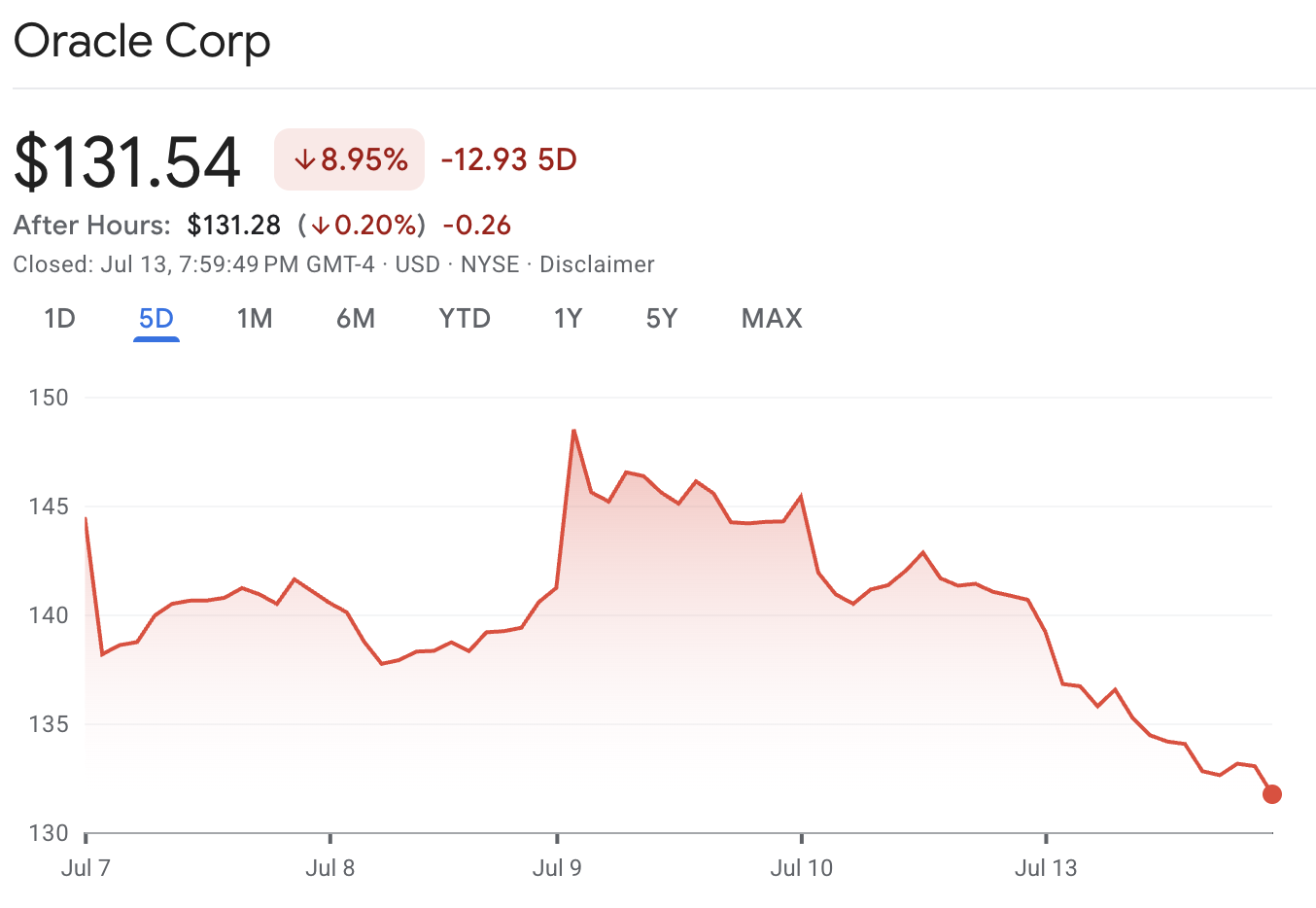
Oracle stock is falling because investors are focused less on its $638 billion AI backlog and more on the cash, debt and execution risk needed to deliver it. The company closed fiscal 2026 with that backlog up 363% in a year, yet the shares fell 6.47% to $131.54 on July 13, their weakest level in twelve months and about 28% below a month earlier.
A record order book landed alongside a $23.7 billion free cash flow deficit and an S&P downgrade to BBB-, pushing the market to reprice the stock around one question: who funds the buildout.

The $638 billion backlog grew 363% in a year, yet Oracle’s market value has slipped below the size of its own order book, an unusual signal for a profitable company.
Capital spending reached $55.7 billion, about 83% of revenue, turning record operating cash flow into a $23.7 billion free cash flow deficit.
Reports estimate OpenAI accounts for close to half the backlog, via a reported five-year, roughly $300 billion contract that does not begin until 2027.
S&P’s cut to BBB- moved Oracle one notch above junk and turned a growth story into a credit story.
Judged on the income statement, Oracle’s fourth quarter earnings was a standout. Revenue rose 21% to $19.2 billion, total cloud revenue climbed 47% to $9.9 billion, and Oracle Cloud Infrastructure, the division that rents out AI compute, grew 93% to $5.8 billion. Management raised fiscal 2027 guidance to about $90 billion in revenue and $8.05 in non-GAAP earnings per share.
Below the operating line the picture inverts. Capital expenditure hit $55.7 billion, up 162% and equal to roughly 83 cents of every revenue dollar, a build rate more typical of a utility than a software vendor. Record operating cash flow of $32.0 billion fell far short of covering it, leaving free cash flow at negative $23.7 billion.
| Metric | Value |
|---|---|
| July 13 close | $131.54, down 6.47% (one-year low) |
| One-month move | About -28% |
| Q4 FY2026 revenue | $19.2 billion, up 21% YoY |
| Q4 OCI revenue | $5.8 billion, up 93% YoY |
| RPO / backlog | $638 billion, up 363% YoY |
| FY2026 capex | $55.7 billion, up 162% |
| FY2026 free cash flow | Negative $23.7 billion |
| Credit rating | BBB- (S&P, July 9, 2026) |
| Reported OpenAI contract | About $300 billion over five years |
The decline built over weeks, not one session. S&P Global cut Oracle from BBB to BBB- on July 9, its last investment-grade rung, warning that the capital-heavy pivot into AI leaves the company with less financial flexibility than Microsoft, Amazon or Alphabet.
Reports on the note cite a projected fiscal 2027 cash flow deficit near $42 billion and capex of $90 billion to $95 billion, up from the $60 billion S&P modeled a year earlier. Sentiment was already fragile by July 13, when Apple’s lawsuit against OpenAI added another headline around the customer behind Oracle’s largest reported AI commitment.
A pre-scheduled insider sale drew notice too: Vice Chairman Jeff Henley sold 400,000 shares in late June at $155.50 to $165.57 under a Rule 10b5-1 plan tied to expiring options, a scheduled trade rather than a fresh market call.
Remaining performance obligations, or RPO, count revenue Oracle has signed but not yet recognized. About $75 billion is prepaid or covered by GPUs customers bought and supplied, trimming the capital Oracle must front.
The rest converts into recognized revenue as Oracle delivers the contracted capacity, while the timing of actual cash depends on prepayments and billing terms. The heaviest obligation belongs to OpenAI, though Oracle does not disclose the customer split.
The Wall Street Journal reported a five-year deal worth roughly $300 billion starting in 2027, close to 47% of the backlog and about $60 billion a year once live.
That annual figure alone tops OpenAI’s entire business, which Reuters put at a $25 billion revenue run-rate in early 2026 while still lossmaking, and whose spending is underwritten by investors such as SoftBank, Nvidia and Amazon that also profit from the AI buildout.
Because the contract does not start until Oracle’s fiscal 2028, almost none of that $300 billion sits inside the $90 billion guide the market is pricing today.
Oracle raised $43 billion of debt and $5 billion of equity in fiscal 2026 and expects about $40 billion more this year, led by a $20 billion at-the-market share sale, while ruling out new debt in calendar 2026. Total debt sits near $167 billion, and total liabilities have swelled about 48% to $218.7 billion.
Funding through equity avoids more leverage, but steady share issuance dilutes per-share earnings that must already absorb heavy GPU depreciation. For a company long valued on software-license durability, the swing factors now are capex discipline, funding cost and customer credit.
The demand itself is not in question. Oracle said its GPU fleet ran at 97.5% utilization, and OCI’s 93% growth shows it winning AI workloads from larger cloud rivals. Guidance implies first-quarter cloud growth of 58% to 64%, and analysts show an average analyst target of $251.85, with 37 buys against 5 holds and one sell, though those targets are not guaranteed.
The bear case rests on arithmetic and timing rather than doubt about AI. A BBB- rating lifts borrowing costs just as Oracle leans hardest on outside capital, and equity raises dilute existing holders.
Construction, power and GPU supply can slip just as revenue is meant to begin, and a cash overrun would force more financing. Tying nearly half the backlog to one unprofitable customer leaves Oracle exposed to a counterparty it does not control.
The next few quarters will settle the funding question. First-quarter fiscal 2027 cloud growth against the 58% to 64% guide is the cleanest read on demand, with RPO conversion showing how fast the backlog becomes billed revenue.
Free cash flow stays the key proof point, and fresh debt or equity issuance shows how much funding remains. OpenAI's revenue and fundraising carry the most weight, given its slice of the order book.
The beat was on revenue, not cash. A $638 billion backlog was offset by negative $23.7 billion free cash flow, capex near 83% of revenue, an S&P downgrade to BBB-, and heavy reliance on OpenAI for future contracted revenue.
Reports estimate roughly half. The Wall Street Journal cited a five-year contract worth about $300 billion from 2027, near 47% of the $638 billion RPO, though Oracle does not disclose the exact customer split.
S&P pointed to structural risk from the capital-intensive AI buildout, rising leverage, and dependence on OpenAI. BBB- sits one notch above speculative, or junk, grade.
September’s fiscal first-quarter report is the next real read, letting investors measure OCI growth against the 58% to 64% guide and check whether the cash deficit narrows. The pace of the $20 billion equity sale and OpenAI’s revenue and fundraising will show whether the $300 billion commitment stays credible before it begins in 2027.
Until free cash flow turns, Oracle trades as a wager that the largest backlog in enterprise software can be financed faster than the buildout burns cash.