Published on: 2026-06-22
Updated on: 2026-07-01
The Relative Strength Index (RSI) is a tool traders use to measure how strong and fast recent price changes have been. RSI ranges from 0 to 100. Traders look at it to see if a market is picking up speed, slowing down, or has moved too far in one direction.
Think of RSI like a speedometer for prices. It shows if prices have been going up or down too fast. Traders often use RSI to spot when a market might be overbought or oversold, but it is not a sure sign to buy or sell.
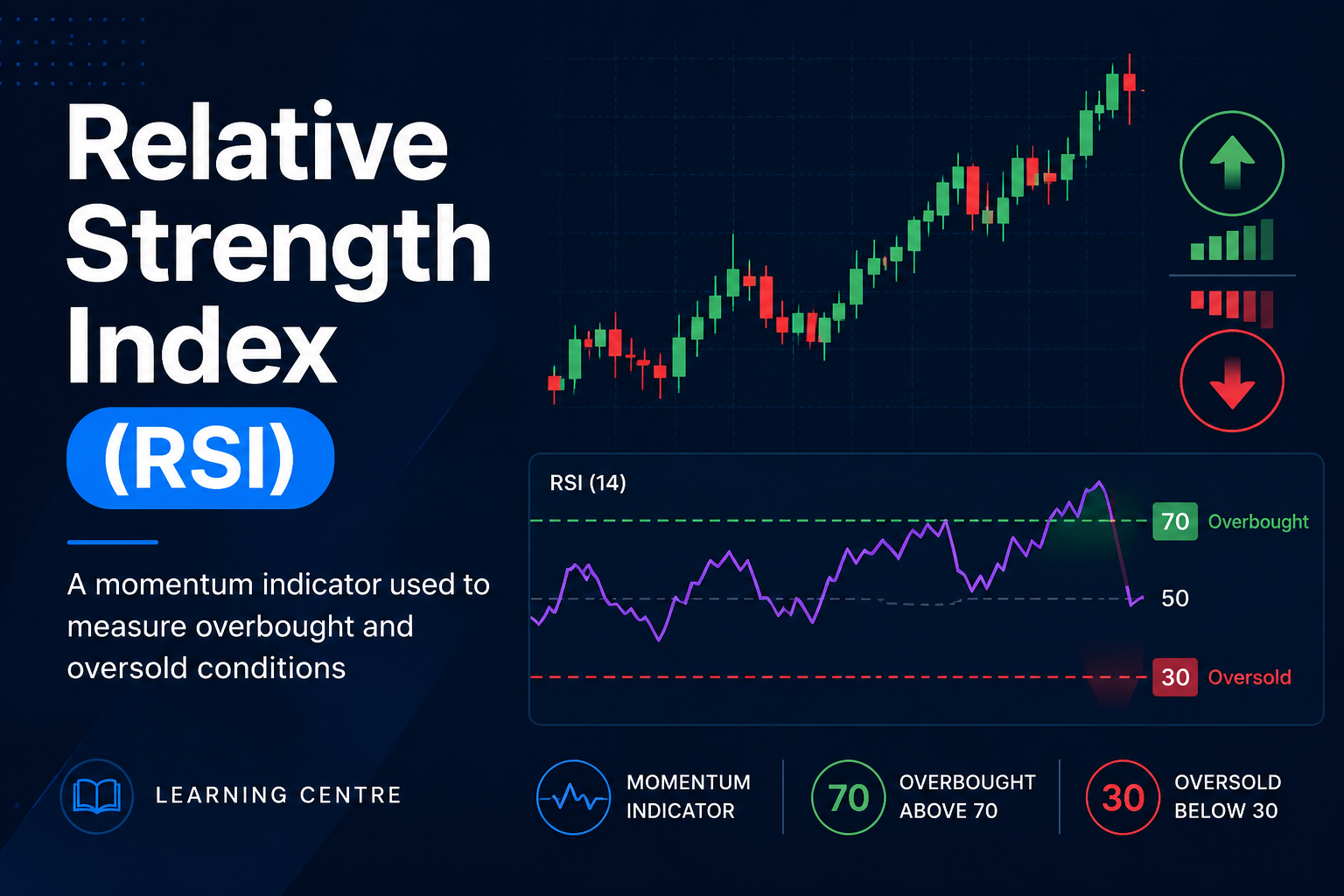
RSI compares recent price gains with recent price losses over a selected period.
The most common setting is 14 periods. On a daily chart, this means RSI looks at the last 14 trading days. On an hourly chart, it looks at the last 14 hours.
Most traders do not work out RSI by hand since trading platforms show it for you. What matters most is understanding how to read it.
When RSI rises, it often indicates buyers are gaining strength. When RSI goes down, it usually means sellers are taking over.
RSI is usually read using three main zones:
Above 70: The market may be overbought.
Below 30: The market may be oversold.
Around 50: Momentum may be more balanced.
When RSI is above 70, it means the price has risen strongly recently. When RSI is below 30, it means the price has fallen strongly.
However, these levels are just warnings. Overbought does not mean the price will drop right away, and oversold does not mean it will jump up immediately.
An overbought RSI reading usually happens when RSI rises above 70. This suggests that buying momentum has been strong. The market may be stretched, especially if the price has moved up quickly.
But, overbought does not always mean the market will turn down. In a strong uptrend, RSI can stay above 70 for a while if buyers keep pushing prices higher.
A better way to look at overbought RSI is to see it as a sign of strong upward momentum, but also a hint to watch for signs that the move might be slowing down.
An oversold RSI reading usually happens when the RSI falls below 30. This suggests that selling momentum has been strong. The market may be stretched after a sharp fall.
But oversold does not always mean the market will go up. In a strong downtrend, RSI can stay below 30 as sellers keep control.
A better way to read oversold RSI is to see it as a sign of strong downward momentum, but it is wise to wait for more proof before expecting a bounce.
Divergence happens when price and RSI move in different directions. A bearish divergence may appear when the price makes a higher high while the RSI makes a lower high. This can suggest that buying momentum is weakening.
A bullish divergence may appear when the price makes a lower low while the RSI makes a higher low. This can suggest that selling momentum is weakening.
Divergence does not guarantee a reversal, but it can alert traders that the current trend might be weakening and identify possible overbought or oversold conditions.
RSI can help traders avoid entering too late after a strong move. For example, if the price has already risen sharply and the RSI is above 70, a trader may wait for a better setup rather than buying on emotion.
RSI can also help traders watch for weakening momentum through divergence. However, RSI works best when combined with other tools, such as trend direction, support and resistance, price action, moving averages, and risk management.
A common mistake is thinking RSI above 70 always means sell. Another mistake is thinking RSI below 30 always means buy.
RSI does not always work like that. Markets can stay overbought or oversold much longer than most beginners think, especially when trends are strong.
Another mistake is relying only on RSI. It should be part of your trading plan, not the whole plan.
Beginners should also check the timeframe. RSI on a short-term chart may show a different signal from RSI on a daily chart.
Momentum Indicator: A tool that helps traders measure the strength or speed of price movement.
Indicator: A chart-based tool that uses market data to help traders analyse price behaviour.
Technical Analysis:The study of charts, patterns, and indicators to understand market movement.
Divergence: A signal that appears when the price and an indicator move in different directions.
Trend: The general direction of price movement in a market.
Resistance Level: A price area where selling pressure may appear.
RSI stands for Relative Strength Index. It is a technical indicator that measures recent price momentum and helps traders identify whether a market may be overbought, oversold, or losing strength.
No. An RSI above 70 means the price has risen strongly, but it does not guarantee a reversal. In a strong uptrend, RSI can stay overbought for a long time. Traders should wait for confirmation.
No. An RSI below 30 means the price has fallen strongly, but it does not guarantee a rebound. In a strong downtrend, the RSI can remain oversold even as selling pressure continues.
RSI divergence happens when price and RSI move in opposite directions. It may suggest that momentum is weakening, but it should be confirmed with trend, price action, and risk management.
The Relative Strength Index, or RSI, is a momentum indicator that helps traders measure the strength and speed of recent price movements. It is often used to identify overbought and oversold conditions.
For beginner traders, RSI is useful because it shows when a price move may be stretched. However, RSI should not be used as a simple buy or sell button. It works best when combined with trend analysis, price action, and risk management.



World's Best Broker