Published on: 2026-03-10
Updated on: 2026-03-10
ORCL reports fiscal third-quarter 2026 results after the U.S. market closes on Tuesday, March 10, 2026, with management scheduled to host its earnings call at 4:00 p.m. Central Time.

Ahead of the release, ORCL stock last traded at $151.56 on March 9, leaving it deep in correction territory and putting unusual weight on tonight's numbers, guidance, and commentary on AI infrastructure spending.
That price tells an important story. Oracle stock is down about 22% in 2026 so far, and it is roughly 54% below its September 10, 2025, closing peak of $326.90. The market is no longer rewarding Oracle for AI excitement alone as investors now want proof that cloud demand, backlog growth, and heavy spending can translate into durable returns.
| Metric | Current setup |
|---|---|
| Revenue | About $16.9 billion expected |
| Adjusted EPS | About $1.70 to $1.71 expected |
| Last reported cloud revenue | $8.0 billion, up 34% |
| Last reported OCI revenue | $4.1 billion, up 68% |
| Last reported RPO | $523 billion, up 438% |
| 2026 funding plan | $45 billion to $50 billion |
Wall Street is looking for roughly $16.9 billion in revenue and about $1.70 to $1.71 in adjusted EPS. On the surface, that would imply a sharp improvement from the year-ago quarter, when ORCL reported $14.1 billion in revenue and $1.47 in non-GAAP EPS.
Tonight's report is especially significant. ORCL's second-quarter results demonstrated strong cloud growth, with $8.0 billion in cloud revenue, $4.1 billion in cloud infrastructure revenue, and $523 billion in remaining performance obligations. However, the quarter also highlighted the increasing capital demands of AI expansion.
Additionally, Oracle plans to raise between $45 billion and $50 billion in gross cash proceeds by 2026 to support the expansion of OCI. This funding strategy shifted the market's focus from growth alone to the quality of that growth.
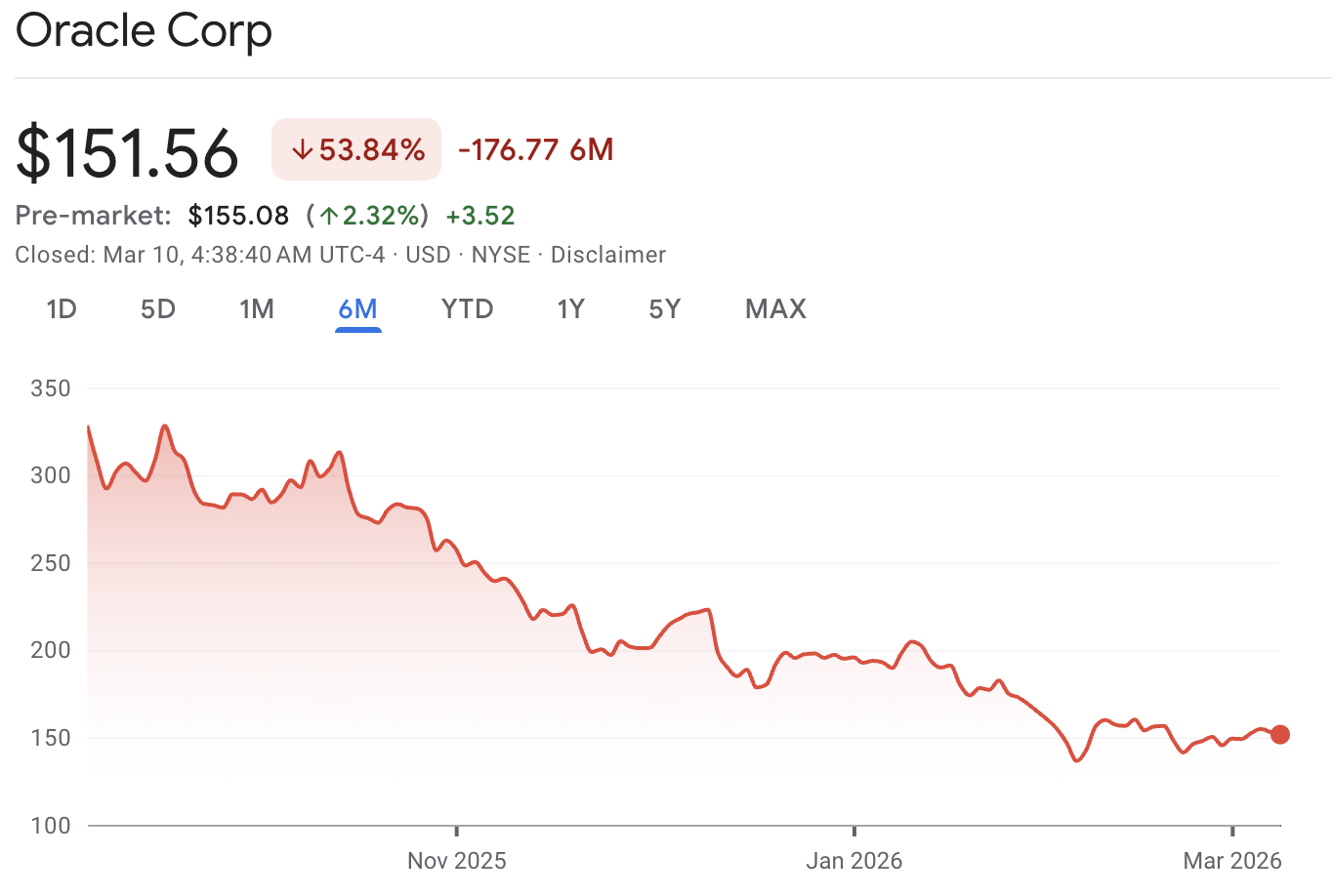
Before analyzing potential impacts on the stock, it's helpful to review Oracle's stock performance leading up to the report.
Over the last week, Oracle shares rose about 1.5%, from $149.25 on March 2 to $151.56 on March 9. That sounds calm, but the trading range was not calm.
The stock traded between the low $140s and the high $150s, suggesting traders are already pricing in volatility.
Over the last month, the stock fell 3.2%, from $156.59 on February 9 to $151.56 on March 9. The path was uneven.
Oracle dropped to $136.48 on February 5, then rebounded above $160 a week later. This suggests sentiment remains fragile and headline-driven.
The six-month view is much harsher. As of its closing high of $326.90 on September 10, 2025, Oracle's stock dropped by approximately 53.6%.
That decline has come even as cloud growth remained strong. The market is now more concerned about spending, financing, and execution risk than raw demand alone.
Oracle's cloud story has been impressive on paper. In fiscal Q1, total cloud revenue rose to $7.2 billion, up 28%, while cloud infrastructure revenue reached $3.3 billion, up 55%.
In fiscal Q2, total cloud revenue reached $8.0 billion, increasing by 34%, while OCI amounted to $4.1 billion, reflecting a 68% rise.
Thus, if Oracle shows another quarter of very strong OCI growth, the market may view recent weakness as overdone.
If cloud growth slows meaningfully, investors could question whether the AI build-out is arriving faster than the revenue payoff.
The jump in remaining performance obligations to $523 billion in Q2 was one of the most striking numbers ORCL has printed in years. It signaled that the company was signing commitments at a pace far beyond reported revenue.
That backlog is crucial because it gives the market a view of future revenue already under contract. If Oracle posts another strong increase in RPO, it would support the idea that enterprise and AI demand are still converting into real signed business.
If backlog growth slows, traders may assume the market has already priced in too much future growth.
ORCL's February financing announcement made this unavoidable.
Management expects to raise $45 billion to $50 billion in 2026 through a combination of debt and equity. This funding will enable OCI to expand and fulfill commitments to customers, including AMD, Meta, NVIDIA, OpenAI, TikTok, xAI, and others.
That statement helped confirm demand but also signaled to the market how expensive the next phase will be. While strong revenue and OCI growth can help, they may not fully alleviate concerns if capital expenditures continue to grow faster than monetization efforts.
Thus, even if Oracle beats on revenue, ORCL could still struggle if spending looks too aggressive or free cash flow looks worse than the market expected
Guidance could decide the direction of the move, as Oracle previously guided for fiscal Q3 revenue growth of 16% to 18% in constant currency, with non-GAAP EPS growth of 12% to 14% in constant currency. That means today's report is also a test of credibility. Did Oracle deliver what it said it would deliver?
Just as important, traders will want to hear what comes next. If management sounds confident about Q4 growth, cloud capacity, and margin control, ORCL could get relief.
If guidance disappoints, ORCL stock may stay under pressure even after a decent quarter.
The options market is signaling a big post-earnings move for Oracle stock. Based on the March 13 weekly options chain, with ORCL closing at $151.54 on March 9, the at-the-money straddle around the $150 to $152.50 strikes implies a move of roughly 11% to 12% by the end of this week.
Based on the listed premiums, the expected trading range after Oracle's earnings is $134.70 to $168.40.
Additionally, the open interest indicates where traders are most active. On the call side, notable open interest can be found at the $160, $165, $170, and $180 strike prices. On the put side, significant activity is observed at the $140 and $150 strike prices.
Oracle said it will release fiscal Q3 2026 results after the market closes on Tuesday, March 10, 2026, and hold its earnings call at 4:00 p.m. Central Time.
Analysts are looking for roughly $16.9 billion in revenue and about $1.70 to $1.71 in adjusted EPS.
Yes. That can happen if Oracle beats on EPS but disappoints on cloud growth, backlog, free cash flow, or guidance. In the current setup, investors seek evidence that AI demand yields strong, scalable returns.
Not in a classic short-term sense. On March 9, Oracle's daily RSI was approximately 49.37, indicating neutral momentum.
In conclusion, Oracle's earnings report arrives at a critical moment for the stock. The market already knows demand is strong. What it still wants to know is whether that demand can keep driving cloud growth without
putting too much pressure on cash flow, margins, and the balance sheet.
That is why today's most important numbers are likely to be OCI growth, RPO, spending discipline, and forward guidance.
If Oracle delivers strength across those areas, ORCL could finally catch a bid. If not, the stock may remain trapped in a market that demands stronger evidence and fewer promises.
Disclaimer: This material is for general information purposes only and is not intended as (and should not be considered to be) financial, investment or other advice on which reliance should be placed. No opinion given in the material constitutes a recommendation by EBC or the author that any particular investment, security, transaction or investment strategy is suitable for any specific person.