Published on: 2026-07-13
CFD vs futures is mainly a choice between flexibility and standardisation. CFDs are easier to size, usually have no fixed expiry and can suit smaller short-term positions. Futures trade on exchanges, use fixed contract sizes and expire on set dates. They may offer efficient pricing and deep liquidity, but the minimum position can be larger than a trader needs.
Options and stocks offer two further choices. Options can limit a buyer’s loss to the premium and support strategies based on price, time or volatility. Stocks require more cash when bought outright, but they provide ownership in a company or fund. The right instrument depends on position size, holding period, trading costs and acceptable risk.
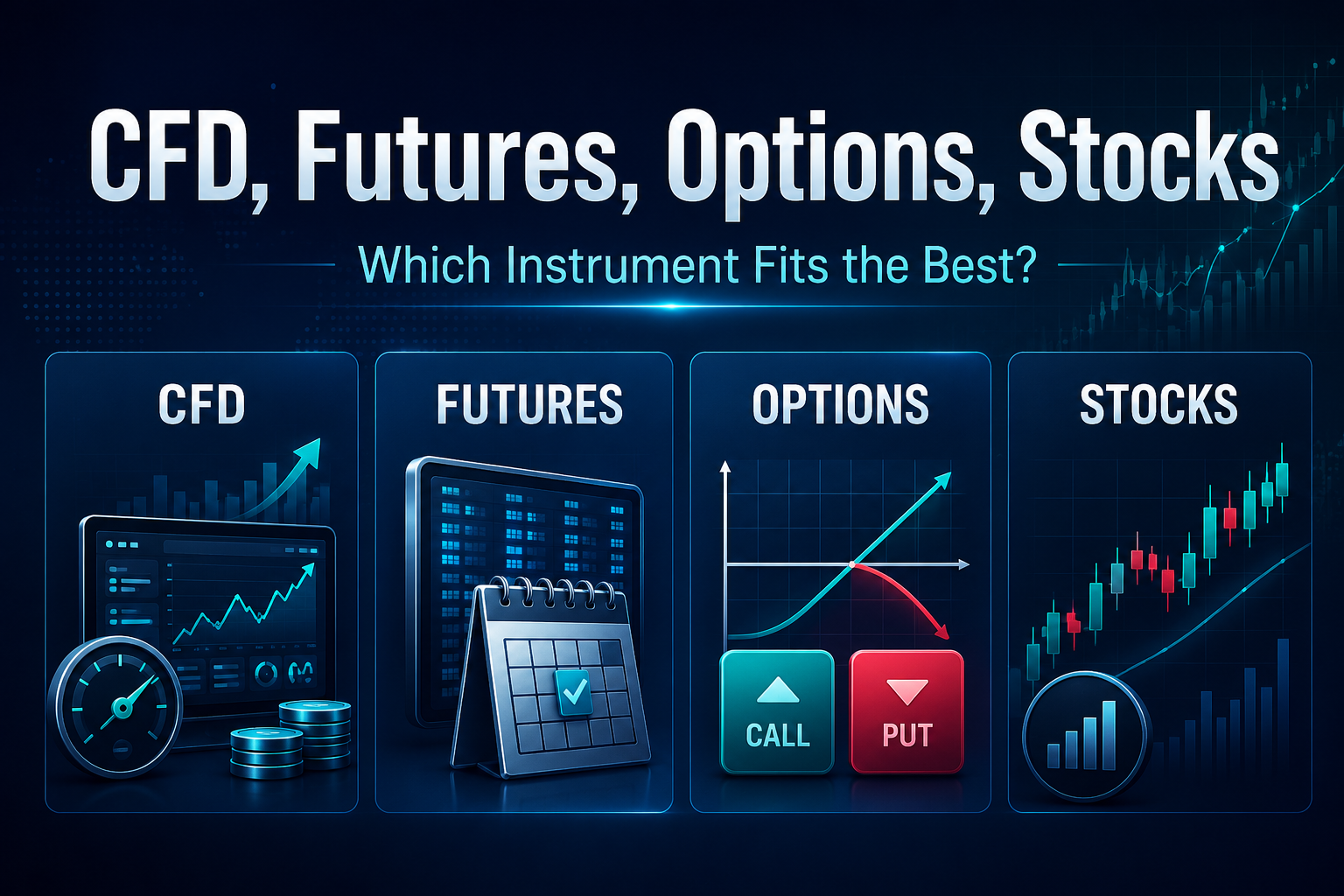
CFDs are easier to size, usually have no expiry and allow smaller long or short positions.
Futures are standardised, exchange-traded contracts with fixed sizes and expiry dates.
Options give buyers the right to buy or sell at a set price, but their value also depends on time and volatility.
Stocks provide direct ownership and have no contractual expiry, although buying them outright usually requires more cash.
Costs change over time. CFD financing, futures rollover and option time decay become more important on longer trades.
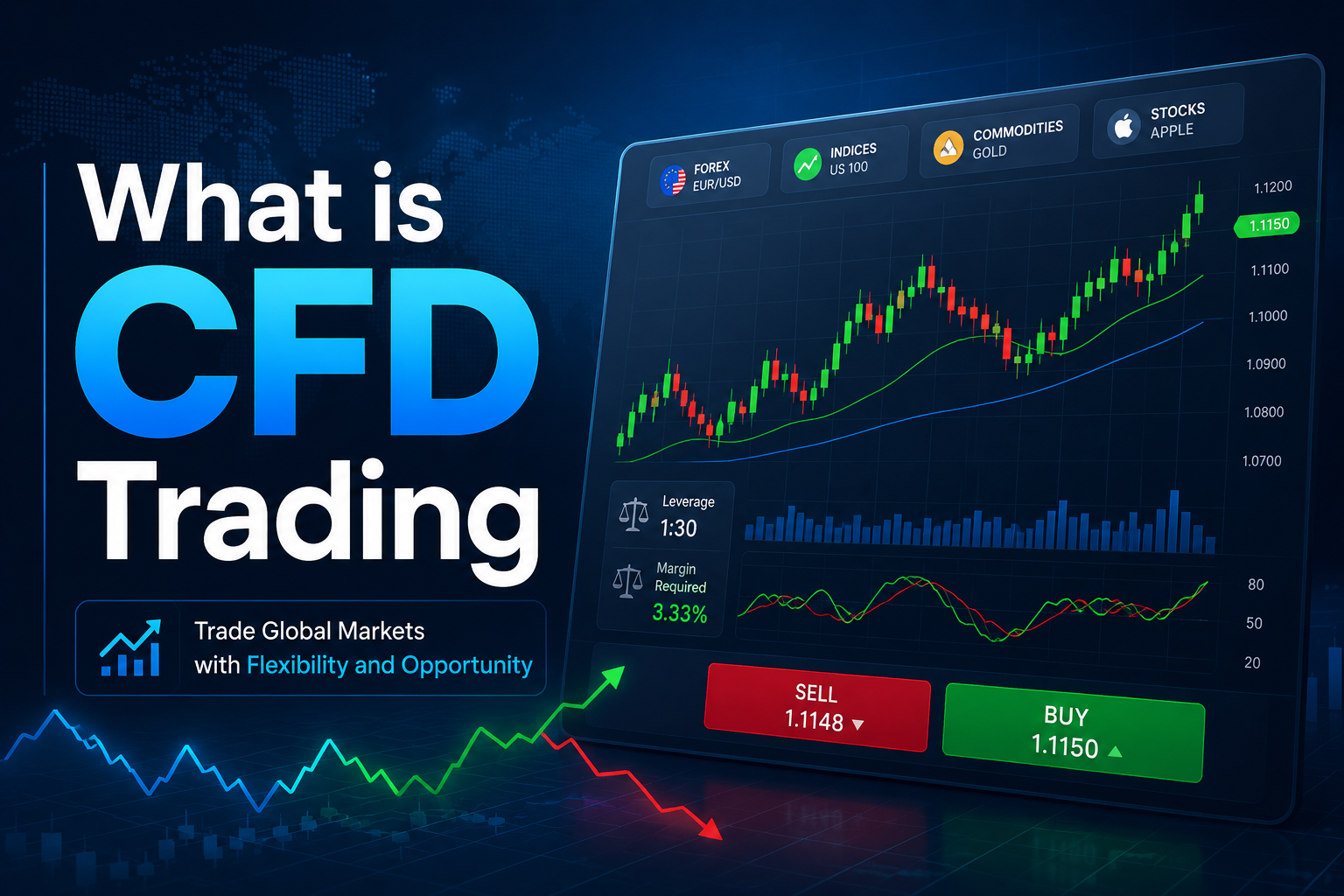
CFD trading involves an agreement to exchange the difference between an asset’s opening and closing prices. Traders can speculate on rising or falling markets without owning the underlying shares, index, commodity or currency.
CFDs usually allow flexible position sizes and require only a portion of the trade’s value as margin. Most spot CFDs have no fixed expiry, although financing charges may apply when positions remain open overnight.
Futures trading involves buying or selling a standardised contract linked to an underlying market. Each contract has a fixed size, expiry date and settlement method set by the exchange.
Futures are commonly used for speculation and hedging. They can provide efficient access to major markets, but traders cannot freely adjust contract size as they can with many CFDs.
| Feature | CFDs | Futures | Options | Stocks |
|---|---|---|---|---|
| Ownership | No ownership | Contract exposure | Right, not obligation | Company or fund ownership |
| Trading venue | Usually OTC through a provider | Exchange-traded | Exchange-traded | Stock exchange |
| Position size | Flexible | Fixed by exchange | Fixed contract size | Based on share count |
| Expiry | Usually no fixed expiry | Fixed expiry | Fixed expiry | None |
| Starting cash | Margin | Margin | Premium for buyer | Full value or margin |
| Main costs | Spread, commission, financing | Commission, exchange fees, rollover | Premium, spread, commission, time decay | Trading fees, taxes, margin interest |
| Common use | Short-term trading | Trading and hedging | Hedging and specialised strategies | Investing and ownership |
CFDs are easier to size, do not usually expire and let traders open smaller positions. A trader might open a CFD worth $3,500, $12,000 or $20,000, subject to the provider’s minimum trade size.
A futures trader must use the contract size set by the exchange. Micro futures have made some markets more accessible, but the nearest available contract may still provide more or less exposure than the trader wants.
CFDs may therefore suit traders with smaller accounts or those subject to highly specific position-sizing rules. They can also be simpler for traders who do not want to monitor expiry dates or move a position into the next contract month.
Futures may be more suitable for traders seeking exchange pricing, centralised liquidity and standard contract terms. They can also be cost-efficient for larger or more active positions, particularly when compared with holding a CFD for an extended period.
Buying stock gives the investor ownership in a company or fund. Shareholders may benefit from price appreciation, receive declared dividends, and, in certain cases, obtain voting rights.
CFDs, futures and options do not provide the same ownership. They are contracts whose value is linked to another market.
A shareholder may receive a dividend directly. A long CFD position may instead receive a cash adjustment, while a short CFD position may be charged an equivalent amount. Expected dividends can also affect futures and option prices.
CFDs are usually traded over-the-counter with a provider. The provider determines the available markets, trade sizes, Margin requirements and pricing method.
Futures and listed options trade on organised exchanges. Their contract sizes, expiry dates and settlement rules are standardised.
Stocks also trade on exchanges, although liquidity can vary considerably between large companies, smaller companies and different trading venues.
Exchange clearing reduces the risk that the other party will fail to meet its obligations, although it does not eliminate market risk.
CFD traders rely on the provider to price, manage and settle the contract. The quality of execution can therefore depend on the provider’s terms, liquidity sources and risk controls.
Exchange-traded products offer centralised pricing, but losses can still result from leverage, market gaps, poor liquidity or an incorrect market view.
Leverage allows a trader to control a position worth more than the cash deposited. It increases both potential profits and potential losses.
For example, if a $20,000 CFD has a 20% margin requirement, the trader deposits $4,000. Profit and loss are still calculated on the full $20,000 position.
A 5% rise would create a $1,000 gross profit. A 5% decline would create a $1,000 gross loss, equal to 25% of the starting margin.
Futures also use margin. Initial margin is the amount needed to open the position. The maintenance margin is the minimum account balance required to keep a trade open.
If losses push the account below the maintenance level, the trader may need to deposit more cash. The broker may otherwise reduce or close the position.
Option buyers do not normally deposit margin in the same way. They pay the full premium when opening the trade. The maximum loss for a purchased option is generally limited to that premium.
Option sellers face a different risk. They may need to provide margin and can suffer losses much larger than the premium received.
Stocks can be bought outright using cash or purchased through a margin account. A fully paid stock position incurs no margin call, whereas borrowed funds incur interest costs and may trigger forced liquidation.
Most spot CFDs have no fixed expiry. The position stays open until the trader closes it, the provider closes it under its margin rules, or the product terms require another action.
Futures expire on predetermined dates. Traders who want to maintain their exposure must close the current contract and open a later one. This process is known as rolling the position. Some futures settle in cash. Others may involve physical delivery if they are held until expiry, although most retail traders close or roll positions before delivery becomes relevant.
Options also have fixed expiry dates. An option may be sold before expiry, exercised, assigned or allowed to expire.
Stocks do not expire. An investor can continue holding them as long as the shares remain listed and the position is not sold.
No instrument is always the cheapest. The most important costs change with the length of the trade.
For positions opened and closed during the same session, the main costs are usually:
Bid-ask spread
Commission
Exchange and clearing fees
Slippage
CFDs may offer convenient sizing for small intraday trades. Liquid futures can offer tight spreads and transparent exchange pricing, although the contract may be too large for some accounts.
CFD overnight financing becomes more important once a position remains open after the trading day. The charge is normally based on the full value of the position, not only the margin deposit.
Futures do not usually have a separate daily financing charge. However, financing expectations can be reflected in the contract price.
Option traders must also consider time decay. An option can lose value each day even when the underlying market barely moves.
Repeated CFD financing can materially reduce returns over a longer holding period.
Futures traders may need to roll from an expiring contract into a later one. This creates another transaction and may expose the trader to a price difference between the two contract months.
Longer-dated options lose time value more slowly than short-dated options, but they usually require a larger premium.
Fully paid stocks avoid derivative expiry, repeated rollover and overnight CFD financing. They may therefore be more practical for investors seeking multi-year ownership.
Stock investors still face trading costs, taxes and company-specific risk. Shares bought with borrowed money also generate interest charges.
CFDs, futures and stocks generally rise or fall in line with the underlying market. If the market moves 5%, positions with similar market values will usually record a similar gross change.
The main difference is the amount of cash supporting the position.
A fully paid stock position can fall without causing a margin call. A leveraged CFD or futures position can lose a large share of the deposited cash after a much smaller market move.
Options behave differently. Their price depends on the underlying market, strike price, time remaining and expected volatility.
A trader can predict the direction correctly and still lose money on an option. The move may be too small, happen too late or be offset by falling volatility.
Assume an exchange-traded fund tracks an equity index and trades at $100. A trader expects the price to rise to $105 and wants approximately $20,000 in market exposure.
Costs and taxes are excluded.
| Instrument | Position | Starting Cash | If the Market Rises 5% | If the Market Falls 5% |
|---|---|---|---|---|
| Stocks | Buy 200 shares | $20,000 | $1,000 profit | $1,000 loss |
| CFD | Buy 200 CFDs with 20% margin | $4,000 | $1,000 profit before financing | $1,000 loss |
| Futures | Nearest contract provides $25,000 exposure | Required margin | $1,250 profit | $1,250 loss |
| Call Options | Buy two $100 calls at $4 per share | $800 premium | $200 profit at expiry | $800 loss |
The stock and CFD positions both provide $20,000 of exposure. A 5% market move therefore produces a $1,000 gross profit or loss.
The CFD requires only $4,000 of margin in this example. A $1,000 loss would remove 25% of that starting cash.
The futures position cannot exactly match the required exposure. If the nearest contract provides $25,000 in exposure, the same 5% move results in a $1,250 profit or loss. Fixed contract sizing can therefore force a trader to take more risk than intended.
The call buyer pays $800. If the market reaches $105 at expiry, the options are worth $1,000, producing a $200 profit after deducting the premium. If the market falls to $95, the options expire without value, and the loss is limited to $800.
The option uses less cash and limits losses, but it does not replicate the return of the stock or CFD position. Each instrument changes the balance between cash, profit potential and risk.
If you want a small short-term trade, a CFD may be suitable. CFDs offer flexible sizing, easy access to long and short positions, and no expiry on most spot products. The main drawbacks are leverage and overnight financing.
Futures may suit traders seeking standardised market exposure. They offer exchange trading, fixed contract terms and strong liquidity in major markets. Traders must still manage contract size, margin and expiry.
Stocks may be better for long-term ownership. They have no contractual expiry and may provide dividends and voting rights. Buying shares outright requires more cash, but it avoids derivative rollover and CFD financing.
Options may suit traders who want to limit the cost of a directional idea. A purchased option limits the loss to the premium and can support strategies that benefit from volatility. The trade can still lose money through time decay.
Futures or options may be useful for hedging. Futures provide direct and standardised exposure, while options can protect against adverse moves without removing all potential upside. The correct choice depends on the size and duration of the risk being hedged.
CFDs are often easier to size and do not usually require expiry management. That does not make them safer. Leverage can turn a modest market move into a large loss relative to the cash deposited.
Major futures markets may combine tight spreads, centralised liquidity and transparent fees. Futures do not usually charge a separate overnight financing fee, although commissions, exchange fees, and rollover costs still apply.
Buying an option limits the loss to the premium paid. However, the option can lose its entire value. Selling options can involve much larger risks than buying them.
They often can, but overnight financing may accumulate. The expected cost should be compared with the cost of buying the underlying shares, rolling futures, or purchasing a longer-dated option.
None of these instruments is objectively better than the others. Stocks favour ownership, CFDs favour flexible short-term trading, futures suit standardised leveraged exposure, and options offer strategies that cannot be replicated elsewhere. The right choice depends less on the market you expect and more on how you want to manage cost, leverage and risk.