Published on: 2026-06-11
Updated on: 2026-06-11
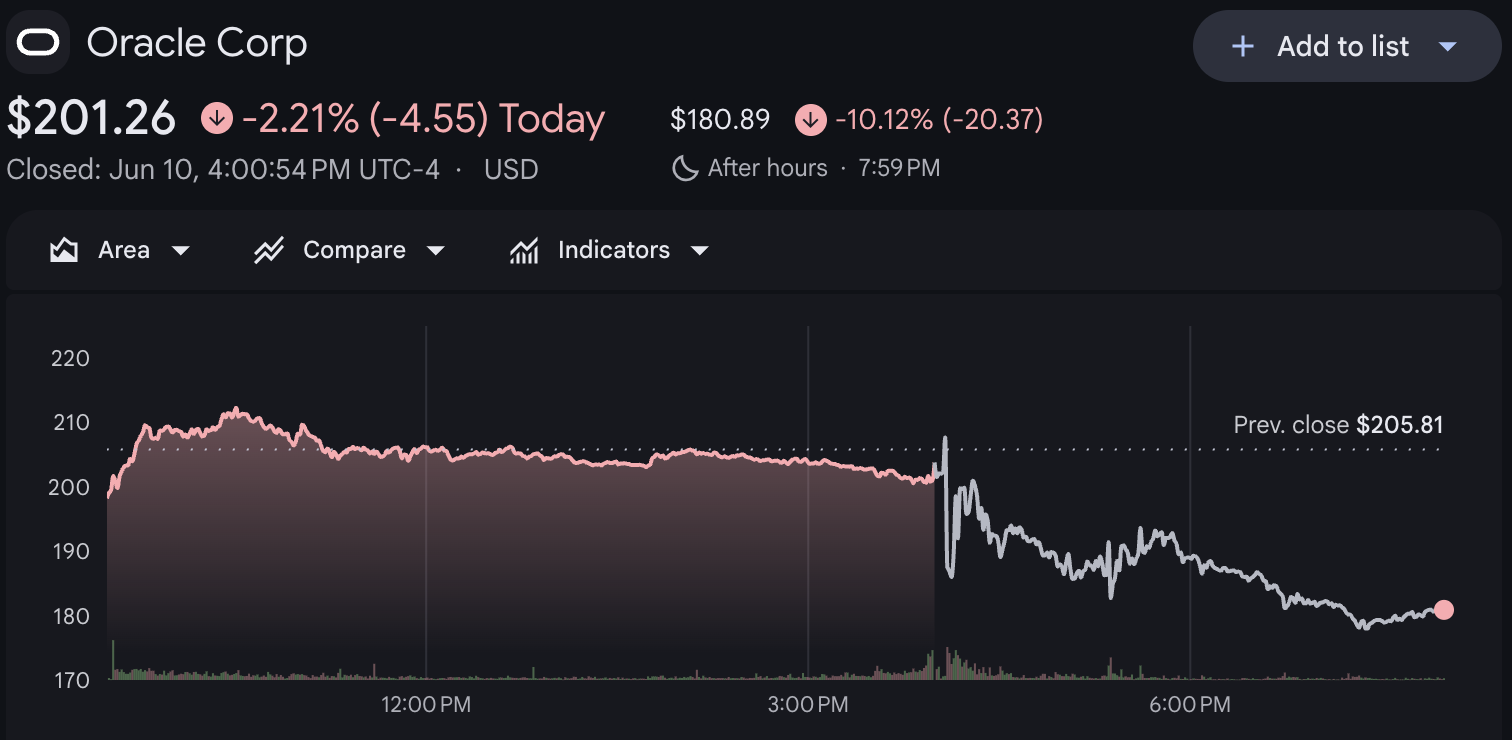
Oracle stock tumbled as much as 10% after hours, falling from a regular-session price near $201 to the $180 area, even after adjusted EPS of $2.11 and revenue of $19.18B beat expectations.
OCI revenue surged 93%, yet investors sold because AI cloud growth now carries capex near $55.7B, negative free cash flow near $23.7B, and a $40B funding overhang.
Management reaffirmed its $90B FY2027 revenue target and raised adjusted EPS guidance to $8.05, but the quarter confirmed demand and exposed the bill.

Oracle’s EPS beat was solid at $2.11 vs $1.96 expected, but revenue beat by only about $83M, leaving little room for disappointment.
OCI revenue jumped 93% to $5.8B, confirming AI cloud demand rather than disproving it.
Fiscal 2026 capex near $55.7B and negative free cash flow near $23.7B turned the earnings beat into a funding story.
RPO reached $638B, giving Oracle major contracted revenue visibility without solving near-term cash pressure.
The next move depends on three numbers: free cash flow, capex guidance, and the final debt-equity mix of the $40B plan.
The earnings table shows why investors sold first and asked questions later: demand was strong, cash flow was weak.
| Metric | Reported Result | Market Read |
|---|---|---|
| Regular-session price | Near $201 before after-hours drop | Gives scale to the 10% selloff |
| Adjusted EPS | $2.11 vs $1.96 expected | Profit beat was real |
| Revenue | $19.18B vs about $19.10B expected | Sales beat was thin |
| OCI revenue | $5.8B, up 93% | AI demand stayed strong |
| RPO | $638B | Backlog supports the bull case |
| FY2027 guidance | $90B revenue target; adjusted EPS raised to $8.05 | Guidance was strong, but funding fears won |
| FY2026 capex | About $55.7B | AI buildout is expensive |
| Free cash flow | About -$23.7B | Cash pressure drove the selloff |
| Financing plan | About $40B | Debt and dilution fears remain |
Free cash flow is the pressure point. Oracle has the demand; shareholders now need proof that the buildout can be funded without another hit from debt or dilution.
Oracle fell for three reasons: the revenue beat was thin, AI cloud growth is expensive, and free cash flow turned the earnings beat into a funding problem.
Oracle did beat expectations. The problem was the size of the beat.
Adjusted EPS came in at $2.11, ahead of the $1.96 estimate. Revenue reached $19.18B, only slightly above the $19.10B consensus. The EPS beat gave investors a positive headline. The revenue beat gave them little margin for comfort.
That left the stock exposed. Oracle was priced for a clean AI-driven upside surprise, not a narrow revenue beat paired with heavier funding risk.
Cloud demand was not the weak spot.
Total cloud revenue reached $9.9B, up 47%. OCI revenue reached $5.8B, up 93%. Those numbers support the AI cloud story, not a collapse in demand.
The selloff came from the cost of serving that demand: data centers, GPUs, power, networking, debt, and equity issuance.
Oracle’s profit number looked fine. The cash-flow signal did not.
Fiscal 2026 capex reached about $55.7B, while free cash flow was negative by roughly $23.7B. Add a $40B funding plan, and the market had enough reason to sell first.
Oracle did not lose the AI demand story. It lost the cash-flow argument.
The $40B funding plan told investors that Oracle still needs outside capital to build the AI capacity it has already sold.
Oracle raised $43B in debt financing and $5B in equity financing during fiscal 2026 for AI data-center expansion. Management still expects about $40B of debt and equity financing in fiscal 2027, including the previously disclosed $20B at-the-market equity issuance.
Debt costs money. Equity spreads future profit across more shares. Neither is painless after a double-digit after-hours selloff.
Capex near $55.7B and negative free cash flow near $23.7B explain the stock’s decline better than the EPS beat. Oracle proved demand. The market punished the funding bill.
Oracle’s $638B backlog stops the selloff from becoming a broken-growth story.
Remaining performance obligations rose by $85B from the prior quarter, from $553B to $638B. The figure stood more than four times above the year-earlier level, giving Oracle unusual revenue visibility in AI cloud infrastructure.
The timing still cuts against the stock. Oracle expects only 12% of RPO to convert into revenue over the next 12 months, with another 34% recognized over months 13 to 36. The backlog supports the long-term case, while the share price is reacting to near-term cash pressure.
Customer prepayments and customer-supplied GPUs reduce part of Oracle’s funding burden. Oracle credited $75B of prepaid or customer-supplied GPU arrangements tied to large AI contracts. The prepayments lower Oracle’s cash burden, not its execution risk. The data centers still have to be built before most of the backlog becomes revenue.
Software revenue fell 2% to $6.8B as customers continued moving from on-premises software to cloud services.
That shift supports Oracle’s long-term cloud strategy, yet it changes the earnings mix. Traditional software carries cleaner margins. AI infrastructure brings data-center costs, depreciation, power demand, and financing risk.
Oracle is losing some software-margin comfort just as AI infrastructure becomes the main growth engine.
Oracle now has to show cash, not just cloud growth.
The stock can stabilise if OCI keeps growing, capex stops climbing, and the $40B funding plan does not bring a larger debt or dilution hit.
It can stay under pressure if free cash flow weakens again, spending guidance rises, or software revenue continues to slip while AI infrastructure absorbs more capital.
The next report has one job: prove Oracle can turn AI demand into cash before asking shareholders to fund more of the buildout.
Oracle fell because cash-flow pressure overpowered the earnings beat. Revenue rose 21%, but capex was near $55.7B, free cash flow was negative, and a $40B financing plan shifted the market’s focus to funding risk.
Cloud demand did not collapse. Total cloud revenue rose to $9.9B, while OCI revenue jumped about 93%. The sell-off came from the cost of scaling to meet that demand, not from a broken cloud growth story.
The plan funds AI capacity, but shareholders may bear the cost through higher interest expense or dilution. Debt makes the buildout more expensive. Equity spreads future earnings across more shares.
Oracle can recover if OCI growth holds, capex stops rising, and free cash flow improves. The stock stays vulnerable if spending climbs again or the funding plan becomes heavier than investors expect.
Free cash flow is the next signal. Revenue growth already looks strong. The harder test is whether Oracle can build enough AI capacity without turning every growth beat into another funding concern.
Oracle’s next test begins with the fiscal first-quarter update and any prior financing disclosures.
Revenue, capex, RPO conversion, and free cash flow will decide whether the selloff fades or deepens. A stronger cloud number alone will not be enough if the cash drain continues.
Oracle’s next report will not be judged by whether AI demand is strong, but by whether that demand can finally fund itself.