Published on: 2026-07-10
AstraZeneca (LSE: AZN) saw billions wiped from its market value after its latest Phase 3 setback. The reaction shows why approval probabilities, launch timing, competition, costs and pipeline concentration matter more than headline peak-sales forecasts.
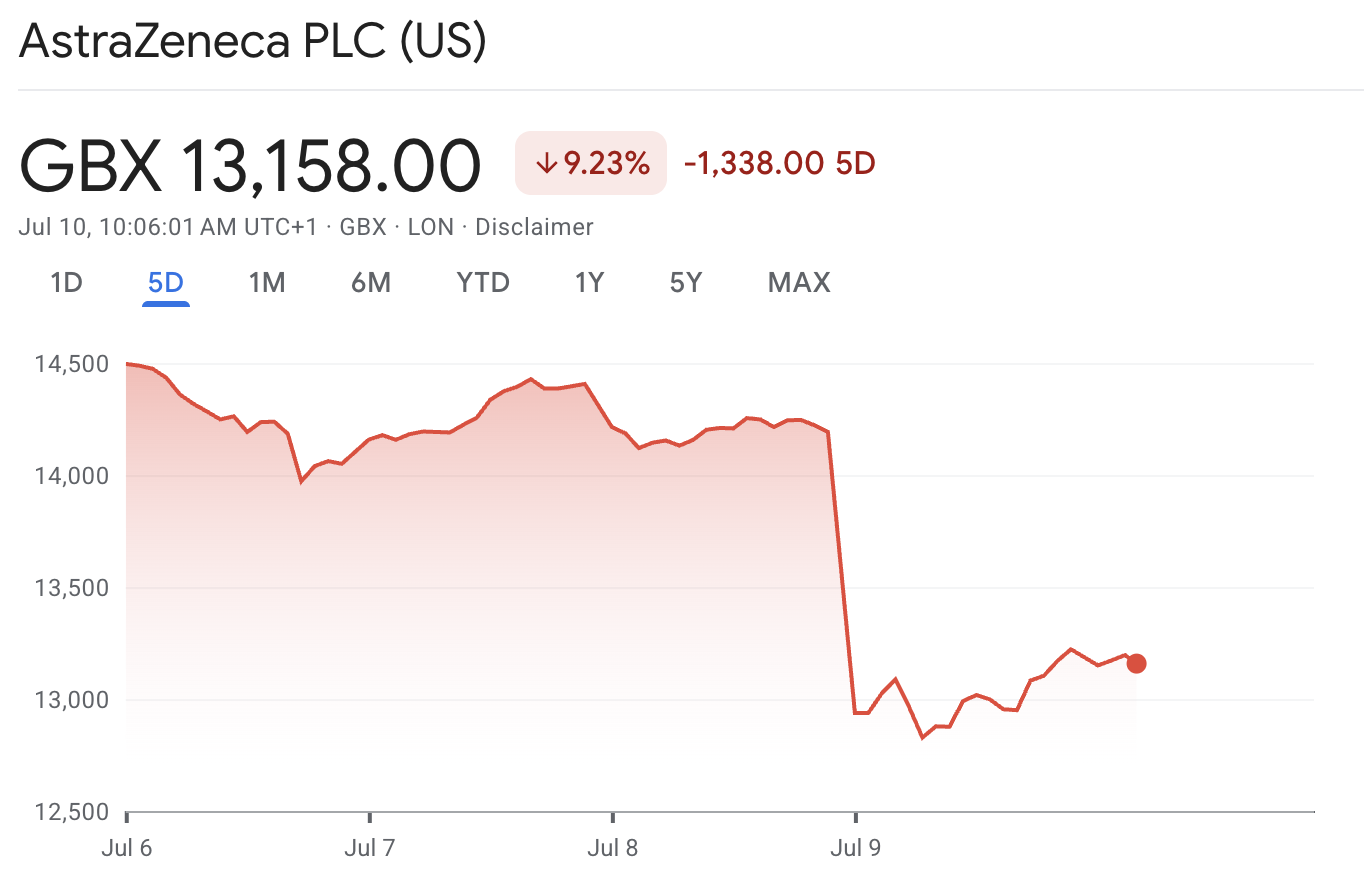
AstraZeneca’s London-listed shares fell 6.2% on 9 July 2026 after its Phase 3 CARDIO-TTRansform trial of Wainua, or eplontersen, failed to meet its primary endpoint in transthyretin-mediated amyloid cardiomyopathy, known as ATTR-CM.
 The treatment had not yet generated revenue from this indication, but investors had already assigned value to a possible launch. When the trial failed, those expected future cash flows were removed from valuation models. The sell-off therefore reflected both the direct loss of programme value and a wider reassessment of confidence.
Pharmaceutical valuations include expected cash flows from treatments still in development.
Late-stage programmes usually carry more value because less clinical uncertainty remains.
Peak sales are annual revenue estimates, not profit, lifetime cash flow or present value.
A Phase 3 failure can reduce asset value and confidence in the wider pipeline.
Pipeline diversification depends on asset independence, not programme count alone.
CARDIO-TTRansform enrolled 1,432 patients across 20 countries and tested Wainua against placebo alongside standard care. Its primary endpoint combined cardiovascular mortality and recurrent cardiovascular clinical events through week 140. The study did not show a statistically significant benefit, although AstraZeneca said the treatment was generally well tolerated.
The setback applied to the proposed expansion into ATTR-CM. Wainua remains approved in more than 20 countries for hereditary transthyretin amyloidosis with polyneuropathy, or ATTR-PN. Its existing approvals were not directly affected.
Each indication has its own patient population, evidence, approval pathway and competitive market. Failure in one does not automatically eliminate the value of the entire drug.
AstraZeneca’s London shares closed 6.2% lower, wiping roughly £13 billion from its market capitalisation. Ionis Pharmaceuticals, its development partner, fell about 24% in US trading. BridgeBio gained around 15% as investors reduced the probability of another competitor entering the ATTR-CM market.
A Pharmaceutical share price reflects more than current earnings. It also includes expected cash flows from treatments that may reach the market.
As evidence improves, investors raise or lower the probability that a programme will reach the market. Preclinical assets receive limited value because commercialisation is distant and failure risk is high. By Phase 3, analysts may include meaningful revenue forecasts in long-term models.
Success probability also depends on the disease, mechanism, endpoint, earlier data and regulatory requirements. Two Phase 3 programmes can therefore carry very different valuations.
The standard framework is risk-adjusted net present value, or rNPV.
rNPV = probability-adjusted future cash flows, discounted to today, minus remaining development costs
Analysts estimate the commercial opportunity using the eligible patient population, diagnosis rates, expected price, adoption speed, likely market share and competition.
Revenue is converted into cash flow after manufacturing, research, regulatory, marketing, tax, royalty and partnership costs. It is then probability-adjusted and discounted because future cash flows are worth less today.
Consider a hypothetical programme with $3 billion in peak annual sales, a 35% operating margin and a 70% probability of success. Peak operating profit would be about $1.05 billion. After the probability adjustment, that falls to roughly $735 million. Its present value would be lower again if launch remained several years away.
A full model also captures adoption, patent expiry, sales decline and remaining development spending. Small changes in timing, pricing or approval probability can materially alter the result.
Peak sales represent the highest annual revenue a treatment might achieve once adoption stabilises. They are a useful shorthand for market size, but they do not capture profitability, timing or risk.
AstraZeneca previously indicated that Wainua could exceed $5 billion in peak annual sales across indications. However, the ATTR-CM opportunity depended on uncertain factors such as patient identification, pricing, competitive positioning and launch timing.
Even if those sales were achieved, AstraZeneca would not retain all of the economics. Ionis is entitled to milestones and royalties in the low double digits to mid-20% range, reducing AstraZeneca’s share of profits.
Timing further reduces value. Treatments typically take years to launch and additional time to reach peak uptake. During that period, competitors may enter, pricing pressure may increase and the remaining patent life may shorten.
As a result, peak sales must be translated into risk-adjusted, discounted cash flows. After accounting for margins, royalties, development costs, approval probability and time value, the present value of a programme is often far lower than its headline peak-sales figure suggests.
Late-stage programmes often carry higher success probabilities and more value in analyst models. A failed Phase 3 trial therefore removes a partially priced asset rather than a distant scientific possibility.
The effect can spread beyond the failed indication if investors question earlier assumptions or apply a higher risk discount across the wider pipeline. A market-cap loss can therefore exceed the estimated rNPV of the failed programme.
The decline can be separated into three components.
The first is the direct loss of rNPV from the ATTR-CM indication. Sales and profit forecasts tied to that opportunity must be removed or sharply reduced.
The second is a confidence discount. Investors may become less willing to rely on previous assumptions about the programme or management’s assessment of the data.
The third is portfolio repricing. The market may assign lower probabilities to other pipeline assets, even when the failed trial offers no direct evidence against them.
AstraZeneca’s scale limits the wider damage. It lists 186 pipeline projects, including 118 new molecular entities or major life-cycle projects in Phase 2 or Phase 3. Management has also reported more than 100 Phase 3 studies underway.
Its ambition to reach $80 billion in annual revenue by 2030 depends on existing medicines and multiple pipeline programmes rather than Wainua alone. The sell-off therefore appears to reflect both the lost ATTR-CM opportunity and a broader confidence discount. Whether that discount persists will depend on future trial results.
Ionis fell more sharply because Wainua represents a larger share of its perceived future opportunity. AstraZeneca is much larger, generates substantial revenue from approved products and has more alternative growth assets.
Although Ionis receives only part of Wainua’s economics, that contribution is more material relative to its size. Competitors can benefit from the same event because removing a potential entrant may improve expected market share, helping explain BridgeBio’s positive reaction.
Pipeline diversification depends on independence, not programme count alone. A stronger pipeline spans different therapeutic areas, mechanisms, clinical stages, patient groups and launch dates.
Concentration remains high when several assets rely on the same pathway, target similar patients or face major results at the same time. Approved products provide a further buffer by funding development after setbacks.
Start by identifying what investors had already priced in, including peak sales, launch timing, market share, probability of success and contribution to long-term forecasts.
Next, define the scope of the failure. Did it affect one indication, the whole treatment or a broader scientific platform? Wainua’s setback was limited to ATTR-CM, while its approved ATTR-PN indication remained intact.
Then compare the estimated lost rNPV with the market reaction. A larger decline may indicate lower confidence or wider pipeline repricing.
Finally, assess whether the company has enough independent growth assets and approved-product cash flow to absorb the loss.
AstraZeneca’s stock declined because investors removed expected future revenue from the failed ATTR-CM indication and reassessed the probability of success across parts of its pipeline.
The company lost roughly £13 billion in market capitalisation on the day of the announcement, reflecting both the lost programme value and a broader confidence adjustment.
Not necessarily. AstraZeneca has a large and diversified pipeline, and its long-term outlook depends on the performance of multiple other programmes and existing products.
Pipeline risk is inherent in pharmaceutical investing, but AstraZeneca’s scale and diversification help reduce reliance on any single programme.
Stock recovery depends on future clinical results, pipeline progress and overall financial performance. Positive data from other programmes could restore investor confidence.
AstraZeneca is a larger company with more diversified revenue streams and pipeline assets, so the failed programme represents a smaller portion of its overall valuation.
AstraZeneca’s setback shows how pharmaceutical valuations extend beyond current earnings. The failed ATTR-CM trial removed a meaningful future opportunity while leaving Wainua’s approved indication intact.
The market reaction reflected both the loss of probability-adjusted cash flows and a broader reassessment of risk. Similar events are easier to interpret by separating peak sales from present value, defining the scope of the failure and examining how concentrated the remaining pipeline is.