Published on: 2026-03-13
Updated on: 2026-03-13
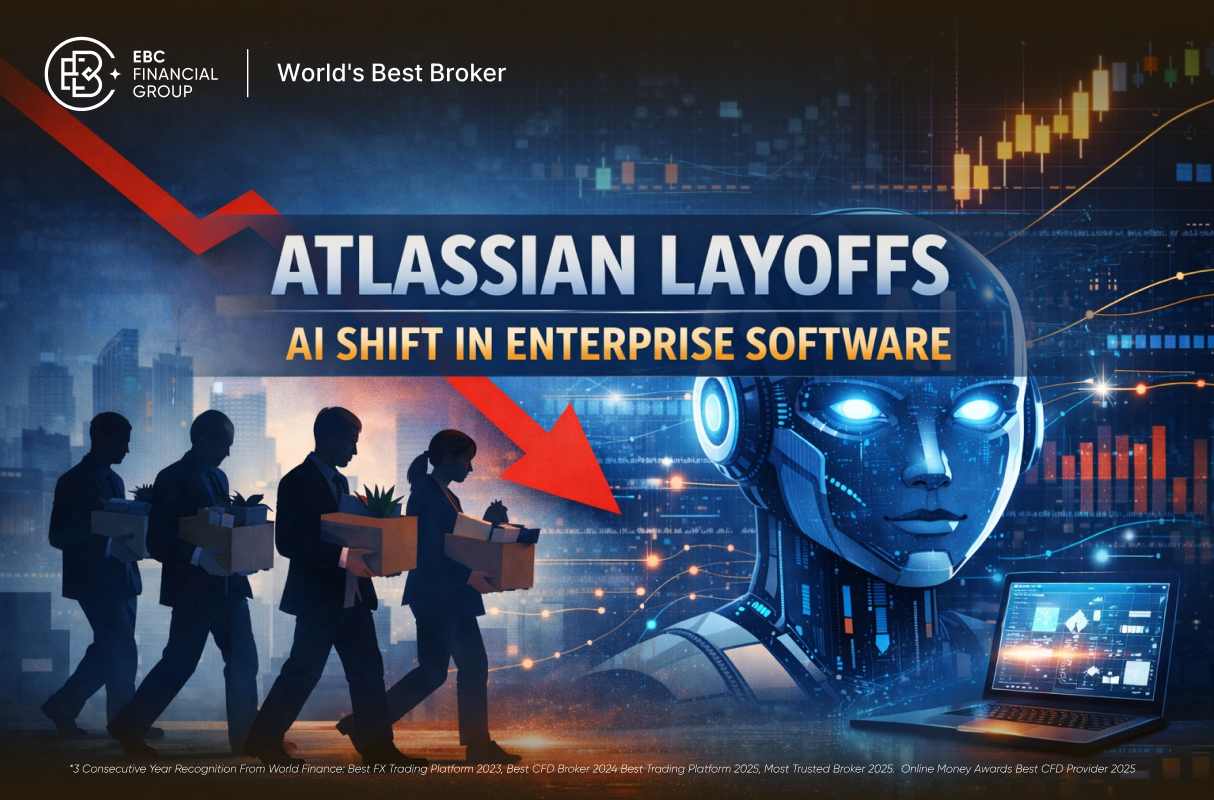
On March 11, Atlassian announced layoffs of about 10% of its workforce, or around 1,600 employees. The company said this move would allow greater investment in artificial intelligence and enterprise sales, while strengthening its financial position.

The layoffs coincide with Atlassian's push to integrate AI more deeply into Jira, Confluence, and its enterprise platform, signaling the future direction of enterprise software.
Atlassian announced a significant workforce reduction to redirect investment toward AI and enterprise sales.
The layoffs span multiple regions, with North America, Australia, and India among the most affected.
The move follows a broader industry trend of enterprise software firms restructuring around AI capabilities.
Atlassian's CTO is stepping down as the company elevates next-generation AI leadership.
Despite the workforce reductions, Atlassian's recent financial performance has remained robust, raising questions about the motivations for the decision.
Atlassian has been positioning AI as central to its next stage of growth. In its latest quarterly update, the company said Rovo had passed 5 million monthly active users, Teamwork Collection had passed 1 million seats and 1,000 customers, and the enterprise business grew 60% year over year in the quarter.
Despite this momentum, Atlassian's leadership chose to reduce headcount. The official reason is strategic reallocation of resources, not a response to financial distress.
Co-CEO and co-founder Mike Cannon-Brookes said the decision was made to "self-fund further investment in AI and enterprise sales" while accelerating the company's path to sustained profitability.
Reports say the layoffs affect multiple regions, with North America taking the largest share, followed by Australia and India. The Guardian reported roughly 640 roles in North America, 480 in Australia, and 250 in India.
The company expects to incur charges of $225 million to $236 million related to the layoffs and office space reductions.
Roles affected span multiple departments, including:
Engineering and data science
Product development
Business operations
Atlassian confirmed that affected staff will receive severance packages, including at least 16 weeks of pay, an additional week for each year of service, six months of healthcare coverage, and a $1,000 technology payment to support their transition.
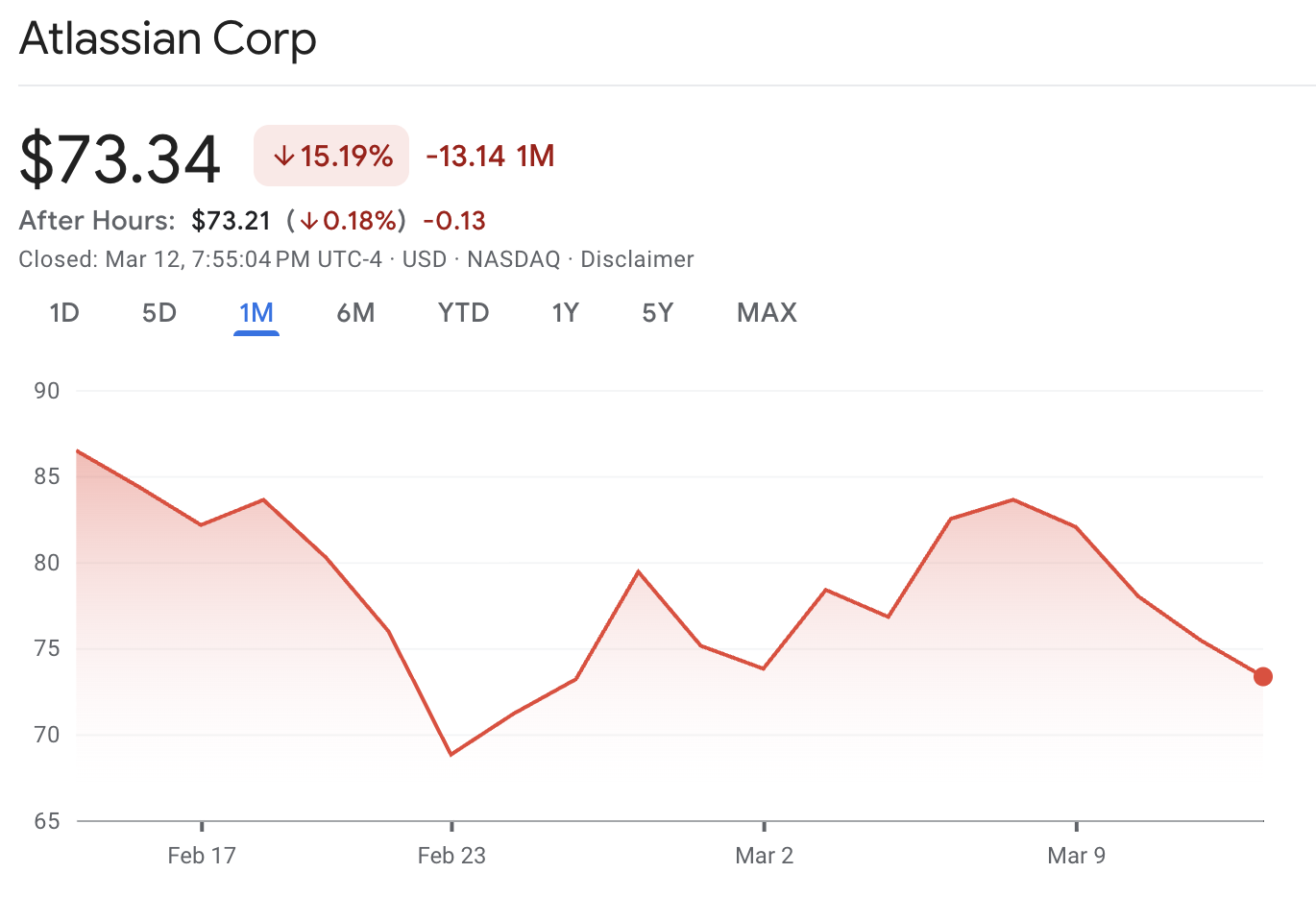
The table below uses the latest regular-session close on March 12, 2026 and compares it with the prior trading day and one week earlier. TEAM closed at $73.34 on March 12, versus $75.45 on March 11 and $83.62 on March 6.
| Period | Reference Close | Latest Close | Change ($) | Change (%) |
|---|---|---|---|---|
| 1D | $75.45 | $73.34 | -$2.11 | -2.80% |
| 1W | $83.62 | $73.34 | -$10.28 | -12.29% |
| 6M | $174.87 | $73.34 | -$101.53 | -58.06% |
TEAM is also trading far below its late-2025 highs. Third-party market data trackers show a 52-week range spanning roughly $67.85 to $242.00, underlining how severe the software rerating has been.
Atlassian’s latest reported quarter was strong on top-line and enterprise metrics. The company reported $1.586 billionin revenue, $1.067 billion in cloud revenue, and $3.814 billion in remaining performance obligations.
However, the stock performance contrasts with these financial results. Atlassian shares have dropped more than 50% this year, reflecting investor concerns that AI may disrupt many of the company's core services.
This divergence between strong revenue performance and negative investor sentiment highlights a central challenge for established enterprise software companies.
Revenue growth alone is not enough; investors want clarity on how AI will change the company's cost structure.
Atlassian has been explicit that AI is not just a feature layer. On February 25, it launched agents in Jira in open beta and described the product as a way to embed human-AI collaboration within existing workflows, comments, permissions, and audit trails.

The company confirmed that its approach is not about AI replacing people, but acknowledged that "it would be disingenuous to pretend AI doesn't change the mix of skills we need or the number of roles required in certain areas."
Industry analysts note that software companies like Atlassian can improve efficiency by adopting AI tools, especially in product development. This reduces the resources needed to deliver current offerings and supports more profitable growth.
However, whether these changes represent a substantive transformation or constitute "AI washing" remains an open question.
Atlassian is not acting alone. The AI-driven restructuring wave is sweeping across enterprise technology.
| Company | Workforce Reduction | Stated Reason |
|---|---|---|
| Atlassian | ~1,600 (10%) | AI and enterprise investment |
| Block | ~4,000 (~40%) | AI-native operating model |
| Oracle | Up to 45,000 | AI infrastructure buildout |
| Amazon | ~14,000 | AI transformation |
By early March 2026, global technology sector layoffs had exceeded 45,000, with AI and automation frequently cited as primary drivers.
Top executives at the World Economic Forum's annual meeting had said that while jobs would disappear, new roles would emerge, though some warned AI would be used as a convenient excuse by companies that were already planning layoffs regardless.
The trend is most concentrated in roles involving repetitive tasks, content generation, and operations, where AI tools are increasingly cost-effective, rather than in senior technical or strategic positions.
The bull case is real, but so is the execution risk. Atlassian has strong enterprise momentum, growing AI adoption, and a large installed base, yet its share price suggests investors still want stronger proof.
AI monetisation: Rovo usage is growing, but investors need to see adoption translate into larger paid commitments and expansion.
Enterprise sales follow-through: RPO growth, $1 million-plus ARR customers, and large-deal momentum need to stay strong after the restructuring.
Margin improvement: Savings from the layoffs need to show up without damaging product velocity.
Product execution: Agents in Jira and the wider Rovo stack need to prove real value inside customer workflows.
Stock sentiment: Analyst trackers still show a Buy consensus, but targets are wide, and confidence will depend on execution.
Atlassian cut about 10% of its workforce to redirect capital into AI development and enterprise sales. Leadership described it as a strategic shift to self-fund growth and reshape its skill mix, not a response to financial distress.
About 1,600 employees worldwide were affected, equal to roughly 10% of Atlassian’s workforce. North America saw the largest share of cuts, followed by Australia and India.
Yes. Atlassian has strong cloud revenue growth, a large base of high-value enterprise customers, and improving operating margins. The layoffs were tied to capital reallocation, not financial weakness.
Atlassian’s AI product is Rovo, an AI assistant built into Jira, Confluence, and other tools. It has become a core part of the company’s long-term enterprise growth strategy.
That depends on AI execution, Rovo adoption, and deeper enterprise customer spending. Analyst sentiment remains broadly positive, but recovery will depend on whether Atlassian can turn its AI push into stronger growth.
Yes. Other major tech companies have also cut jobs in 2026 while increasing AI investment. The broader trend points to leaner, AI-integrated operating models across the enterprise software industry.
Atlassian’s layoffs are significant because they reflect a broader transformation developing in the enterprise software sector. AI has evolved beyond being just a feature announcement or a conference topic.
It is now shaping product design, sales priorities, and workforce planning at one of the sector’s best-known companies.
Atlassian is prioritizing enterprise AI, AI agents, and expanded platform adoption over maintaining its previous workforce structure. This strategic shift is likely to influence how the broader software market is evaluated in 2026.
Disclaimer: This material is for general information purposes only and is not intended as (and should not be considered to be) financial, investment or other advice on which reliance should be placed. No opinion given in the material constitutes a recommendation by EBC or the author that any particular investment, security, transaction or investment strategy is suitable for any specific person.