Published on: 2026-07-28
Updated on: 2026-07-28
The Nikkei 225 had fallen 14.5% from its June record by Tuesday afternoon, and the weak yen that usually lifts Tokyo’s exporters could not stop the slide, because the selling fell hardest on the high-priced semiconductor shares that carried the index up in the first place.
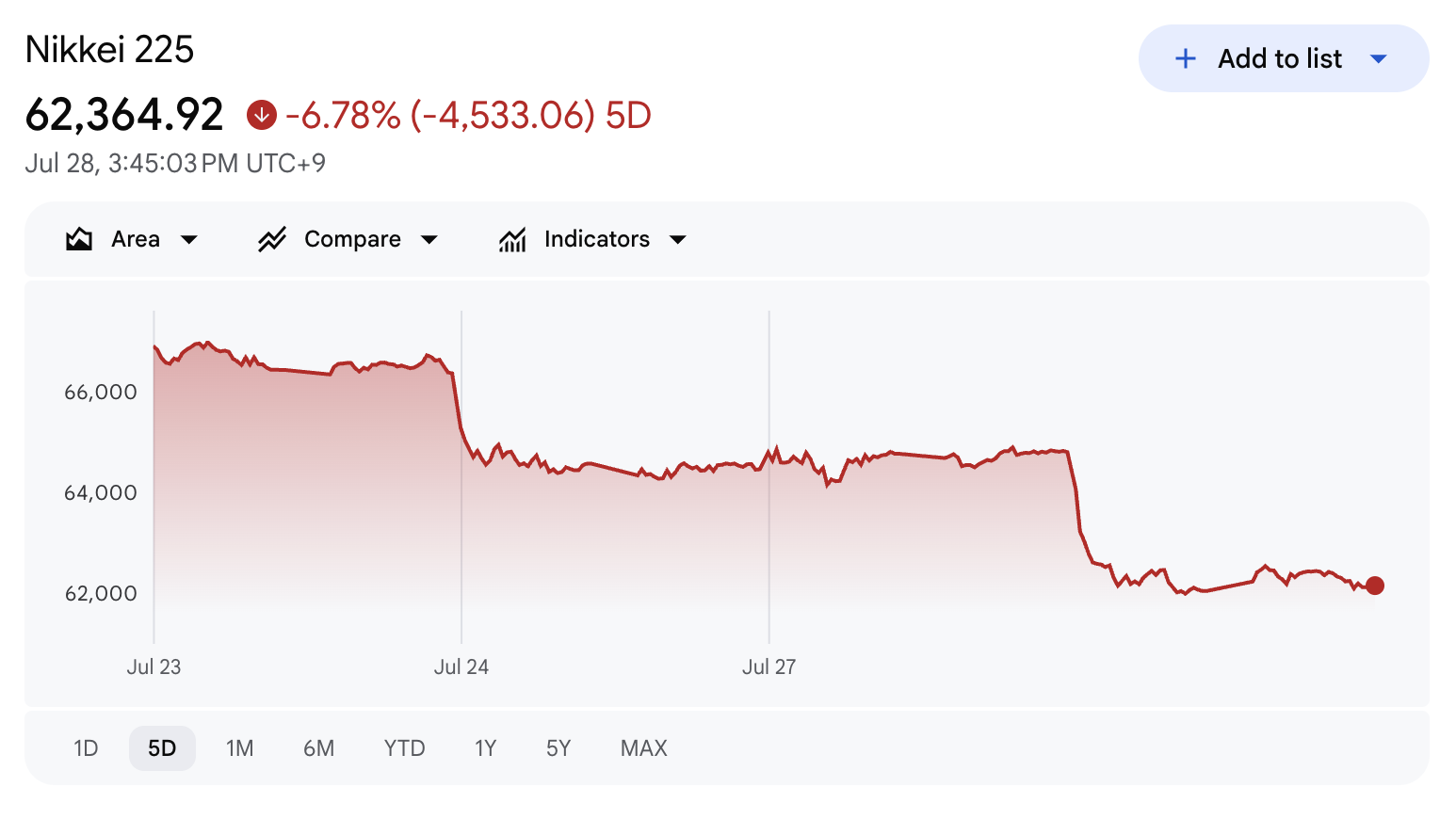
At 3:30 p.m. JST on 28 July, the index traded at 62,262.92, down 4.11%, or 2,668.27 points. Its intraday low of 61,923.60 sat 14.98% below the 22 June record of 72,831.73, the weakest level in about two months.
The yen was trading near ¥163.74 to the dollar. At that level it should be inflating the yen value of exporters’ overseas revenue and cushioning them through a market slide. That support did show up in several exporters on Tuesday. It was buried under losses in the Nikkei’s most heavily weighted chip stocks. The trigger came from abroad: another sell-off in global technology shares, against which a cheap currency offered Tokyo little defence.
The Nikkei 225 was down 4.11% at 3:30 p.m. JST, leaving it 14.5% below its June peak. The session low stretched the fall to almost exactly 15%.
A weak yen still supported a handful of exporters, but their gains were far too small to cover double-digit losses in semiconductor shares.
USD/JPY held near ¥164, with no sign of the rapid yen buying that a large carry-trade unwind would produce.
The Nikkei’s price-weighted design amplified the falls in Advantest and Tokyo Electron, while the broader TOPIX lost a smaller 2.8%.
Five catalysts land between 29 and 31 July: three Japanese chip earnings reports, the Federal Reserve decision and the Bank of Japan statement.
| Measure | Latest reading | Market signal |
|---|---|---|
| Nikkei 225 | 62,262.92, −4.11% | 14.5% below June record |
| Tokyo Electron | ¥55,960, −10.89% | Equipment outlook in question |
| Advantest | ¥25,455, −10.31% | AI-testing exposure unwinding |
| Kioxia | ¥44,670, −18.11% | Memory-cycle concerns |
| USD/JPY | Around ¥163.74 | Weak yen could not lift the index |
| JGB 10-year yield | Around 2.80% | Valuation headwind for growth |
The component prices were the latest available during Tuesday afternoon trading. Kioxia had fallen the daily limit to ¥44,550, while Tokyo Electron and Advantest were both down more than 10%. Japan’s 10-year government bond yield held near 2.80%.
The sell-off started on Wall Street. Nvidia, AMD and Micron all fell overnight, extending the slide in the Philadelphia Semiconductor Index and handing Asia’s technology sector a negative lead. In Tokyo, the early selling clustered in chip and metals names, then accelerated after lunch. Three worries converged.
The first is the return on all that AI spending. Investors are asking how quickly hyperscalers can turn vast AI budgets into revenue and free cash flow.
The second is the quality of the demand behind it. Nvidia is reportedly in talks over a financial backstop of about $250 billion to underwrite OpenAI’s leasing commitments for a proposed 10-gigawatt data-centre project in Ohio. The deal could lower OpenAI’s financing costs, but it has also sharpened an uncomfortable question: how much of today’s AI demand is being propped up by the very companies that sell the hardware.
The third is competition. China has reportedly begun producing its own immersion deep-ultraviolet (DUV) lithography machines, a technology long controlled by a small group of foreign suppliers. The pressure grew after CXMT, a Chinese DRAM maker, rose 466% on its Shanghai debut, a signal of both its access to capital and China’s expanding memory ambitions.
None of this instantly erases the lead held by Japanese, American and European chipmakers. What it erodes is the assumption built into their valuations that competitive pressure would stay contained through the later stages of the AI investment cycle.
Tokyo Electron, Advantest, Kioxia and SoftBank Group were among the biggest winners of Japan’s AI rally, and their prices had baked in years of strong demand for chipmaking equipment, chip testing, memory and data-centre gear.
Tuesday’s drop also came before Advantest, Tokyo Electron or Kioxia had reported their latest quarterly numbers. The evidence so far points mainly to a valuation and positioning reset ahead of earnings, not a confirmed downturn.
A genuine deterioration in orders, guidance or customer capital spending would convert that de-rating into an earnings downgrade.
The Nikkei 225 is a price-weighted index: a stock with a high share price moves it far more than the company’s total market value would justify. That is why a handful of high-priced stocks can steer the whole benchmark. TOPIX weights its members by free-float market value instead, spreading the impact more evenly.
At the latest reading on Tuesday, TOPIX was down about 2.8%, against more than 4% for the Nikkei. The gap shows how much the headline index leans on a narrow group of expensive technology shares. The same weighting that lifted the Nikkei when Advantest and Tokyo Electron soared is now working in reverse.
The weak yen failed here because global investors were cutting AI exposure across several markets at once, and that decision turned on sector risk, valuation and crowded positioning rather than on the translated earnings of Japanese exporters.
The split across Tokyo makes the point. Toyota rose about 0.5%, Sony about 0.6% and Fast Retailing 0.8%, while Tokyo Electron fell 10.89%, Advantest 10.31%, Mitsubishi UFJ 3.47% and Sumitomo Mitsui Financial 3.49%. The familiar weak-yen trade was still visible in the winners, but its contribution was dwarfed by the losses in the index’s heavyweight chip names.
The currency market also showed no sign of a disorderly carry-trade unwind. Closing leveraged, yen-funded positions would normally force the yen sharply higher, as traders buy back the currency to repay their funding. Instead, USD/JPY sat still near ¥163.74. Tuesday was an equity de-risking event, then, not a funding shock: the carry risk is unresolved rather than live.
Two currency risks still hang over the rest of the week. A hawkish turn at the Bank of Japan could push the yen up and squeeze whatever carry positions survived Tuesday. Japanese authorities could also resort to currency intervention if they judge the yen’s decline too fast or too deep.
| Timing (Japan) | Event |
|---|---|
| 29 July, 3:30 p.m. | Advantest first-quarter results |
| 30 July, 3:00 a.m. | Federal Reserve decision |
| 30 July | Tokyo Electron first-quarter results |
| 31 July | Bank of Japan policy statement |
| 31 July, 3:30 p.m. | Kioxia first-quarter results |
Advantest has confirmed first-quarter results for 3:30 p.m. JST on 29 July. Tokyo Electron reports on 30 July, and Kioxia at 3:30 p.m. JST on 31 July. The BOJ’s two-day meeting runs 30 to 31 July.
The Federal Reserve is a secondary amplifier here, not the original trigger. Its target range stands at 3.50% to 3.75%, and a hold is still the base case, though rate futures have not entirely ruled out a 25-basis-point hike. Lingering doubt lifts the discount rate on technology earnings, supports the dollar and discourages buying the dip before the decision.
Each report will be read for a different signal. Advantest hangs on demand for testing AI accelerators and high-bandwidth memory. Tokyo Electron will be judged on orders, backlog, customer spending plans and its outlook for wafer-fabrication equipment. Kioxia will give the clearest read on NAND pricing, shipments and supply discipline.
If Advantest, Tokyo Electron and Kioxia hold their guidance and neither the Fed nor the Bank of Japan surprises on the hawkish side, the case that prices fell faster than the business did gets stronger. Japanese chip shares could recover part of the drop, and the weak yen would keep working for exporters.
Delayed customer capital spending, softer orders or cut forecasts would turn the valuation reset into an earnings downgrade. That would probably keep the Nikkei lagging TOPIX, and a sustained break below the 61,923.60 session low would undercut the idea that 62,000 offers dependable support.
This is the hardest mix for Japanese equities. A firmer yen would erode the currency benefit for exporters, while higher domestic rates would add pressure to valuations. If rapid yen strength arrives alongside more equity selling, it would suggest the correction is reaching into carry positions.
Japan’s chip champions carried the Nikkei 225 to 72,831.73 in June. By Tuesday afternoon the index sat 14.5% lower, with the session low marking a 14.98% fall, and the weak yen, still helping a few exporters, could not begin to offset the double-digit losses in the high-priced semiconductor stocks that drive the benchmark.
Confidence in AI spending, pricing power and long-term competitive protection has cracked before the earnings have confirmed any downturn. Between 29 and 31 July, three chip reports and two central-bank decisions will offer the first concentrated evidence of whether the sell-off has run ahead of the fundamentals or has further to go.