Published on: 2026-07-29
Updated on: 2026-07-29
The Dow gained 537 points while the Nasdaq fell as six blue-chip stocks surged and semiconductor shares extended their sell-off. Index construction made the divergence look even larger.
The Dow Jones Industrial Average rose 537.24 points, or 1.03%, to close at 52,747.32 on Tuesday 28 July 2026, still short of its 6 July record of 53,055.91, while the Nasdaq Composite slipped 0.22% to 24,876.91. The S&P 500 added 0.21% to 7,428.78 and the Philadelphia Semiconductor Index fell 4.5%.
The Dow rose because earnings beats and a rotation into non-technology sectors lifted several of its highest-priced members. The Nasdaq stayed underwater because memory chip and semiconductor equipment shares fell for a fourth consecutive session.
Six Dow components supplied roughly 460 points of the index’s 537-point advance, and the way the Dow is built did the rest of the work.
Six Dow members closed up between 4.5% and 8.3%: Sherwin-Williams, IBM, Coca-Cola, Boeing, Salesforce and Amgen.
Sherwin-Williams and Coca-Cola together were worth roughly 185 Dow points, close to 35% of the net gain.
The semiconductor index fell 4.5% after trading down as much as 6.5%, which kept the Nasdaq from following the Dow higher.
Price weighting amplified everything: each $1 of share-price movement was worth roughly six Dow points on the day.
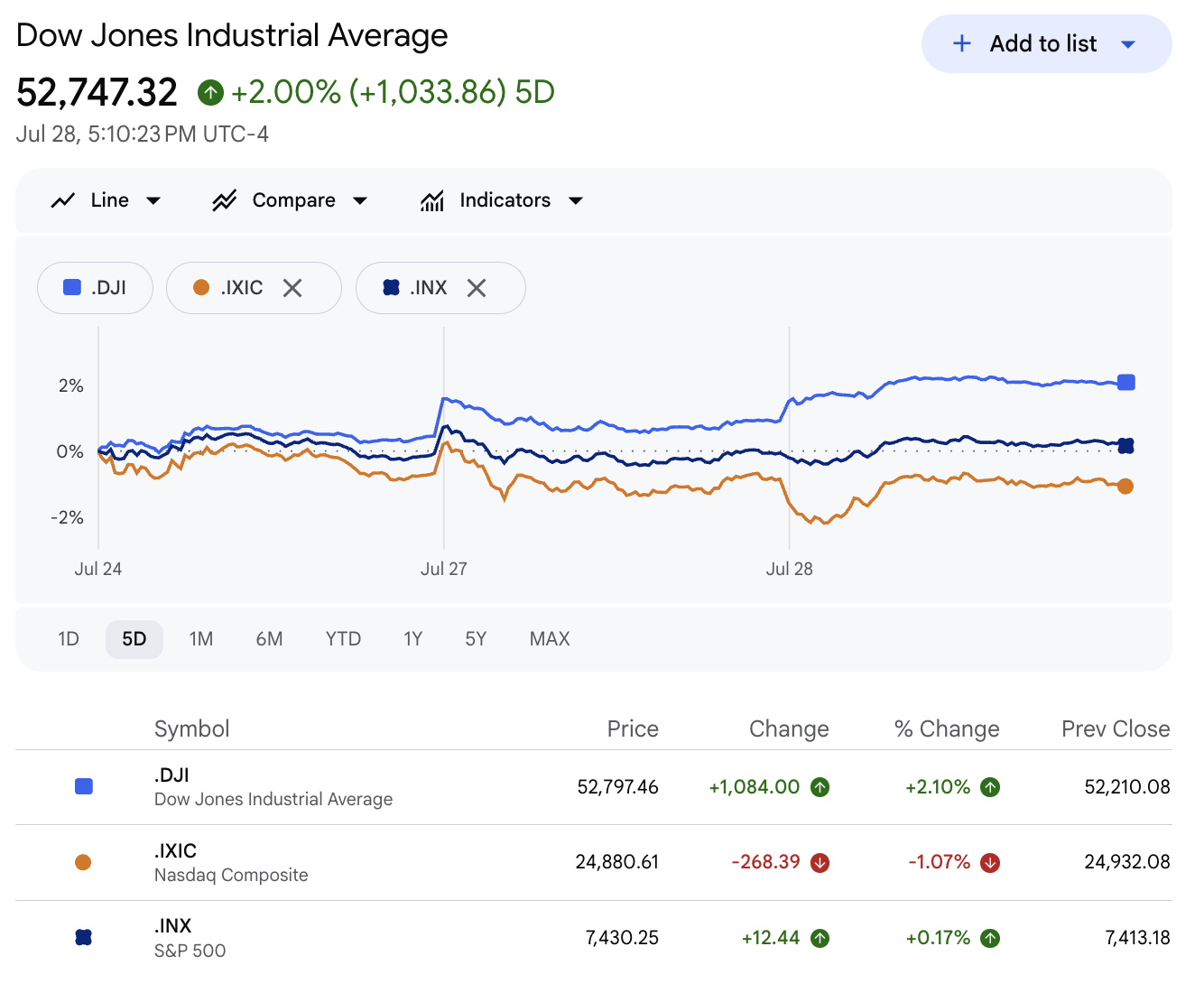
| Index | 28 July close | Move | Main influence |
|---|---|---|---|
| Dow Jones Industrial Average | 52,747.32 | +1.03% | Blue-chip earnings and rotation |
| S&P 500 | 7,428.78 | +0.21% | Broad gains offset chip weakness |
| Nasdaq Composite | 24,876.91 | −0.22% | Semiconductor sell-off |
Three readings from one session point to a rotation rather than a market-wide rally or retreat. Twenty-six of the Dow’s thirty members finished higher, yet the Nasdaq could not hold positive territory.
Because the Dow is price weighted, a component’s dollar move matters more than its percentage move. Converting each gain into index points shows how concentrated the session was.
| Dow stock | Share-price move | Dollar change | Approximate point contribution |
|---|---|---|---|
| Sherwin-Williams | +8.25% | +$27.00 | About 160 |
| Amgen | +4.48% | +$16.84 | About 100 |
| IBM | +5.21% | +$11.27 | About 67 |
| Boeing | +4.76% | +$10.06 | About 60 |
| Salesforce | +4.55% | +$7.90 | About 47 |
| Coca-Cola | +5.00% | +$4.20 | About 25 |
Contributions use roughly 5.94 index points per $1 of movement and total about 460 points.
Only three of the six reported that morning. Sherwin-Williams posted adjusted earnings of $3.70 per share on revenue of $6.79 billion and raised its full-year outlook. Coca-Cola reported comparable earnings of $0.97 per share on revenue of $13.38 billion and lifted full-year comparable earnings growth guidance to 9% to 10% from 8% to 9%. Boeing disclosed a core loss of $0.76 per share, including a $280 million charge on the Air Force One programme, though revenue beat forecasts and deliveries rose 14% to 171 aircraft.
IBM, Salesforce and Amgen released no results that day. Their gains were not tied to same-day earnings and were consistent with the broader rotation, a less durable basis for a move than a reported beat.
Two names outside the six also counted: UnitedHealth added about 66 points and Home Depot roughly 50. Working the other way, Caterpillar fell 3.71% and subtracted close to 193 points on its own, with Goldman Sachs taking off another 88.
The Philadelphia Semiconductor Index closed down 4.5% after falling as much as 6.5% intraday. The selling began overnight in Asia, where South Korea’s Kospi dropped 10.8% and triggered trading halts as SK Hynix and Samsung Electronics slid, and Japan’s Nikkei 225 lost 3.95%.
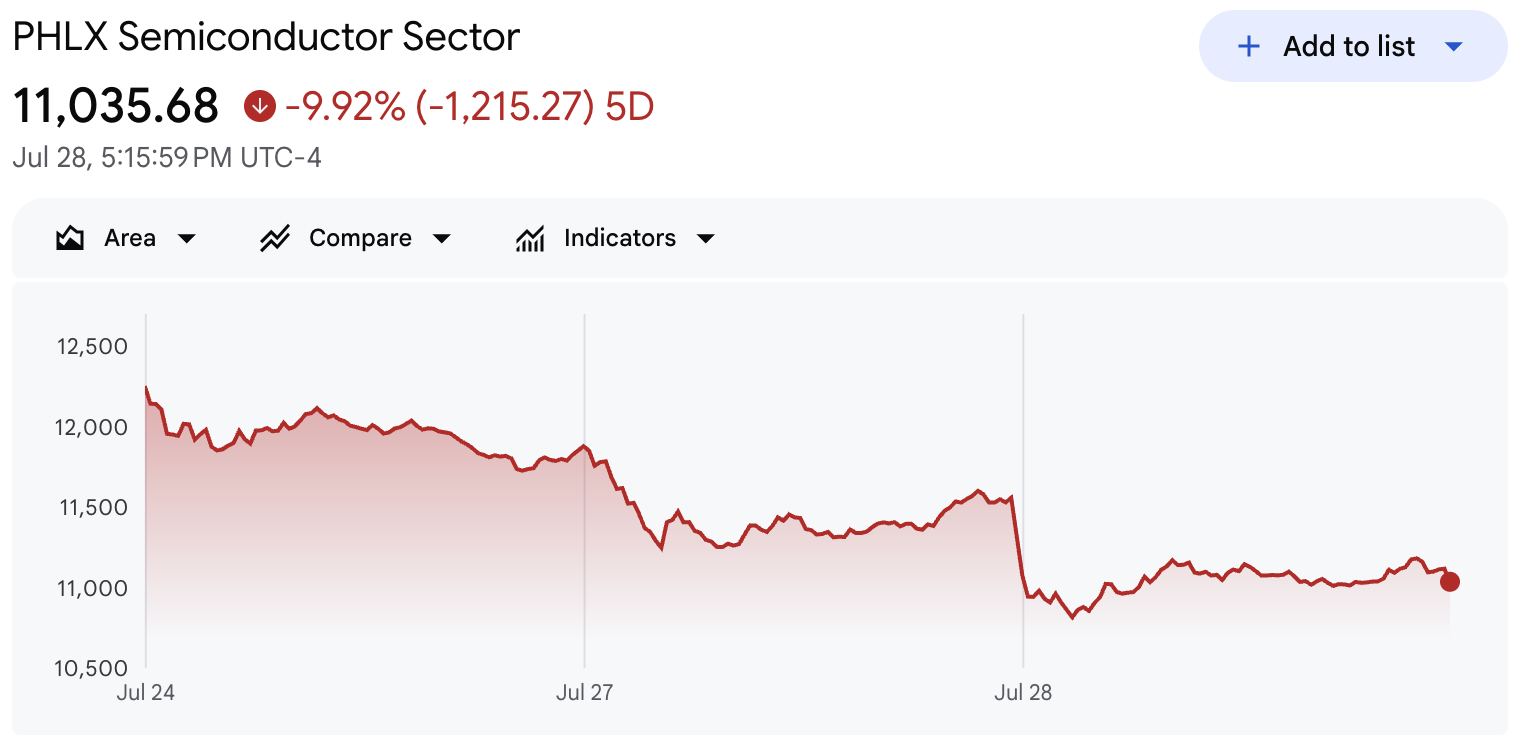
In the United States, the damage stayed concentrated in memory and chip equipment. Micron fell 8.9% and was among the heaviest drags on the S&P 500, AMD lost 8.1% and Applied Materials shed 7.8%.
Elsewhere in technology the picture was calmer. Alphabet rose 1.85%, Microsoft gained 1.09% and Apple added 0.94%, briefly touching a $5 trillion market capitalisation intraday before closing below it. The Nasdaq-100 fell about 1% and neared correction territory, while the Composite finished only 0.22% lower after trading as much as 9.3% below its record.
Software, internet and communication names largely absorbed the hit, so calling the day a technology collapse would misread a 0.22% decline.
The Dow assigns influence by nominal share price, not by market value. A company trading at $354 moves the index far more than one trading at $88, regardless of which is worth more. The arithmetic is simple:
Approximate Dow contribution = share-price change ÷ Dow divisor
On 28 July, the thirty components produced a combined net gain of about $90 in share prices, which translated into 537 index points, or roughly six Dow points per $1 of movement.
Sherwin-Williams gained $27 and was worth about 160 points. Coca-Cola rose a solid 5%, but from an $84 base, so its $4.20 gain gave the index only about 25 points. The S&P 500 and Nasdaq weight by market capitalisation instead, which is why Micron’s 8.9% fall hit those benchmarks hard and had no direct effect on the Dow, where Micron is not a member.
Some evidence pointed to genuine participation. The equal-weighted S&P 500 reached an all-time high. Health care and financials sector funds pushed to record territory while the technology sector fund slid to a multi-month low. Twenty-six of the Dow’s thirty members advanced. The Russell 2000 rose 0.20% to 2,953.80.
The counterargument is that participation was thin. The Russell 2000 and the S&P 500 each gained about 0.2%, a fraction of the Dow’s 1.03%. Much of the Dow’s advance came from three earnings reports and three rotation trades, and one decliner erased more than a third of the gross gains. The VIX fell 2.46% to 18.21, a reading more consistent with repositioning than with stress.
Both readings remain open. One session of rotation does not confirm that capital is moving durably towards healthcare, industrials and consumer staples.
Several tests arrive quickly. The first is whether semiconductor shares stabilise after four losing sessions. Microsoft reports on Wednesday, with Amazon and Apple on Thursday, and their capital spending commentary will shape how investors price AI infrastructure demand.
The Federal Reserve’s decision on Wednesday 29 July also matters for rate-sensitive Dow names, with the target range at 3.50% to 3.75%. Futures were pricing a meaningful chance of an increase at the July meeting itself, alongside a wider debate about September.
Oil is a further variable after front-month West Texas Intermediate settled about 4% lower at $79.26 and front-month Brent fell 4.8% to $84.09, easing near-term inflation pressure. Consumer confidence, which slipped to 90.8 in July, adds a note of caution.
The clearest signal would be the Nasdaq recovering without the Dow surrendering its gains.
They hold different companies and weight them differently. The Dow weights by share price and holds no memory chipmakers, so gains in a few expensive components lifted it while semiconductor weakness dragged on the technology-heavy Nasdaq.
Partly. Twenty-six of thirty members rose and the equal-weighted S&P 500 hit a record, but six stocks supplied roughly 460 of the 537 points, which is an unusually concentrated contribution.
The Nasdaq Composite carries far greater exposure to chip designers, memory manufacturers and equipment suppliers. The Dow holds Nvidia but no memory names, so the same sell-off registered very differently across the two indexes.
One session cannot establish that. Upcoming mega-cap earnings, capital spending plans and semiconductor guidance will determine whether this is a repricing of expectations or a longer shift.
If semiconductor shares steady while the Dow’s earnings winners hold their gains, the session will look like healthy broadening across sectors. If the Dow gives back its advance as quickly as chip stocks fell, the 537-point move will read as a concentrated earnings reaction rather than a durable rotation.