Published on: 2026-07-17
Updated on: 2026-07-17
Japan’s Nikkei 225 closed at 64,141.12 on Friday, 17 July 2026, down 2,694.42 points, or 4.03%. The index sank as much as 6.18% to an intraday low of 62,704.60 before recovering part of the loss into the close. It finished about 11.4% below its record closing high of 72,366.34 set on 25 June, putting the benchmark in correction territory. Over the week, the Nikkei lost 6.44%.
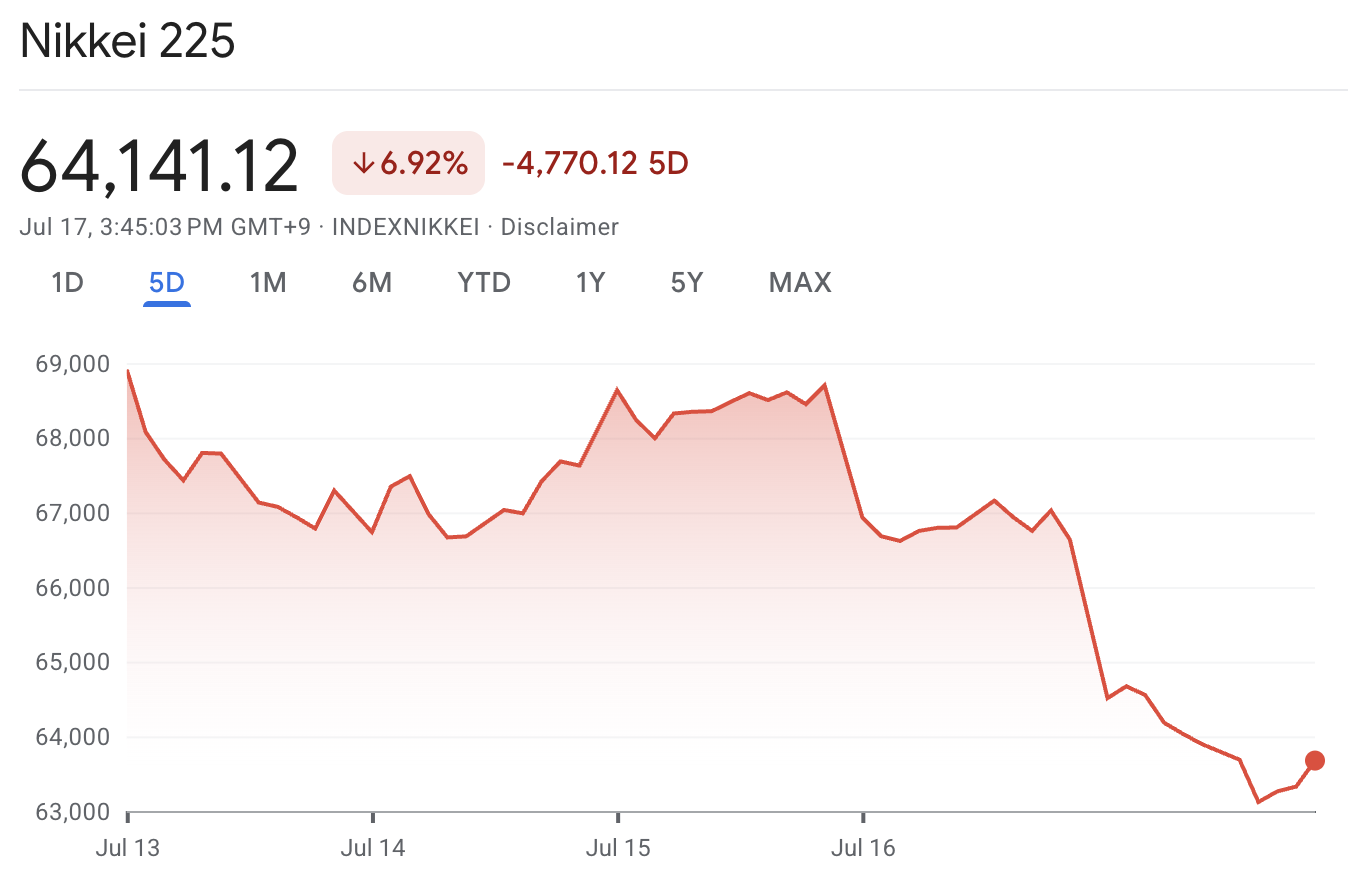
The move was less a verdict on Japan’s economy than a sharp unwind of artificial-intelligence, memory and semiconductor positions, amplified by the way the index is built.
The Nikkei 225 closed at 64,141.12 on 17 July 2026, down 2,694.42 points or 4.03%, after falling as much as 6.18% to an intraday low of 62,704.60.
The index finished about 11.4% below its 25 June record close of 72,366.34, entering correction territory, and lost 6.44% over the week.
The selloff was led by memory and chip-equipment names, with Kioxia down 16.10%, Sumco down 15.17% and Screen Holdings down 12.04%.
The price-weighted Nikkei fell harder than the market-cap-weighted TOPIX, which declined 2.72%, showing the damage was concentrated in high-priced technology shares.
A weak yen near 162 failed to cushion exporters as global chip selling dominated, while Brent crude near $85 added an import-cost and inflation risk.
The decline is a correction, not a bear market, and reads as a valuation unwind of crowded AI trades rather than evidence of broad economic deterioration.
The selling started overseas. The Philadelphia Semiconductor Index dropped 4.3% overnight, and US-listed shares of South Korean memory maker SK Hynix fell more than 13%. When Tokyo opened, Japanese chip, memory and equipment names absorbed that pressure.
South Korea’s market was shut for a holiday. Daiwa Securities senior strategist Daisuke Hashizume said the closure intensified selling pressure in Japan’s technology sector, particularly in Kioxia. With Korean chip stocks unavailable, Japanese semiconductor shares became a major outlet for regional investors cutting technology exposure.
The Nikkei is price-weighted rather than weighted by market value, so a large move in a high-priced stock can swing the index out of proportion to the company’s actual market capitalisation. That structure amplified Friday’s decline.
The contrast with the broader TOPIX makes the point. The market-cap-weighted TOPIX fell 2.72% to 3,919.21, less than the Nikkei’s 4.03% drop. The gap shows that high-priced technology and AI-linked shares drove a disproportionate share of the decline rather than the market falling uniformly.
Losses concentrated in memory, semiconductor equipment and AI proxies.
| Company | 17 July Move | What It Represents |
|---|---|---|
| Kioxia Holdings | -16.10% | NAND flash memory and AI storage |
| Sumco | -15.17% | Silicon wafers for chip production |
| Screen Holdings | -12.04% | Chip-manufacturing equipment |
| Taiyo Yuden | About -11.9% | Electronic components |
| SoftBank Group | About -9.0% | AI investment and technology exposure |
| Tokyo Electron | About -8.4% | Semiconductor-production equipment |
| Advantest | About -7.5% | Semiconductor-testing equipment |
Reuters confirmed the Kioxia, Sumco and Screen moves, while closing-price data placed Tokyo Electron down about 8.4% and Advantest down about 7.5%.
Kioxia is the sharpest example of the reversal. Its market value briefly passed Toyota’s in June after an enormous AI-driven memory rally, but its shares have since fallen more than 50% from their peak, even as analysts argue that the longer-term demand story around AI data centres remains intact.
Not entirely. The selloff is less about whether AI demand exists and more about whether AI-related profits can rise fast enough to justify the prices investors were paying.
Hashizume said the long-term trend in AI and data centres had not changed, but investors were questioning whether memory-chip prices could continue rising sustainably. Shoichi Arisawa of Iwai Cosmo Securities similarly argued that the business environment and semiconductor demand outlook had not fundamentally changed.
Memory and chip shares had posted extraordinary gains through the first half of 2026. Even after Thursday’s US decline, Micron remained up just under 199% for the year, while SanDisk was still up about 494%.
Gains of that scale leave the market exposed once investors start questioning future memory prices, capital spending or the eventual payoff from AI infrastructure. The market is reducing the valuation premium attached to AI, not declaring the theme finished.
USD/JPY was trading around 162.36 to 162.38 on Friday afternoon, a level that normally supports Japanese exporters by lifting the yen value of overseas earnings. On this occasion, that tailwind was overwhelmed by the global retreat from chip and AI shares.
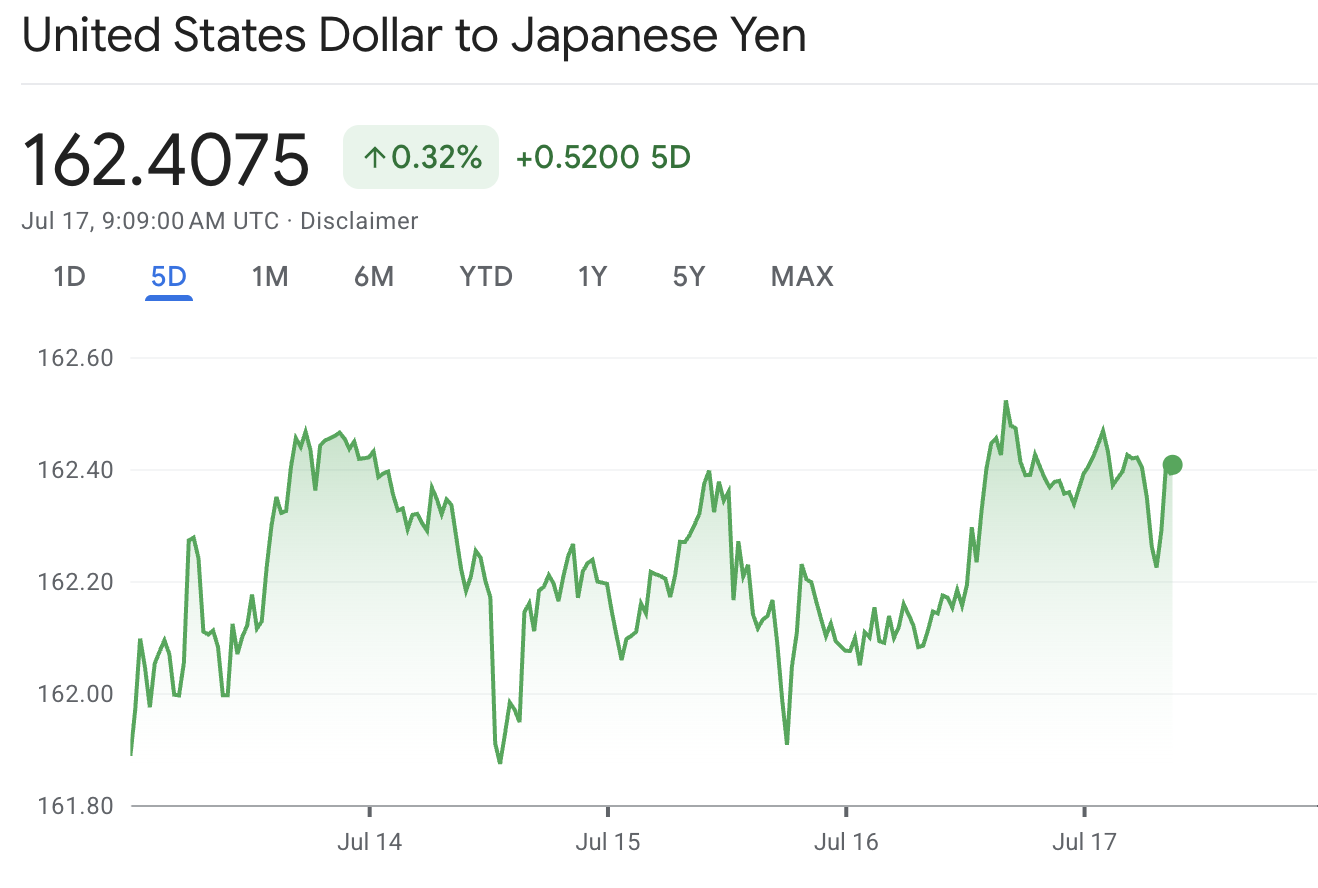
A very weak yen is also a more mixed benefit than it once was. It raises Japan’s import bill, especially when energy prices are elevated. Brent crude briefly rose to $85.13 a barrel earlier in the session before easing toward approximately $84.25 to $84.55 later in Asian and early European trading.
The combination of an exceptionally weak currency and expensive imported energy can squeeze Japanese consumers and companies dependent on overseas fuel and raw materials.
Breadth was weak. Within the Nikkei, 152 constituents fell, 71 rose and two were unchanged.
The damage spread beyond the headline semiconductor names. Mitsubishi UFJ fell about 4.66%, Sumitomo Mitsui Financial Group lost roughly 4.64%, and Hitachi declined about 2.63%. The picture was not uniform, though. Toyota slipped only around 0.55%, while Sony gained approximately 1.22%.
The session had two layers: a technology-led index shock, followed by broader risk reduction as global equities weakened and concerns about oil, inflation and geopolitical risk increased.
A correction is generally defined as a decline of at least 10% but less than 20% from a recent peak. A bear market usually begins after a fall of 20% or more. At approximately 11.4% below its 25 June record close, the Nikkei is in correction territory but remains well above the conventional bear-market threshold.
Even after Friday’s drop, the benchmark remains substantially higher than it was one year ago. This correction follows an unusually powerful advance rather than a long period of weak performance.
Around 64,000: Friday’s close at 64,141.12 makes this the immediate reference point. Holding this area would suggest that the most aggressive forced selling is beginning to slow.
Around 62,700 to 63,000: Friday’s intraday low was 62,704.60. A return to this zone would test whether buyers are willing to defend the session low or whether investors are still selling rebounds.
Around 65,000: Reclaiming 65,000 would ease immediate downside pressure, although a brief move above it would not be enough. The index would need to hold there while Tokyo Electron, Advantest and SoftBank stabilise.
Around 66,800: Thursday’s closing level was 66,835.54. Recovering it would repair Friday’s breakdown and suggest that part of the decline was capitulation rather than the beginning of another sustained leg lower.
US semiconductor trading. Tokyo will take its next cue from Nvidia, Micron, SanDisk, Western Digital and the Philadelphia Semiconductor Index. Another steep US chip decline would likely keep pressure on Tokyo Electron, Advantest and Kioxia. Nvidia fell 2.4% on Thursday, Micron lost 5.6%, SanDisk dropped 12.6% and Western Digital declined 9.2%.
Memory prices and guidance. The central question is whether memory producers continue reporting tight supply and rising prices or begin warning that customers are slowing orders.
Oil and the Middle East. Brent returning above $85 and staying there would sharpen concerns about Japanese import costs and inflation. A clear de-escalation or improvement in shipping conditions around the Strait of Hormuz would remove part of the geopolitical premium.
USD/JPY. A sustained move beyond 162 would increase intervention speculation. A sudden yen rally would create a separate problem for exporter shares, even though the current weak yen has not protected the Nikkei.
Nikkei versus TOPIX. If the Nikkei continues underperforming TOPIX, the correction remains primarily a technology and index-concentration unwind. If TOPIX begins falling at a similar rate, the weakness is spreading more decisively into domestic and economically sensitive sectors.
The decline is best read as a sharp reversal of AI, memory and semiconductor trades, magnified by the price-weighted structure of the Nikkei. It is not yet evidence that Japan’s wider economy or corporate sector has suddenly deteriorated.
Still, the move has outgrown a single bad day. The index is about 11.4% below its June record, chip leaders have surrendered large parts of their gains, and geopolitical risk is adding a second source of pressure. The first sign of stabilisation would be the Nikkei holding above 64,000 while semiconductor shares stop making new lows.