Published on: 2026-07-28
Updated on: 2026-07-28
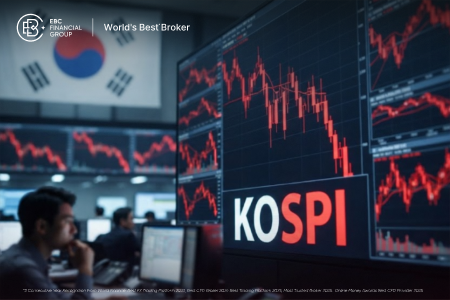
The KOSPI fell far harder than Asia’s other major chip-heavy markets, triggering its eighth circuit breaker of 2026. Foreign selling and double-digit losses in Samsung Electronics and SK hynix magnified the global semiconductor rout, while CXMT’s rise revived fears of weaker memory pricing.
The rest of the session will show whether the pressure remains concentrated in chip shares or begins spreading into the won and the wider Korean market.

The 8% threshold triggered a 20-minute marketwide halt, showing how rapidly semiconductor selling had spread across the benchmark.
Samsung Electronics and SK hynix were down about 11% and 12%, respectively, in a late-morning snapshot, giving weakness in two companies an outsized influence over the KOSPI.
Japan and Taiwan also declined sharply, but Korea’s deeper fall shows how index concentration and foreign outflows amplified the regional shock.
CXMT can pressure conventional DRAM prices without matching Korea in advanced high-bandwidth memory, where the Chinese producer still faces technological and equipment constraints.
The won remains the deciding signal. Its limited decline points to an equity selloff, while a sharper depreciation would indicate that the pressure is spreading across Korean assets.
South Korea fell roughly twice as much as Japan and Taiwan because the KOSPI concentrates exceptional weight in Samsung Electronics and SK hynix. The overnight U.S. chip selloff supplied the trigger, but late-morning losses of about 11% in Samsung Electronics and 12% in SK hynix turned sector weakness into a marketwide shock.
| Market | Snapshot move | Main exposure |
|---|---|---|
| KOSPI | -8.02% | Samsung Electronics, SK hynix |
| Nikkei 225 | About -4.4% | Chip equipment |
| TAIEX | About -4.2% | Foundries and AI hardware |
| PHLX Semiconductor | -2.2% | U.S. chipmakers |
The KOSPI figure reflects the 10:13 a.m. KST circuit-breaker level. The Nikkei figure is an intraday reading, the TAIEX figure reflects its early-morning low, and the PHLX figure is Monday’s closing move.
The same concentration that powered the KOSPI’s earlier rise is now working in reverse. Samsung Electronics and SK hynix together account for more than half of the benchmark, allowing weakness in two memory producers to exert more influence than losses spread across a broader market.
Doubts over AI spending deepen that exposure. Memory demand depends heavily on continued data-centre construction and investment in accelerators, servers and supporting infrastructure. Slower capital expenditure or weaker returns on AI projects would reduce expected demand for both conventional DRAM and high-bandwidth memory.
Foreign investors were net sellers of approximately ₩2.16 trillion at the latest accessible intraday snapshot, while individuals bought about ₩2.27 trillion. The KOSPI still fell more than 9%, with only 45 advancing stocks against 861 decliners. The imbalance shows that domestic buying absorbed shares without restoring control of the benchmark.
The Korea Exchange paused program sell orders at 9:06 a.m. About an hour later, the full market halted for 20 minutes after the KOSPI remained more than 8% below its previous close for one minute. The sidecar slowed execution, but it did not remove the underlying selling pressure.
Retail demand could not offset double-digit losses in the index’s two largest semiconductor names. Price direction depended less on the similarity of the buying and selling totals than on where the strongest orders were concentrated.
The circuit breaker showed how quickly the imbalance had spread through the market. It did not establish a bottom.
CXMT does not need to match Samsung Electronics or SK hynix in high-bandwidth memory to pressure Korean earnings. Greater conventional DRAM production can ease shortages and weaken contract prices even while China remains behind in advanced HBM.
CXMT opened 472% above its RMB8.66 IPO price and finished its first session 466% higher. The company raised at least $8.6 billion, giving it substantial capital to expand production.
Its competitive scale depends on the metric used. CXMT held about 7.7% of global DRAM revenue in the first quarter of 2026, accounted for roughly 9% of shipments and represented about 11% of wafer capacity. The higher capacity share reflects production potential rather than equivalent revenue or technological capability.
CXMT is expanding near the strongest point of the current memory cycle. Korea’s HBM lead protects its most advanced products, not the pricing of conventional DRAM.
The won has not confirmed the panic visible in Korean equities. USD/KRW traded near ₩1,467, up only about 0.1% during the session even as the KOSPI fell more than 9%. The comparatively small currency move points to concentrated equity selling rather than an immediate flight from Korean assets.
Three developments would show that the selloff is spreading.
The won weakens sharply while Samsung Electronics and SK hynix continue falling.
Foreign selling remains heavy after index futures begin to stabilise.
Losses keep broadening beyond semiconductor and technology shares.
A rebound in chip stocks alone would not settle the question. Slower foreign selling alongside a stable won would provide stronger evidence that the shock remains contained.
A sidecar pauses program sell orders for five minutes when KOSPI 200 futures fall by at least 5% from their reference price and remain there for one minute. A Level 1 circuit breaker halts the full market for 20 minutes after the KOSPI remains at least 8% below its previous close for one minute.
No. A circuit breaker temporarily slows trading after an extreme decline. It does not change earnings expectations, memory prices or foreign positioning, and the market can continue falling after trading resumes.
Retail buyers purchased more than ₩2.2 trillion of shares, but Samsung Electronics and SK hynix continued to record double-digit losses. Their exceptional index weight allowed weakness in the two companies to outweigh buying elsewhere in the market.
SK hynix reports second-quarter results at 9:00 a.m. KST on July 29. Strong HBM demand and firm pricing guidance would support the view that concentrated selling pushed the KOSPI further than memory fundamentals justified.
Weak demand or softer pricing would show that the market is questioning the earnings cycle itself. If strong results fail to slow foreign selling, the KOSPI is repricing Korea’s memory outlook, not one bad session.