Published on: 2026-07-27
Updated on: 2026-07-27
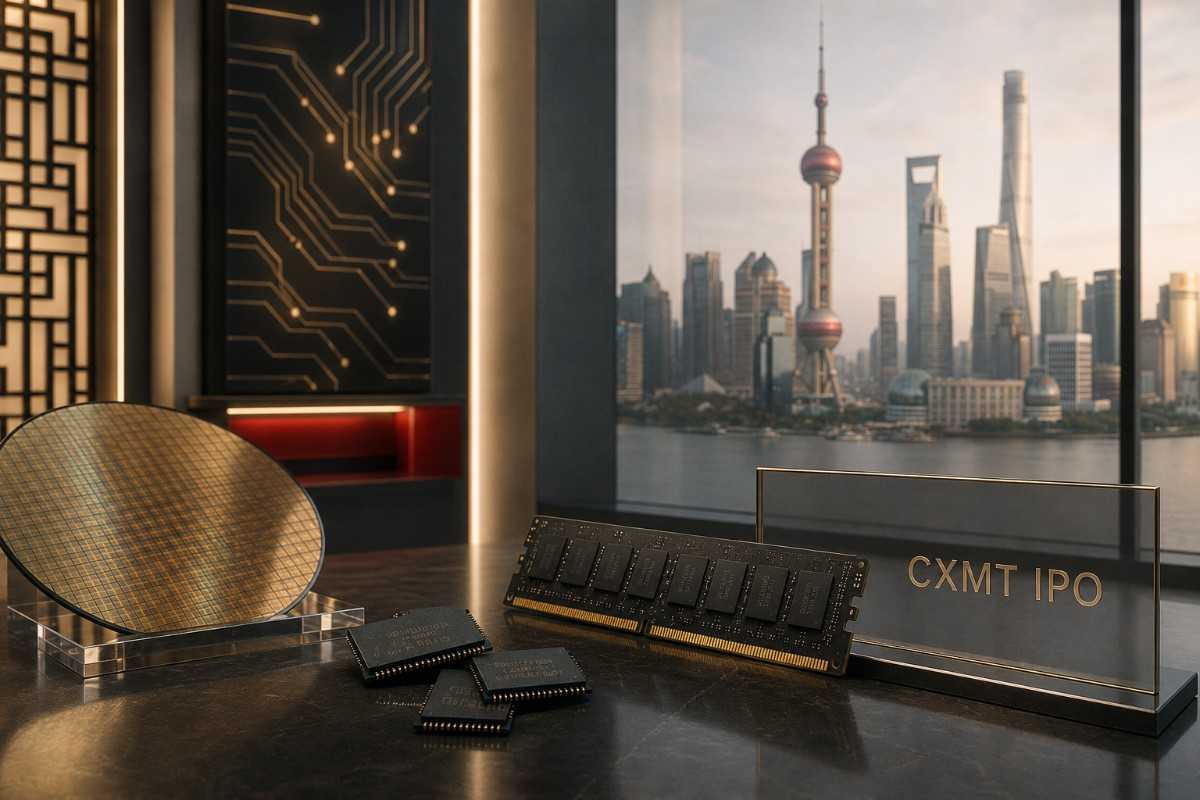
CXMT stock’s first trade produced a $489 billion valuation for a company with about 7.7% of the global DRAM market. A restricted float placed CXMT far closer to Samsung, SK Hynix and Micron in market value than in technology, market share or earnings power.
CXMT is already large enough to pressure conventional DRAM pricing. At the same time, HBM progress, durable margins and global customers will decide whether the debut marked a new industry order or a scarcity-driven peak.
CXMT’s July 24 listing announcement showed that less than 7% of its enlarged share capital was initially unrestricted, while the official allocation notice recorded institutional demand equal to about 570 times the final offline allocation.
The opening price equalled roughly 29 to 33 times annualized 2026 earnings, assuming CXMT repeats its projected first-half profit during the rest of the year.
CXMT represents about 11% of global DRAM wafer capacity and aims to approach 15% by 2028, giving it enough scale to pressure conventional-memory pricing before reaching HBM parity.
Samsung, SK Hynix and Micron are producing or shipping HBM4, while CXMT is targeting the older HBM3 generation.
Apple qualification and the January 27, 2027 lock-up expiry will provide the first major commercial and share-supply tests of whether business performance can support the price once scarcity eases.
CXMT’s first trade added about RMB2.73 trillion to its implied value before its revenue, production capacity or technology had changed. CXMT’s July 24 listing announcement showed that 4.503 billion shares were initially unrestricted, equal to 6.73% of post-IPO capital before exercise of the greenshoe and 6.63% if the option is fully exercised.
The initial offering represented 10% of CXMT’s enlarged share capital before the greenshoe, but not all issued shares were immediately tradable. Strategic placements carried separate lock-ups, while 70% of the final offline institutional allocation was locked for six months. The official allocation notice recorded valid offline orders equal to about 570 times the final offline allocation.
The RMB49.50 opening price was established within that restricted pool and applied across CXMT’s entire share base, producing an implied market capitalization near RMB3.31 trillion. China’s semiconductor strategy and strong DRAM pricing attracted demand, while the limited float amplified how forcefully that demand reached the share price.
CXMT forecasts first-half 2026 revenue of RMB110 billion to RMB120 billion and attributable profit of RMB50 billion to RMB57 billion. Repeating that performance during the second half would place the opening valuation at roughly 29 to 33 times annualized earnings and 14 to 15 times annualized sales.
Those figures use earnings generated during a DRAM shortage. Rising contract prices, stronger server demand and an improving product mix have lifted profitability across the industry, making current conditions an aggressive base for future valuation.
CXMT must keep gaining market share while improving manufacturing yields, product quality and margins after memory pricing normalizes. Higher production alone cannot sustain a premium multiple if new capacity eventually weakens industry pricing.
The opening valuation already assumes that CXMT’s growth will outlast the shortage.
CXMT represents about 11% of global DRAM wafer capacity and aims to approach 15% by 2028. That scale can reduce China’s reliance on imported memory and expand domestic supplies for computers, servers and smartphones.
Factory capacity does not produce comparable profits on its own. Manufacturing yield, chip density and product mix determine how much valuable memory each wafer generates. High-bandwidth memory earns higher margins because AI accelerators require far greater data throughput than standard memory products.
| Company | DRAM share | HBM status | Main edge |
|---|---|---|---|
| Samsung | 38.5%, Q1 2026 | Shipping HBM4 | Manufacturing scale |
| SK Hynix | 28.8%, Q1 2026 | HBM4 production ready | HBM leadership |
| Micron | 22.4%, Q1 2026 | Shipping HBM4 | HBM4 ramp |
| CXMT | 7.7%, Q4 2025 | Targeting HBM3 | Domestic market access |
Samsung, SK Hynix and Micron market shares cover the first quarter of 2026. CXMT’s latest disclosed figure covers the fourth quarter of 2025.
The table shows a full product-generation gap between CXMT and the established producers. Closing it requires more than additional factories because HBM also depends on advanced packaging, manufacturing yields and customer qualification.
Export controls increase the cost and difficulty of producing advanced memory by restricting CXMT’s access to extreme ultraviolet lithography equipment. The constraint widens the gap between installed capacity and profitable production of higher-value chips.
CXMT does not need technological parity to alter the market. Additional DDR and mobile LPDDR supply could weaken conventional-memory pricing, leaving Samsung and Micron more exposed than SK Hynix, whose stronger HBM position provides greater protection.
Apple is testing CXMT DRAM and seeking US permission to use Chinese memory more broadly, including in some devices sold outside China. No supply agreement has been confirmed.
Qualifying for Apple would show that CXMT can meet the reliability, consistency and production-volume requirements of a major global customer. That outcome would carry more weight than another domestic contract because it would test CXMT against international supply-chain standards.
Even a limited order could change supplier negotiations by establishing CXMT as a credible fourth source. Apple would gain greater purchasing leverage, while Samsung, SK Hynix and Micron would face stronger pressure on pricing and contract terms when memory supply tightens.
CXMT Corporation trades on the Shanghai Stock Exchange STAR Market under ticker 688825. The shares are quoted in Chinese yuan and began trading on July 27, 2026.
CXMT was not included on the Northbound Stock Connect eligibility list updated on July 24, 2026. Access outside mainland China therefore depends on a brokerage or institutional route supporting mainland A-shares unless CXMT later becomes eligible for Stock Connect.
CXMT is developing HBM3, although it has not demonstrated large-scale commercial shipments comparable with Samsung, SK Hynix or Micron. Volume production and confirmed customer deliveries would provide clearer evidence of progress than development targets alone.
A larger supply of tradable shares is the clearest near-term risk. Seventy percent of the final offline institutional allocation carries a six-month lock-up from the July 27 listing, placing its first scheduled expiry on January 27, 2027. Falling DRAM prices, weaker yields, delayed HBM production or failure to secure global customers could add further pressure.
CXMT’s first post-listing earnings report will test whether margins can survive weaker DRAM pricing. Commercial HBM shipments and qualification by a global customer would show whether technological and commercial progress can support the valuation.
January 27, 2027 will provide the first direct share-supply test when the six-month lock-up on 70% of the final offline institutional allocation expires. The price response will reveal how much of the opening premium depended on restricted availability rather than durable demand.
Scarcity drove CXMT’s opening valuation. HBM, margins and global customers now have to defend it.