Published on: 2026-05-14
Updated on: 2026-05-14
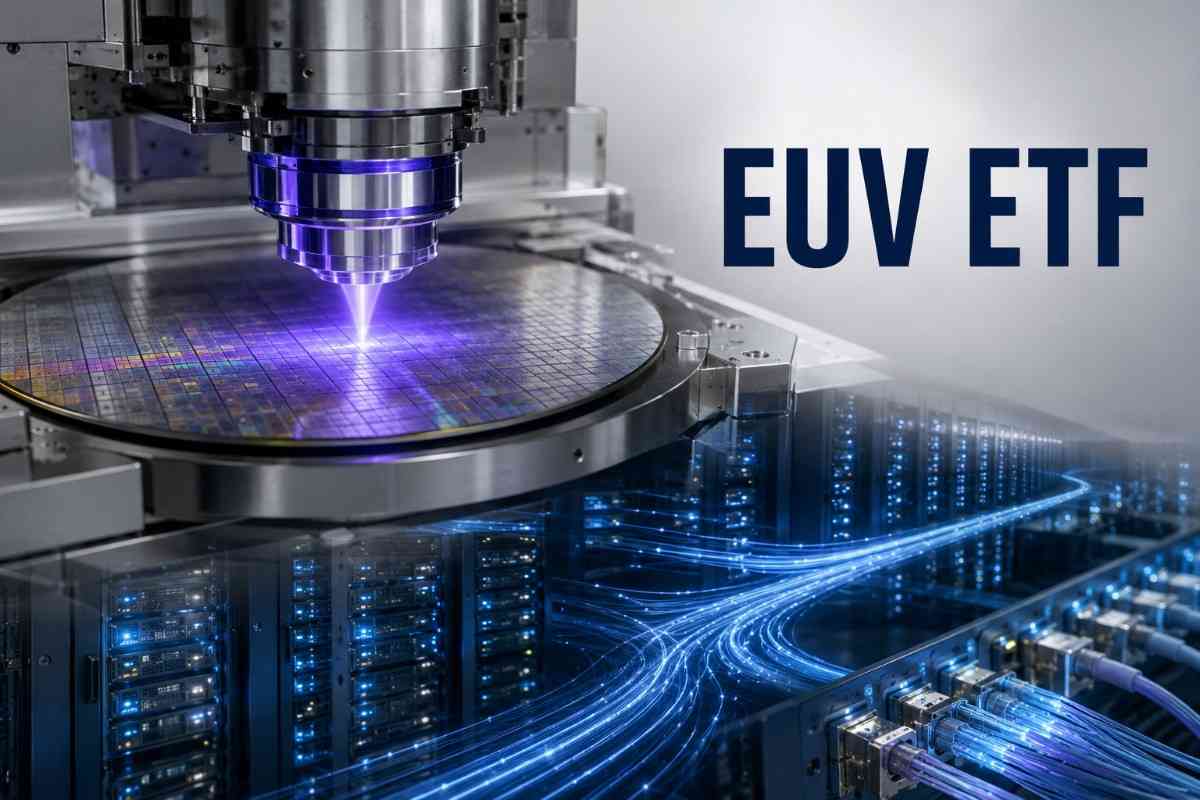
EUV ETF is not a pure ASML fund. It combines companies that make advanced chips, inspect chips, and move data through optical systems used in AI infrastructure.
Its holdings point to a mixed AI infrastructure trade, with exposure to TSMC, ASML, Corning, Lam Research, Applied Materials, Lumentum, Ciena, KLA, Coherent, and MACOM. The top 10 holdings account for about 52.5% of assets.
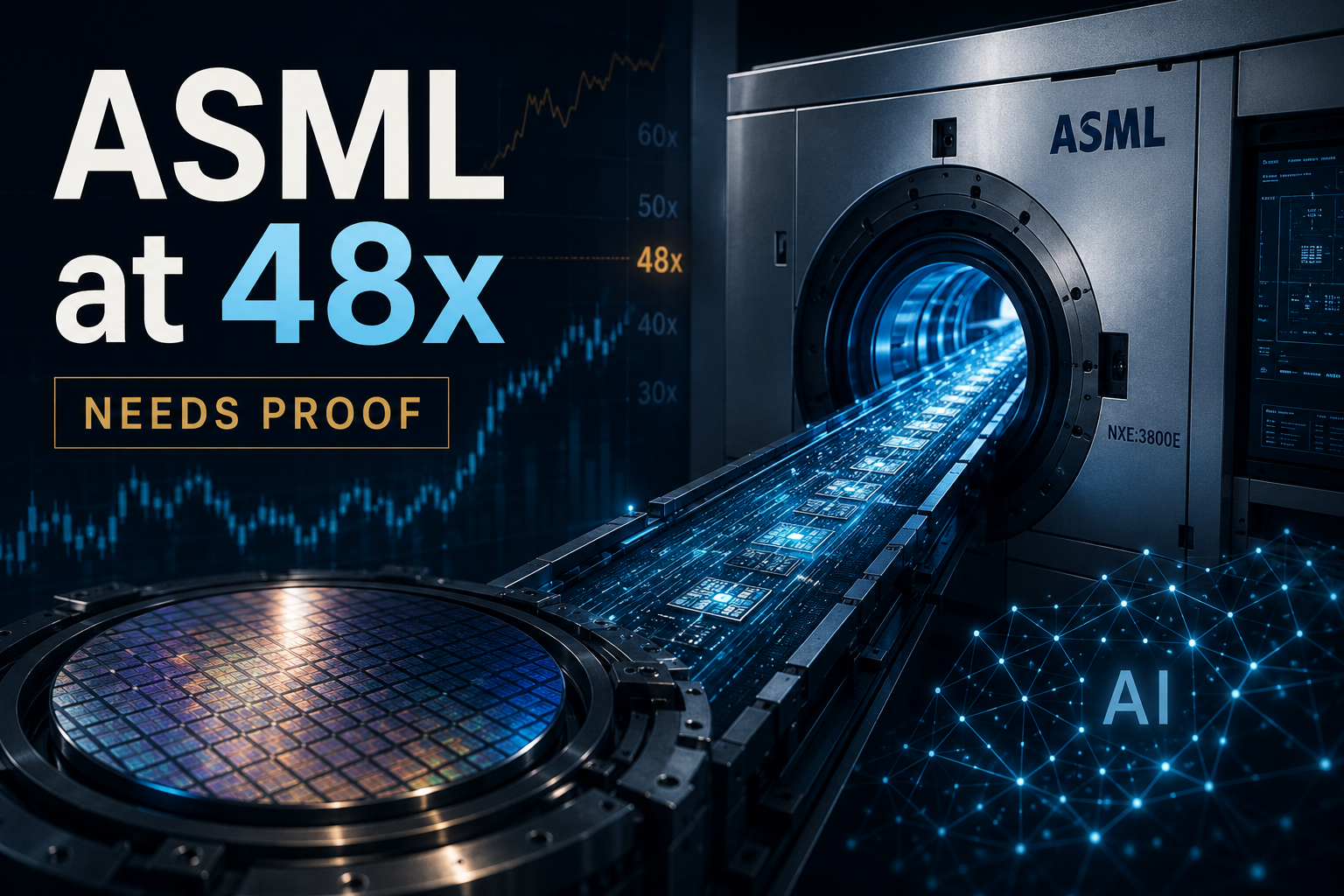
ASML gives the fund its strongest credibility anchor after reporting Q1 2026 net sales of €8.8 billion, 53.0% gross margin, and 2026 sales guidance of €36 billion to €40 billion.
EUV’s best setup comes when AI spending moves from GPUs into fabs, lithography tools, inspection systems, optical links, and high-speed data-center infrastructure.
The main risk is structure. EUV is new, active, non-diversified, and exposed to liquidity, bid-ask spread, premium or discount, export-control, and semiconductor capex-cycle risks. (EUV ETF SEC)
If photonics becomes a recognized AI bottleneck, EUV has a distinct portfolio role. If photonics remains a niche theme, EUV may struggle to justify itself against ASML, Nvidia, SMH, and SOXX.
EUV ETF gives investors one ticker for two AI bottlenecks: the tools that make advanced chips and the optical systems that move data fast enough to use them. Most investors buying the ticker may focus on the first and miss the second.
The portfolio question is not whether AI grows. It is where the next dollar of AI capex goes. If that dollar moves from GPUs into fabs, lithography tools, inspection systems, and optical links, EUV has a distinct role. If it stays concentrated in accelerators, the fund may struggle to justify itself beside ASML, NVIDIA, SMH, and SOXX.
| EUV ETF snapshot | Current signal |
|---|---|
| Fund name | Corgi Lithography & Semiconductor Photonics ETF |
| Ticker | EUV |
| Launch date | 6 May 2026 |
| Strategy | Active thematic ETF |
| Expense ratio | 0.35% |
| Number of holdings | 40 |
| Top 10 weight | About 52.5% |
| Core issue | New fund with limited trading history |
EUV ETF is the Corgi Lithography & Semiconductor Photonics ETF. It launched on 6 May 2026 and trades on Cboe BZX under the ticker EUV. The fund is actively managed, charges a 0.35% expense ratio, and targets companies involved in lithography, chip inspection, optical components, and AI data-center infrastructure.
In short, EUV owns companies that use light to make chips, test chips, or move data. That gives the fund a wider identity than its ticker. EUV lithography is the headline, but the portfolio spans the physical systems that underpin AI.
The fund is too new for performance history to carry much weight. Early due diligence should focus on holdings, liquidity, trading spreads, and whether EUV offers exposure investors cannot already get through ASML, Nvidia, SMH, or SOXX.
The holdings reveal why EUV should not be treated as an ASML substitute.
| Exposure layer | Example EUV holdings | What investors are really buying |
|---|---|---|
| Foundry capacity | TSMC | Advanced chip production scale |
| Lithography | ASML | The bottleneck in leading-edge chipmaking |
| Wafer-fab equipment | Lam Research, Applied Materials, KLA | Semiconductor capex sensitivity |
| Optical infrastructure | Corning, Ciena, Lumentum, Coherent | AI data-center bandwidth exposure |
| High-speed components | MACOM | Data transmission and connectivity demand |
The fund’s breadth improves diversification inside the theme, but it dilutes precision. Investors expecting a pure EUV lithography trade are getting something wider: a portfolio tied to fabs, inspection, optical networking, and AI data-center buildouts.
No. ASML remains the most obvious reference point, but EUV is not built as a single-company wrapper.
ASML reported Q1 2026 net sales of €8.8 billion, net income of €2.8 billion, and gross margin of 53.0%. It also raised full-year 2026 net sales guidance to €36 billion to €40 billion, with expected gross margin of 51% to 53%. Those figures keep ASML at the center of the advanced-chip manufacturing story. (ASML News Release)
EUV shareholders still face a wider set of drivers. Strong ASML orders support the lithography sleeve. Rising fab spending can support Lam Research, Applied Materials, and KLA. Data-center bandwidth demand can support optical names such as Ciena, Lumentum, Coherent, and Corning.
That is the portfolio tradeoff. EUV reduces single-stock dependence on ASML, but it also gives investors exposure to companies that may respond to different earnings cycles.
Broad semiconductor ETFs usually give investors exposure to the largest chip designers, foundries, memory companies, and equipment suppliers. They are easier to understand, more established, and often more liquid.
EUV targets a narrower question: what happens when AI demand pushes spending into the physical systems behind chips and data centers?
| Investor question | Broad semiconductor ETF | EUV ETF |
|---|---|---|
| I want simple AI chip exposure | Better fit | More specialized |
| I want Nvidia-heavy exposure | Better fit | Weaker fit |
| I want ASML and chip-equipment exposure | Partial fit | Stronger fit |
| I want optical networking exposure | Partial fit | Stronger fit |
| I need long trading history | Better fit | Still developing |
EUV does not replace a broad semiconductor ETF for most retail portfolios. It works better as a satellite position for investors who already understand the semiconductor cycle and want more focused exposure to chipmaking and data-movement bottlenecks.
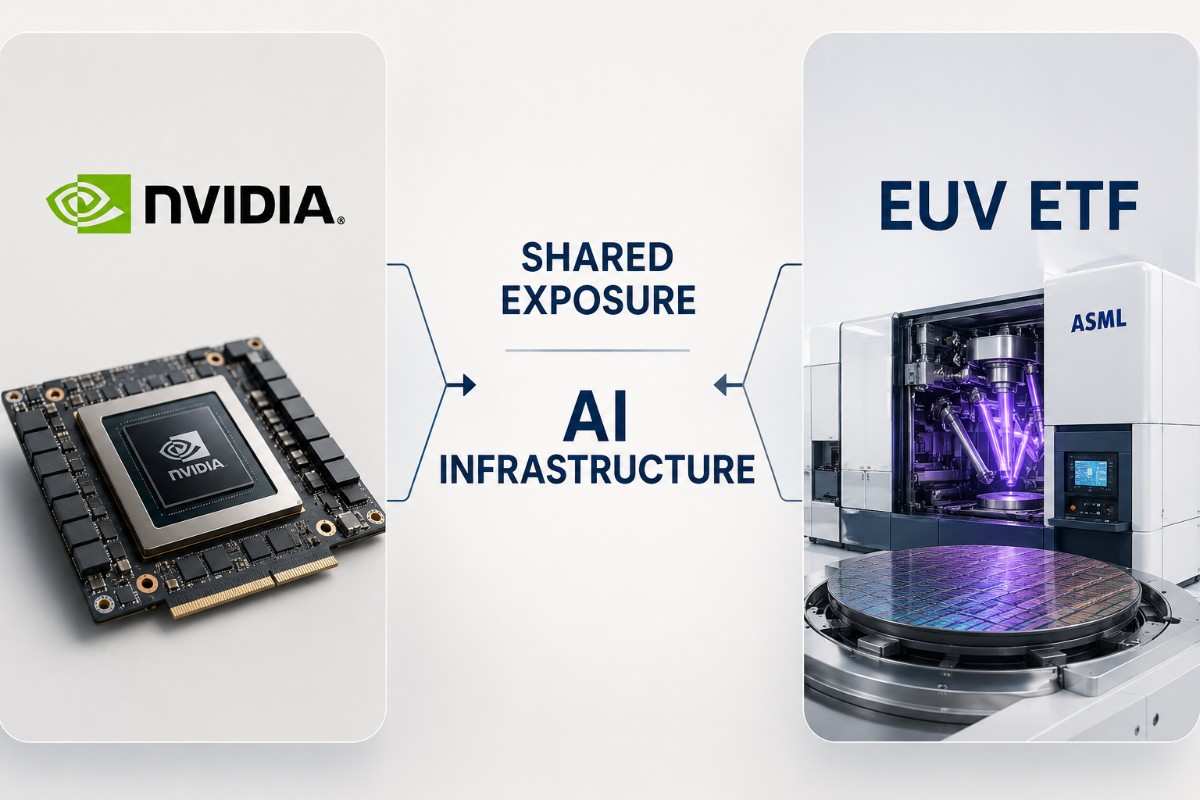
Nvidia gives investors direct exposure to AI compute demand. EUV ETF targets a different layer: the companies that help manufacture advanced chips and move data across AI infrastructure.
That makes EUV less of a Nvidia substitute and more of a supply-chain complement. Nvidia rises and falls with accelerator demand, margins, platform strength, and competition. EUV depends more on foundry expansion, lithography orders, wafer-fab equipment spending, optical networking upgrades, and data-center buildouts.
If AI spending stays concentrated in GPUs, Nvidia and broad semiconductor ETFs remain the cleaner trade. If capital shifts toward fabs, process tools, optical links, and interconnects, EUV gains a clearer portfolio role.
The portfolio question is not whether AI grows. It is where the next dollar of AI capex goes.
EUV’s strongest relative setup depends on three conditions: firm advanced-node demand, rising fab-equipment spending, and wider recognition of photonics as an AI bottleneck.
ASML’s upgraded 2026 guidance shows customers are still expanding advanced-chip capacity, while SEMI projects worldwide 300mm fab-equipment spending to rise 18% to $133 billion in 2026 and 14% to $151 billion in 2027. That supports EUV’s lithography and equipment exposure.(SEMI Press Release)
The harder test is photonics. If investors start pricing optical links, lower-latency networking, and data-center interconnects beside lithography as core AI constraints, EUV has a clearer reason to stand beside SMH and SOXX. If they do not, the fund may trade like a narrower semiconductor-equipment ETF with a more complex label.
EUV can underperform even if AI demand stays strong.
A foundry spending pause would pressure equipment names. An ASML order reset would weaken the lithography thesis. A de-rating in optical networking stocks would hurt the photonics sleeve. Tighter export controls could affect sales channels, customer mix, and valuations across advanced semiconductor suppliers.
Fund structure adds another layer. EUV is new, active, non-diversified, and can trade above or below net asset value. Investors also pay bid-ask spreads, which can widen when liquidity is thin.
A strong theme does not protect investors from poor entry points, thin trading, or a portfolio that behaves differently than the ticker implies.
Yes. EUV is a new thematic ETF with limited trading history. It is actively managed, non-diversified, and exposed to liquidity, export-control, bid-ask spread, and semiconductor spending-cycle risks. A broad semiconductor ETF is easier for most beginners to evaluate.
EUV can benefit if AI demand turns into higher spending on advanced chip factories, lithography tools, inspection systems, and optical data-center infrastructure. If AI spending stays concentrated in GPU makers, EUV may lag more direct AI chip stocks.
EUV is not a Nvidia replacement. Nvidia gives direct exposure to AI compute demand. EUV gives exposure to the supply chain that helps manufacture advanced chips and move data. The better fit depends on whether the investor wants the AI leader or the infrastructure layer behind it.
EUV’s thesis does not depend on AI hype alone. It depends on whether investors start pricing photonics as a real AI constraint beside lithography, rather than a secondary theme trailing GPU demand.
The signal to watch is not just EUV’s share price. The question is whether ASML orders, fab-equipment spending, and optical networking revenue begin moving within the same AI infrastructure cycle. If those signals converge, EUV becomes more than a clever ticker. If they do not, investors may keep owning the trade through ASML, Nvidia, SMH, and SOXX.