Published on: 2026-05-25
A diversified portfolio across Asian stock markets is becoming a sharper decision in 2026, as the region is no longer moving as one trade. The Nikkei 225, China A50 Index and Hang Seng Index now give traders three distinct ways to approach Asia: Japan’s reform-led equity cycle, mainland China’s policy-sensitive recovery, and Hong Kong’s globally traded China exposure.
The World Bank predicts that China’s growth will slow from 5.0% in 2025 to 4.2% in 2026. Growth in developing East Asia and the Pacific will remain above the global average, but it is also slowing. So, making smart investments in Asia in 2026 is not just about adding more markets. It means picking the right markets for the current conditions.
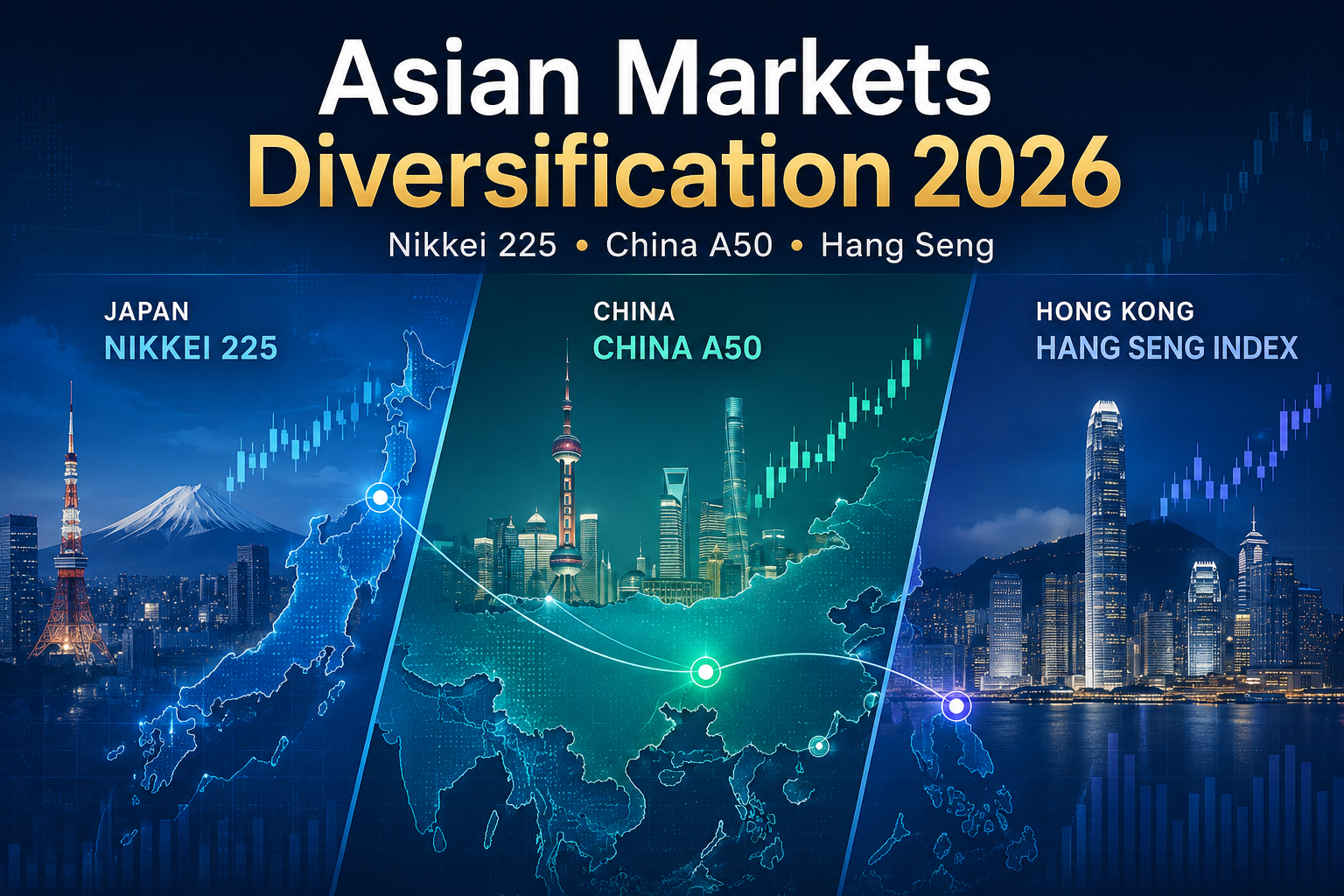
Asian markets still offer growth exposure, but higher energy costs, policy divergence and currency sensitivity make single-market positioning riskier in 2026.
The Nikkei 225 offers developed-market Asia exposure, with Japan’s JP225 CFD proxy reaching 65,178 on 25 May 2026 after gaining 7.67% over one month.
The China A50 Index provides direct exposure to 50 of the largest mainland A-share companies listed on the Shanghai and Shenzhen exchanges.
The Hang Seng Index provides Hong Kong-listed China exposure and closed at 25,606.03 on 22 May 2026, reflecting a market still shaped by offshore liquidity and China sentiment.
Index CFDs can help active traders express broad market views without selecting individual stocks, though leverage requires strict position sizing and risk control.
Many people think diversification is simply about investing in various countries. However, by 2026, this strategy alone will not be sufficient. Japan, mainland China and Hong Kong respond to different drivers.
Japan is being priced in by corporate governance reform, shareholder returns, technology demand, and the yen. Mainland China is more sensitive to policy support, credit conditions, domestic consumption and property-sector repair. Hong Kong sits between China's fundamentals and global capital flows, making it highly responsive to offshore investor sentiment.
This distinction is important. Investing only in US stocks can make your portfolio overly dependent on a single interest-rate cycle and technology sector performance. Focusing solely on China may tie your results too closely to policy decisions. Including a broader range of Asian markets helps reduce reliance on any one market. The aim isn’t to own every possible asset. Instead, each investment should have a clear purpose in your portfolio.
The Nikkei 225 is often treated as the headline measure of Japanese equities. It tracks 225 stocks listed on the Tokyo Stock Exchange Prime Market and is calculated as a price-weighted average, meaning higher-priced stocks can have a larger influence on index movement.
When building a portfolio, the Nikkei 225 can serve as the quality-momentum component for Asian exposure. It includes Japan’s exporters, automation leaders, financial companies, and technology-related firms. It also reacts strongly to currency moves. A weaker yen can support exporter earnings, while a stronger yen can quickly change the valuation picture.
Japan’s market in 2026 offers more than just rising prices. Ongoing governance reforms, better capital discipline, and growing foreign interest are all helping. For traders looking for Asian exposure but wanting to avoid direct risk from mainland China, the Nikkei 225 is still a straightforward option.
The China A50 Index focuses on 50 of the largest A-share companies listed in Shanghai and Shenzhen. This gives traders a straightforward way to access China’s domestic stock market.
This index is useful when expecting a recovery driven by government policy support. Banks, insurers, consumer companies, and industrial firms often react to changes in credit, stimulus, and local demand. Unlike offshore China benchmarks, the China A50 is less affected by global trends and more by what happens inside China.
In a diversified portfolio, the China A50 is best used as a focused bet on China. It can rise quickly when policy boosts confidence, but it may fall just as fast if economic data is weak or if stimulus hopes are not met.
The Hang Seng Index gives traders another type of China exposure. It tracks major Hong Kong-listed companies and is built on a free-float-adjusted market capitalisation approach, making it a key benchmark for Hong Kong’s listed equity market.
The Hang Seng Index offers strong accessibility and liquidity. It serves as a single benchmark for China-linked technology, financials, consumer sectors, and multinational capital flows. The index tends to rise when global investors increase their exposure to China and decline when offshore risk appetite decreases.
Within an Asian portfolio, the Hang Seng Index falls between the Nikkei 225 and the China A50 Index. It is more sensitive to China than Japan, yet typically trades more globally than domestic A-shares.
If one wants broad market exposure but does not want to pick individual Japanese, mainland Chinese, or Hong Kong-listed stocks, index CFDs gives a straightforward way to take a view on the region. Through EBC’s index CFD offering, traders can access major global indices, including the Nikkei 225, while using one account to monitor multiple markets. EBC also notes that index CFDs allow traders to speculate on index price movements without owning the underlying assets, which can simplify market-wide positioning compared with building a basket of individual shares.
A trader focused on growth could use the Nikkei 225 for core Asian momentum, the Hang Seng Index for exposure to China’s liquidity, and the China A50 Index for tactical moves based on stimulus or local data. Someone more cautious might lower their China A50 exposure, keep less in the Hang Seng, and rely more on Japan as the developed-market part of their mix.
For example, if oil prices go up quickly, Asian countries that import energy could see higher costs and inflation. If China’s government announces more fiscal support, the China A50 might respond more quickly than Japan. If global yields drop and investors become more willing to take risks, the Hang Seng Index could see more money coming in from abroad.
The main point is that you do not need to give each part an equal weight. It is correlation awareness. Three Asian indices do not automatically create diversification if every position depends on the same risk-on trigger. A stronger portfolio asks what would make each trade work, what would make it fail, and whether the exposures overlap more than they appear.
It can improve balance when US exposure is concentrated in a narrow group of sectors or mega-cap names. Asian markets add different currencies, policy cycles and earnings drivers. The benefit depends on whether each Asian index serves a distinct role rather than duplicating the same risk-on trade.
The China A50 Index tracks large mainland A-share companies listed in Shanghai and Shenzhen. The Hang Seng Index tracks major Hong Kong-listed companies and is more exposed to offshore capital flows. China A50 is more domestic-policy driven, while Hang Seng often reflects global sentiment toward China.
The Nikkei 225 gives exposure to Japan’s large-cap market, including exporters, technology-linked firms and financials. It can provide developed-market Asia exposure within a diversified portfolio, especially for traders who want Asian equity exposure without relying only on China-related assets.
Yes, index CFDs can help traders express broad market views without buying individual stocks. They are useful for tactical exposure to benchmarks such as the Nikkei 225, the China A50 Index, and the Hang Seng Index. They also involve leverage, so position sizing and risk limits remain essential.
It depends on the trading view. The Nikkei 225 may suit momentum and currency-sensitive strategies. The China A50 Index may suit policy-driven China trades. The Hang Seng Index may suit traders watching offshore China sentiment, technology shares and global liquidity conditions.
The Nikkei 225 offers Japan’s reform and momentum cycle. The China A50 Index gives direct mainland policy exposure. The Hang Seng Index provides a liquid offshore route into China-linked equities. Together, they create a more flexible Asian stock market framework than any single index can provide.
A diversified portfolio is more effective when each market serves a specific purpose. In a year marked by uneven growth, energy shocks, policy changes, and shifting capital flows, Asian diversification offers traders more than exposure. It provides flexibility to adapt.