Published on: 2026-04-24
Updated on: 2026-04-24
Thematic investing matters in 2026 because the strongest market trends no longer fit neatly within traditional sectors. A healthcare breakthrough can reshape food demand.
Artificial intelligence can lift semiconductor stocks while increasing pressure on power grids. Energy transition can affect utilities, miners, industrial companies, and inflation expectations.
This is the central idea behind thematic investing. Instead of asking only whether a company belongs to healthcare, technology, or consumer staples, investors examine how structural change moves through the economy.
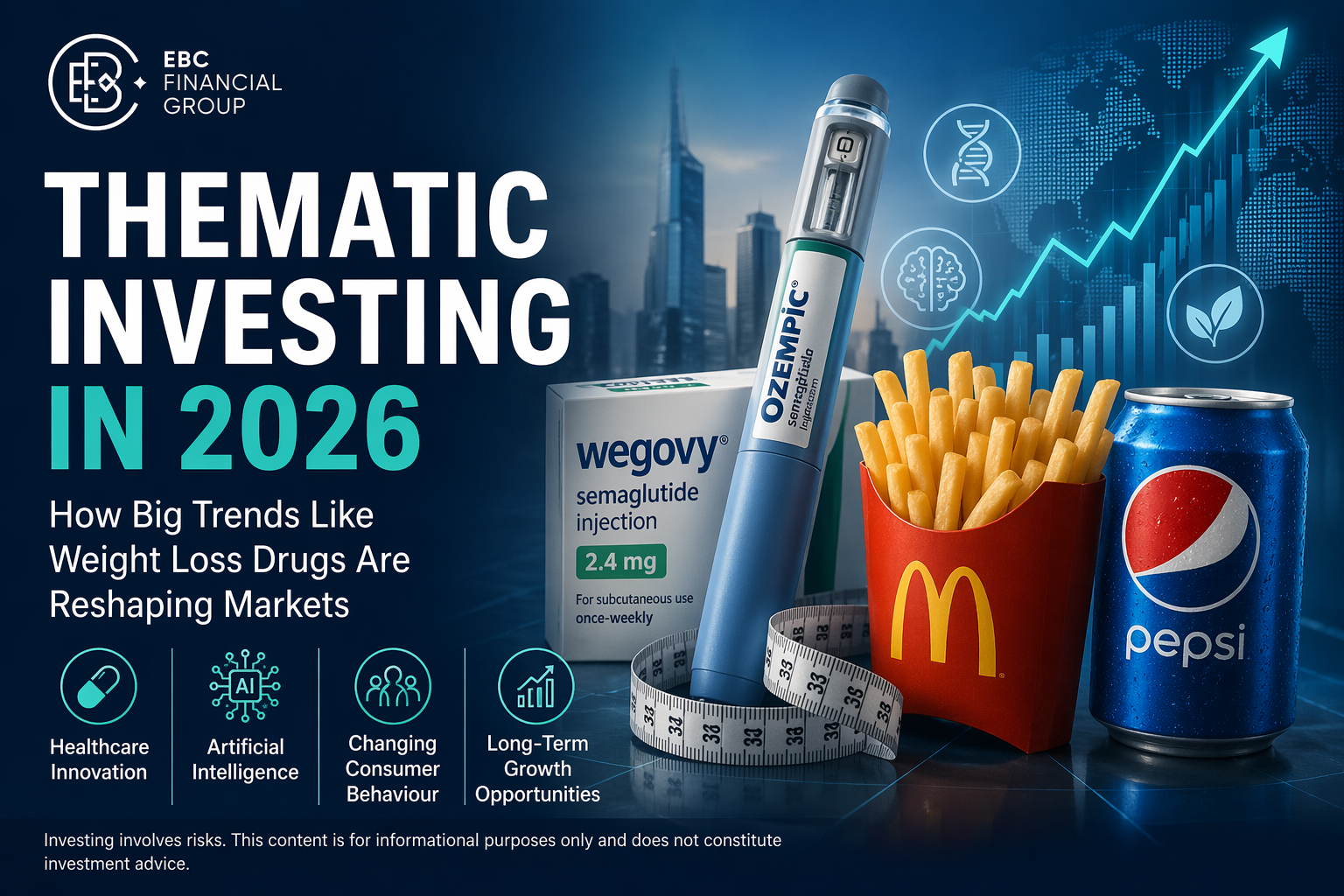
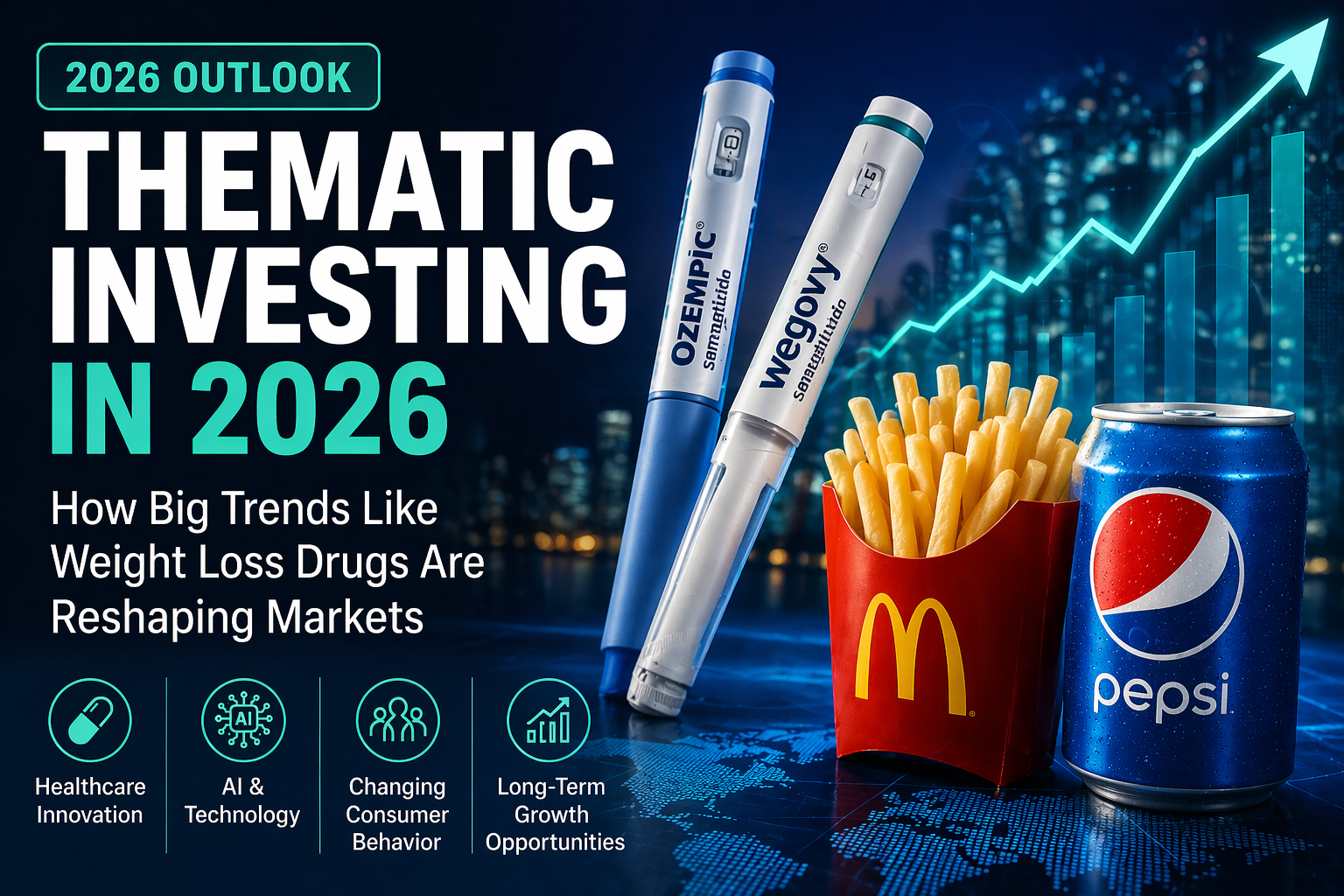
GLP-1 weight-loss drugs such as Ozempic and Wegovy provide a clear case study. What began as a diabetes and obesity treatment story has become a broader market question involving drugmakers, insurers, pharmacies, restaurants, food manufacturers, retailers, and global consumer brands.a
Global thematic fund assets reached $779 billion in Q3 2025, their highest level in three years. That scale shows thematic investing has moved from a niche strategy to a mainstream portfolio tool. Yet uneven performance means discipline matters more than enthusiasm.
Thematic investing tracks structural change rather than short-term stock movements.
Strong themes often cross sectors, linking healthcare, technology, energy, consumer goods, and infrastructure.
GLP-1 drugs show how direct healthcare effects can spill into food demand and consumer behaviour.
McDonald’s and PepsiCo show why company exposure differs within the same theme.
A disciplined strategy requires adoption data, revenue exposure, valuation checks, and diversification.
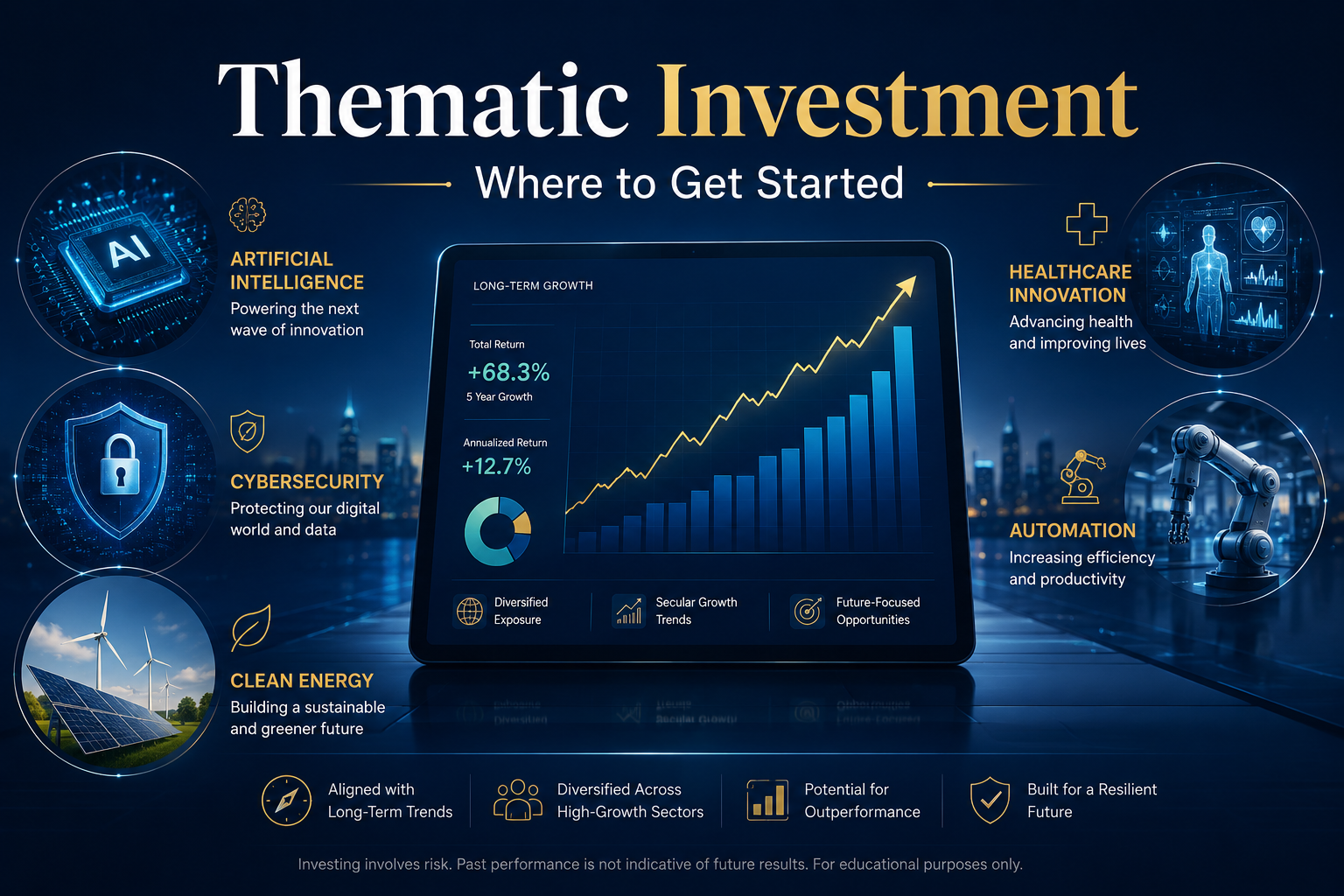
Thematic investing is an investment approach built around long-term trends that may reshape economies, industries, and consumer behaviour. Rather than starting with a single sector, investors start with a theme.
Examples include artificial intelligence, energy transition, ageing populations, digital payments, cybersecurity, obesity treatment, and health-focused consumption. A single theme can include companies from several industries.
AI affects semiconductors, cloud computing, data centres, utilities, and power equipment. Healthcare innovation may first affect drugmakers, then insurers, employers, restaurants, retailers, and food companies.
Sector investing asks which companies belong to an industry. Thematic investing asks which companies are exposed to structural change, directly or indirectly. Some of the largest investment implications emerge later through consumer behaviour, regulation, supply chains, pricing power, and earnings expectations.
GLP-1 drugs affect appetite, blood sugar regulation, and digestion. Ozempic is widely used for type 2 diabetes, while Wegovy is approved for chronic weight management and cardiovascular risk reduction in eligible patients.
The medical and commercial impact is already visible. Wegovy received approval in 2024 to reduce the risk of cardiovascular death, heart attack, and stroke in adults with cardiovascular disease and either obesity or overweight. In the relevant trial, major adverse cardiovascular events occurred in 6.5% of patients receiving Wegovy, compared with 8% receiving placebo.
Adoption has moved beyond a niche patient group. KFF polling found that 12% of U.S. adults had taken a GLP-1 drug, while 6% were currently taking one, although cost remained a major barrier. Oral treatments may expand access further after the FDA approved Novo Nordisk’s once-daily Wegovy pill in December 2025, with launch planned for early 2026.
The first-order effects sit closest to healthcare. Drugmakers may benefit from rising demand, expanded indications, and pricing power. Pharmacies and healthcare platforms may see higher prescription volumes. Insurers face a more complex trade-off: higher near-term drug costs against possible long-term savings from fewer obesity-related complications.
The valuation challenge is clear. Obvious winners are often identified early. By the time a theme becomes widely discussed, market prices may already reflect years of optimistic growth assumptions.
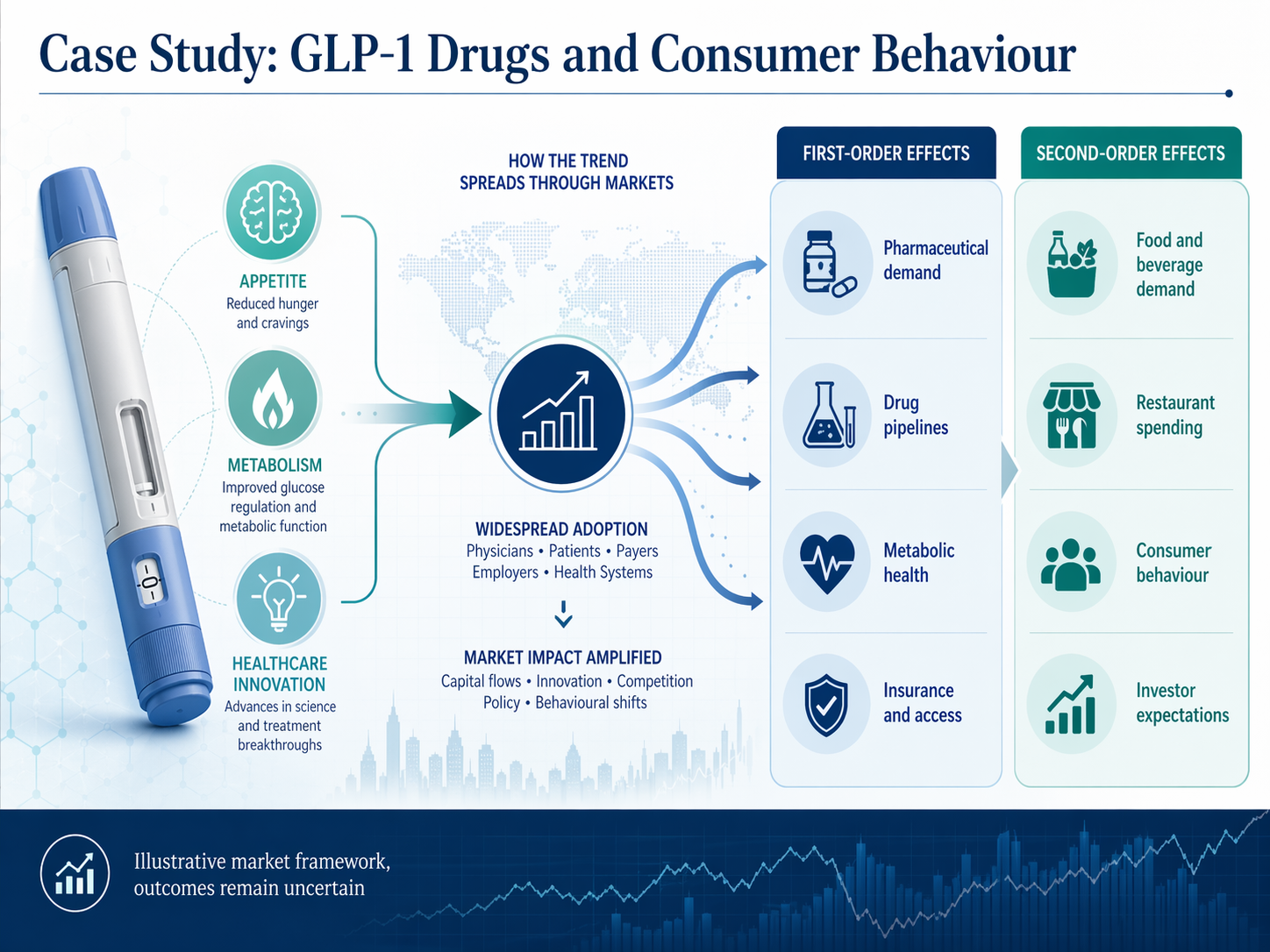
The harder question is how GLP-1 adoption moves beyond healthcare. If users eat less, make fewer impulse purchases, or shift toward smaller portions, the effects can ripple through grocery stores, snack brands, fast-food chains, beverage companies, and retailers.
Early research suggests the changes are measurable. Cornell research found that households starting GLP-1 medication reduced grocery spending by an average of 5.3% within six months, while spending at fast-food restaurants, coffee shops, and other limited-service eateries fell about 8%. Purdue’s review found a similar 5.5% reduction in grocery spending, equal to roughly $416 less in annual food purchases per household.
The investment conclusion is not that food companies collapse. It is possible that consumption patterns may shift enough to affect growth expectations, product strategy, and valuation. Even modest spending changes can matter across snacks, beverages, fast food, and packaged meals.
PepsiCo and McDonald’s are useful examples because both are tied to food consumption, but their exposure differs.
PepsiCo has more direct exposure to snacks and packaged beverages. In 2025, food represented 58% of PepsiCo’s net revenue, while beverages represented 42%. That makes snack demand important to investor analysis, especially if appetite-suppressing drugs change impulse consumption.
That does not mean GLP-1 adoption automatically damages PepsiCo. Large food companies can respond with smaller portions, higher-protein products, zero-sugar drinks, functional beverages, reformulation, and pricing strategies. The investment question is whether innovation can offset weaker demand in calorie-dense categories.
McDonald’s has a different profile. Its business depends not only on appetite but also on convenience, value, breakfast habits, digital ordering, delivery, and loyalty. In 2025, global systemwide sales rose 7% to more than $139 billion, while loyalty-member sales increased 20% to nearly $37 billion across 70 markets.
This makes the GLP-1 impact more nuanced. Lower appetite may pressure some meal occasions, but value menus, breakfast, coffee, convenience, and loyalty engagement can soften the effect. The same theme can create different risks depending on business model, product mix, customer behaviour, and management response.
A disciplined thematic process starts with four questions: is the theme structural, is adoption measurable, which companies have real revenue exposure, and has the market already priced in too much optimism?
This process helps investors avoid a common mistake: confusing a strong theme with an automatic investment opportunity. A theme can be valid, widely discussed, and still poorly timed. Investors must consider narrative risk, timing risk, valuation risk, and adaptation risk.
Thematic investing is an approach based on long-term trends rather than traditional sectors. It focuses on structural changes such as AI, healthcare innovation, energy transition, ageing populations, and shifts in consumer behaviour.
GLP-1 drugs matter because they affect both healthcare spending and consumer behaviour. Drugmakers are the direct beneficiaries, but food companies, restaurants, insurers, pharmacies, and retailers may also face changing demand patterns.
Yes, but only as part of a diversified portfolio. Beginners should treat themes as long-term exposures, not short-term trades. Valuation, concentration, adoption data, and risk control matter as much as the theme itself.
Thematic investing helps investors understand how structural change moves through markets. GLP-1 drugs show this clearly in 2026 by linking healthcare innovation with food demand, consumer behaviour, insurance costs, and company valuations.
The lesson is to think beyond obvious winners. Strong thematic analysis tests direct beneficiaries, second-order effects, business model resilience, and valuation risk. That is what separates disciplined thematic investing from chasing a popular market story.