Published on: 2026-08-11
Updated on: 2026-08-11
LYTE gives one-ticker exposure to AI photonics, yet five holdings already control 70.61% of the fund. LYTE fell about 8.5% on August 10, only days after launch, as several of its largest optical stocks sold off. The fund targets a genuine AI infrastructure bottleneck, while 70% in five stocks means any disappointment reaches LYTE fast.
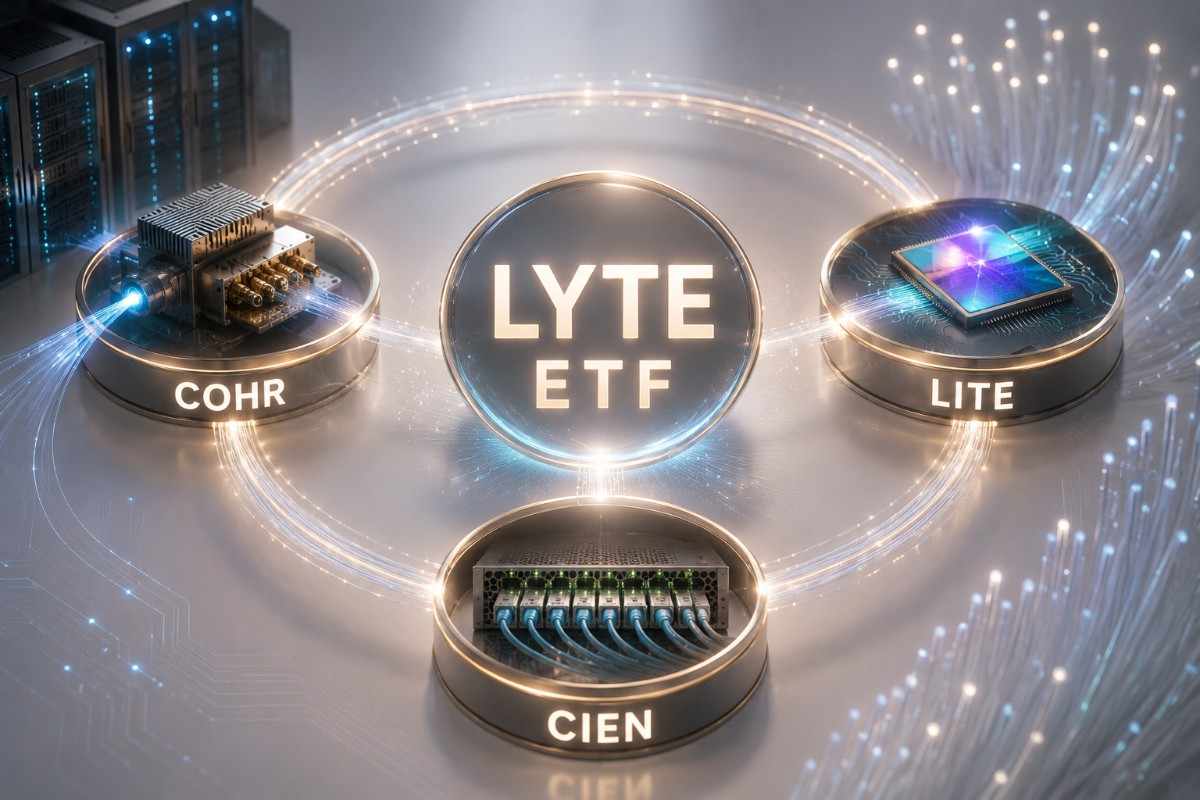
Coherent and Lumentum alone make up nearly 31% of LYTE, giving two companies substantial influence over the fund’s returns.
About 40% of LYTE comes through China-linked total-return swaps, providing exposure to Eoptolink, Innolight, Suzhou TFC and Yuanjie without direct ownership of those shares.
NVIDIA invested $4 billion across Lumentum and Coherent in March, alongside multibillion-dollar purchase commitments and future access to optical capacity for AI infrastructure.
LYTE’s case rests on optical demand becoming durable earnings, not AI spending alone. Customer concentration, rising capacity and weaker pricing can pressure several holdings even while the underlying market expands.
LYTE concentrates on companies supplying lasers, transceivers, optical modules and networking systems used to move data through AI infrastructure. Its largest positions combine directly held U.S.-listed shares with China-linked swap exposure.
| Holding | Weight | Main role | Exposure |
|---|---|---|---|
| Coherent | 15.99% | Lasers/components | Stock |
| Lumentum | 14.82% | Lasers/modules | Stock |
| Eoptolink | 13.73% | Transceivers | Swap |
| Innolight | 13.11% | Optical modules | Swap |
| Ciena | 12.96% | Network systems | Stock |
Companies normally need at least 50% of revenue tied to qualifying photonics or optics activities to enter LYTE’s investment universe. The mandate covers technologies ranging from optical transceivers and silicon photonics to lasers, fiber infrastructure and optical computing.
LYTE’s August 10 drop was readily explained by weakness in several of its largest U.S.-listed holdings. Coherent fell 14.25%, Lumentum lost 8.58%, and Ciena declined 5.99%.
Using LYTE’s latest disclosed weights, those three moves alone represent roughly 4.3 percentage points of downward pressure before accounting for the rest of the portfolio and its swap exposures. A portfolio dominated by a handful of optical names can therefore turn sharp single-stock moves into equally visible ETF volatility.
About 40.12% of LYTE is linked to Eoptolink, Innolight, Suzhou TFC Optical and Yuanjie Semiconductor through total-return swaps rather than directly held shares.
The swaps give LYTE the economic gains and losses of those companies without ownership or voting rights. Roundhill uses the structure to maintain substantial exposure to Chinese optical suppliers while complying with regulated investment company diversification tests.
The contracts introduce counterparty risk because LYTE depends on the swap provider to deliver the agreed return. The underlying companies also remain exposed to trade restrictions and shifts in U.S.-China policy, adding geopolitical risk to the portfolio’s optical-industry exposure.
Larger AI clusters move increasing amounts of data between chips, servers and data centers. Copper connections face tighter constraints in distance, bandwidth and power as those systems scale, pushing more traffic toward optical links built around lasers, transceivers and high-speed networking equipment. NVIDIA describes optical interconnects as foundational to scaling increasingly large AI systems.
NVIDIA committed $2 billion each to Lumentum and Coherent in March, alongside multibillion-dollar purchasing agreements and rights to future optical capacity. The $4 billion investment backs two companies that together represent nearly 31% of LYTE.
Operating results already show the scale of demand. Lumentum’s fiscal third-quarter revenue reached $808.4 million, up 90% year over year, while Ciena’s fiscal second-quarter revenue rose 40% to $1.57 billion. Optical networking is already capturing AI infrastructure spending rather than relying entirely on a future adoption cycle.
LYTE places greater weight behind a small group of optical-networking companies than LAZR, while FOTO follows a separate active pure-play photonics mandate. Coherent carries a 15.99% weight in LYTE versus 4.05% in LAZR, while Lumentum sits near 15% in both funds.
| ETF | Fee | Current profile |
|---|---|---|
| LYTE | 0.65% | Concentrated global optics portfolio |
| LAZR | 0.75% | 28 holdings and broader AI-photonics mix |
| FOTO | 0.75% | Active pure-play photonics mandate |
The 10-basis-point fee gap is minor beside the concentration gap. LAZR spreads exposure across a wider set of photonics, semiconductor and AI-related positions, while FOTO normally commits at least 80% of assets to companies directly related to photonics. LYTE gives its largest optical-networking names substantially more influence over returns.
LYTE can disappoint even while AI spending keeps rising because its largest holdings still need to convert demand into margins, cash flow and pricing power.
Two customers generated 34% of Ciena’s latest quarterly revenue, leaving results sensitive to changes in a small number of spending programs. Order delays or weaker pricing across major customers can reach several optical suppliers at the same time.
Scarcity can also fade before demand does. New capacity and improving production yields can increase supply, compress pricing and narrow margins even while the photonics market continues expanding. LYTE’s prospectus identifies rapid technology change, competition and shifts in supply and demand among the core risks facing optical companies.
The decisive test is not whether AI keeps growing, but whether LYTE’s largest holdings can grow earnings faster than expectations already embedded in their valuations.
Yes. LYTE does not track an index. Roundhill actively selects the portfolio, which is normally rebalanced and reconstituted at least quarterly using a modified market-cap approach. The fund does not ordinarily trade securities between those rebalances.
LYTE charges an annual expense ratio of 0.65%. On a static $10,000 balance, that corresponds to roughly $65 a year in fund expenses before trading costs and changes in portfolio value.
No. Trading volume measures the value of ETF shares changing hands, while inflows require the creation of additional fund shares and assets. The same shares can trade repeatedly during a session, so $72 million of first-day turnover does not mean $72 million entered LYTE as new assets.
Companies normally need at least 50% of revenue tied to qualifying photonics or optics activities. Roundhill also screens for a minimum $1 billion market capitalization and at least $10 million in average daily trading volume, excluding companies with only incidental exposure to the theme.
LYTE concentrates its outcome in companies sitting between rising AI compute and the bandwidth required to make that compute useful. If optical suppliers capture more economic value as networks scale, concentration becomes the fund’s advantage. If competition and new capacity absorb that value first, the same structure magnifies the disappointment.
LYTE ultimately succeeds or fails on how much of AI’s optical bottleneck its largest holdings can turn into profit.