Published on: 2026-06-03
The chipmaker logged its biggest one-day gain on record after a Computex endorsement spotlighted its role in AI data-center connectivity. At roughly 94 times earnings, the burden now shifts to execution.
Marvell Technology (MRVL) rose 32.5% on Tuesday to close at a record $290.79, its largest single-day gain on record, after Nvidia CEO Jensen Huang described the company as a future trillion-dollar business during a joint appearance at the Computex conference in Taipei. The move added more than $60 billion in market value, lifting Marvell’s capitalization to about $255 billion, and narrowly eclipsed the company’s prior best session, set in May 2023.
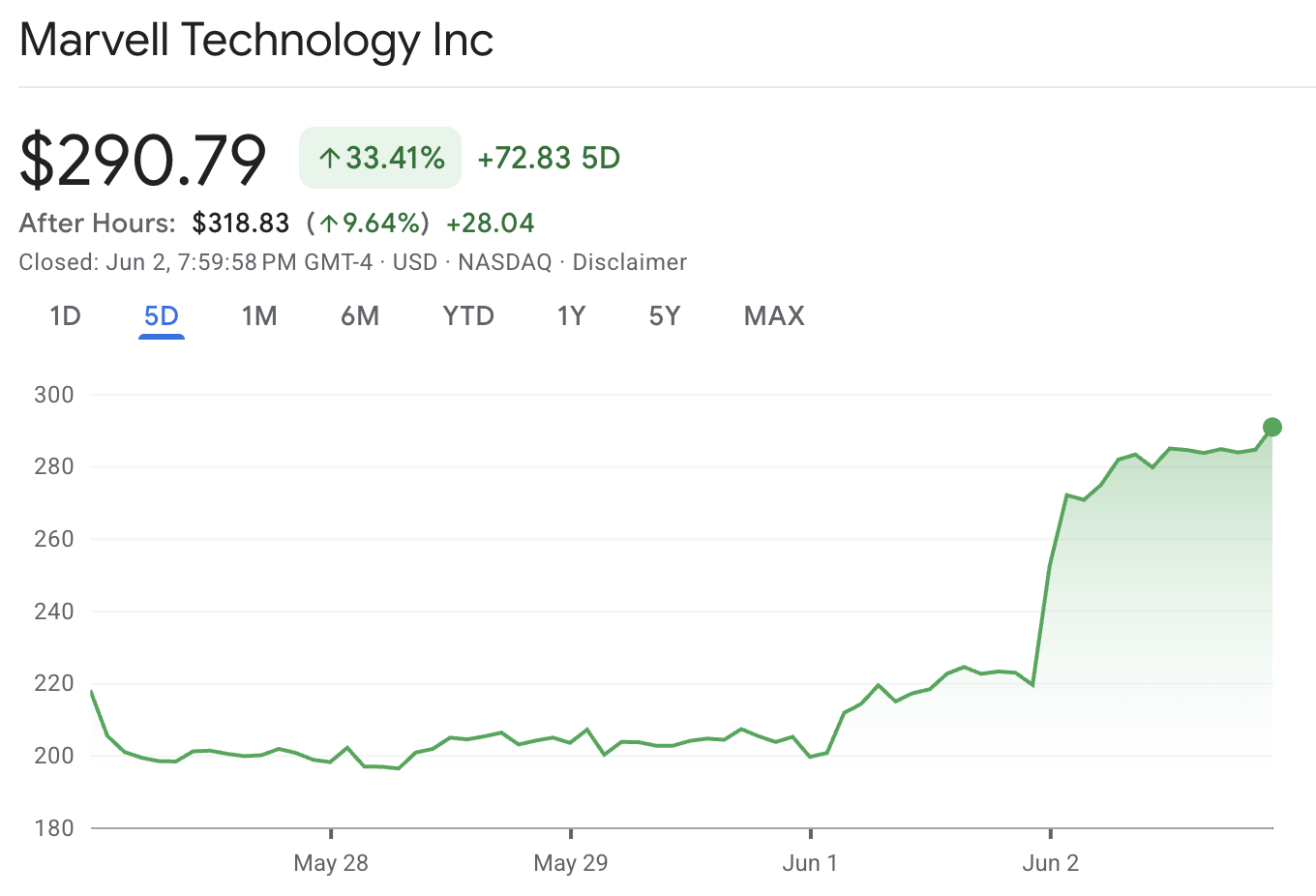
Marvell remains far from the mark Huang invoked. Reaching a $1 trillion valuation would require the stock to climb more than 400% from Monday’s close, and the shares are already up roughly 158% this year. Only a handful of companies have crossed the trillion-dollar threshold. The endorsement, in other words, set a direction rather than a target.
Marvell rose 32.5% to a record $290.79, its biggest one-day gain ever, adding more than $60 billion in market value.
The catalyst was Jensen Huang calling Marvell a future trillion-dollar company at Computex, alongside CEO Matt Murphy.
Leadership on the day sat in the connectivity and custom-silicon layer: the Philadelphia Semiconductor Index rose 5.9% and Broadcom hit a record, while Nvidia closed roughly flat.
Fundamentals support the re-rating. Fiscal 2026 revenue was $8.2 billion, up 42%, with the data center now about 76% of sales.
The Nvidia tie is concrete: a roughly $2 billion equity stake taken earlier this year, linked through the NVLink Fusion platform.
Valuation is the constraint. At about 94 times trailing earnings, the price leaves little room for disappointment.
Speaking onstage with Marvell CEO Matt Murphy, Huang argued that AI data centers spread computing across thousands of chips, and that performance therefore depends on the connectivity that moves data between them. That, he said, is what makes Marvell essential to the buildout, and he predicted the company would become the next trillion-dollar chipmaker.
The comment carried weight because it came from the company that defines the current AI cycle, but it is worth reading with one caveat. Nvidia took a roughly $2 billion equity stake in Marvell earlier this year as part of a broader partnership, so it has a direct interest in talking up a company it partly owns. That makes the remark a sentiment catalyst rather than disinterested analysis, and not company guidance.
Marvell gave the day its own substance. At Computex it introduced the Teralynx T100, a new switch-silicon platform aimed at AI and cloud data centers that the company positions as offering higher bandwidth and materially lower power than competing parts.
The launch fit Murphy’s argument that as clusters grow across more chips, racks and facilities, the bottleneck shifts from individual accelerators to how efficiently data moves through the system.
The session was a broad semiconductor rally rather than a rotation out of Nvidia. The Philadelphia Semiconductor Index climbed 5.9% to a record, with optical-communications names leading, and major U.S. indices closed at record highs.
What stands out is where the leadership sat: in the connectivity, optical and custom-silicon layer that sits beneath the GPU, rather than in the accelerators themselves.
| Stock | June 2 Move | Context |
|---|---|---|
| Marvell Technology | +32.5% | Custom silicon, optical interconnects, AI networking |
| Broadcom | About +5% | Hit a record high ahead of its June 3 earnings |
| Super Micro Computer | About +5% | Lifted by its own Computex platform launches |
| Nvidia | -0.7% | Roughly flat |
Marvell captured the strongest bid because it combined the cleanest catalyst, a new product and direct Nvidia exposure. The takeaway is not that investors are leaving Nvidia, which barely moved, but that the parts of the AI stack responsible for data movement are increasingly being valued as essential infrastructure in their own right.
At about 94 times trailing earnings, the gap between what is verified and what the market is assuming is the heart of the story.
| Metric | Figure |
|---|---|
| FY2026 revenue | $8.2 billion, up 42% year over year |
| Q1 FY2027 revenue | $2.418 billion, a record |
| Data center share | About 76% of total revenue |
| Q2 FY2027 guidance | About $2.7 billion at the midpoint |
| FY2027 outlook | Nearly $11.5 billion, roughly 40% growth |
| Custom-chip target | More than $10 billion by fiscal 2029 |
| Nvidia stake | Roughly $2 billion equity, taken earlier this year |
| Trailing P/E after the rally | About 94 times earnings |
The confirmed numbers support the rally better than a headline-only trade would. Fiscal 2026 revenue reached a record $8.2 billion, up 42%, and the data center now drives roughly three-quarters of sales. Reuters reported that management expects the custom-chip business alone to surpass $10 billion in revenue by fiscal 2029, which gives the bull case a concrete anchor.
What stays speculative is the leap from there to a trillion-dollar valuation, a roughly fourfold re-rating that would depend on sustained hyperscaler spending and the successful ramp of custom silicon.
The investment case rests on Marvell sitting within Nvidia’s architecture rather than competing with it at the GPU layer. The roughly $2 billion stake came with integration through Nvidia’s NVLink Fusion platform, under which Marvell supplies custom XPUs and scale-up networking while Nvidia provides the broader AI-factory hardware, including CPUs, interconnects and switches.
Marvell has reinforced that position on its own. Its roughly $3.25 billion acquisition of Celestial AI, a silicon-photonics company whose technology speeds chip-to-chip data movement, slots directly into the interconnect roadmap both companies are pursuing.
The market is not pricing Marvell as the next Nvidia. It is pricing it as a company that grows more important as Nvidia-based systems get larger, denser and more distributed.
At about 94 times trailing earnings, the multiple bakes in elevated hyperscaler capital spending, sustained data center growth, successful custom-silicon ramps and continued demand for optical connectivity. Those assumptions are reasonable on the current trajectory. They are not guaranteed.
A slowdown in cloud AI spending, weaker bookings, delayed customer ramps or supply constraints could compress the multiple quickly, and Broadcom remains a formidable competitor in custom ASICs and switching. Large cloud providers are also designing more of their own silicon in-house, which could pressure long-term supplier economics over time.
The rally has handed Marvell a clean setup: the revenue growth, the strategic partner and the product roadmap are in place. The task now is delivering earnings strong enough to justify the price.
Marvell’s June 2 move was less a reaction to a single Computex headline than a reassessment of where value accrues in the next stage of AI infrastructure. Nvidia still defines the era, but the systems built around its hardware increasingly require custom silicon, optical links and lower-power networking to run at scale, and that is the position Marvell has built.
The opportunity is real and the revenue growth gives it credibility. So does the risk: near 94 times earnings, the stock already discounts much of the future. The next quarterly results, and any read on custom-silicon ramps and hyperscaler demand, will show whether enthusiasm for AI connectivity can translate into durable earnings power.
Market data as of the June 2, 2026 close. Forward revenue figures reflect company guidance or management commentary where specified. Commentary on market-capitalization targets reflects analyst and executive remarks, not company guidance. This article is for informational purposes only and is not investment advice.