Published on: 2026-03-26
Updated on: 2026-03-26
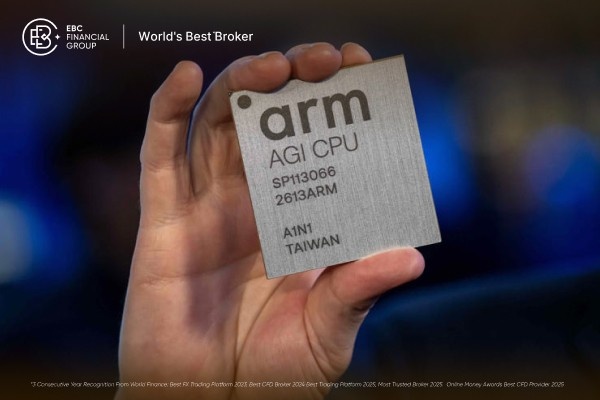
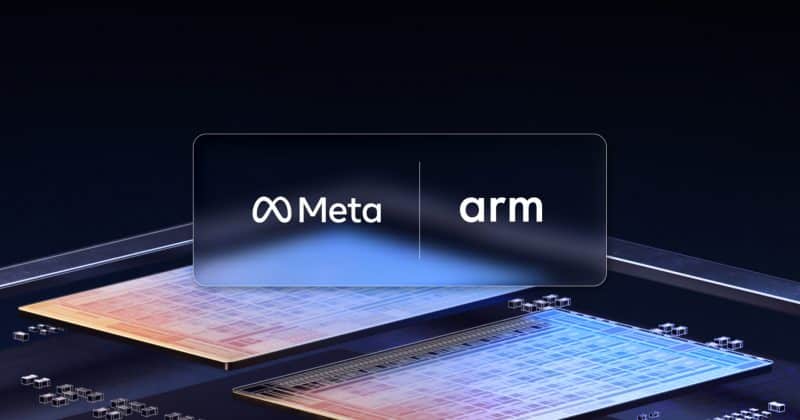
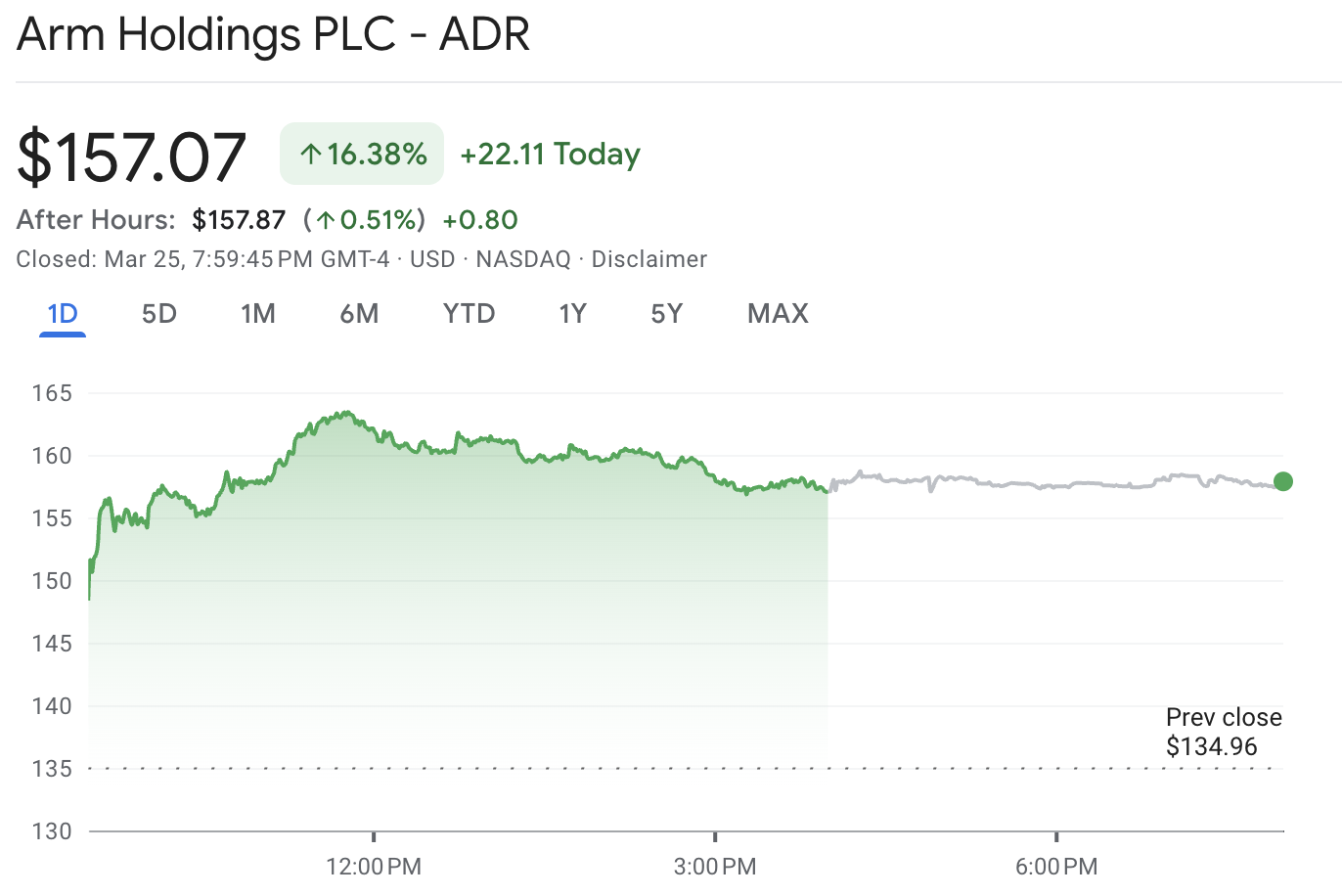
On March 25, 2026, ARM's stock closed at $157.07, up 16.4% for the day after reaching a high of $163.71. That move came one day after ARM unveiled its first production silicon product, the ARM AGI CPU, and said Meta is the lead partner and co-developer.
ARM stock surged as investors viewed the company's chip move as more than just a small product launch. They saw it as a major change in what ARM can become.
ARN has spent more than three decades mainly licensing chip architecture and related designs rather than selling its own merchant silicon. However, the announcement stated that it is now expanding its platform into production silicon products for the first time in the company's history, beginning with a data center CPU designed for agentic AI workloads.
This was the biggest reason for the rally. Under Arm's old model, the company earned license fees and royalties when customers used its technology.
Under the new model, it can still do that, but it also has a path to sell a more complete product. Investors now recognize the opportunity for Arm to gain a larger share of the AI infrastructure market, especially if demand increases for purpose-built CPUs designed for inference, orchestration, and data movement.
It was not a random expansion. Arm said partners were asking for faster ways to deploy Arm technology at scale, and the company described the silicon move as part of a broader platform strategy rather than a break from its IP business. That framing helped investors see the announcement as additive, not destructive.
The stock did not rally only because ARM launched a CPU. It rallied because management attached a much bigger revenue story to that CPU.
Arm expects about $15 billion in chip sales by 2031, with total company revenue around $25 billion and adjusted EPS around $9 by that point. Compared with the company's current scale, those are big numbers.
This perspective alters the market's perception of ARM. Instead of valuing it purely as a premium IP licensor, investors can start to value it as a platform company with a larger addressable market and potentially much faster growth if execution goes well.
If ARM had announced its own chip without visible customers, the reaction might have been much more cautious.
Instead, the company mentioned Meta is the lead partner and co-developer, while additional commercial momentum includes Cerebras, Cloudflare, F5, OpenAI, Positron, Rebellions, SAP, and SK Telecom.
It also stated that leading OEMs and ODMs such as ASRock Rack, Lenovo, Quanta, and Supermicro are involved, with broader ecosystem support from companies including AWS, Broadcom, Google, Marvell, Microsoft, NVIDIA, Samsung, SK hynix, and TSMC.
The chip announcement landed on top of a business that was already growing well.
In its latest quarter, Arm reported revenue of $1.24 billion, up 26% YoY, and record royalty income of $737 million, up 27%. The company also said demand for its Compute Subsystems continues to exceed expectations.
In short, ARM was launching with record quarterly revenue and strong momentum in AI-related royalties.
| What changed | Before | After |
|---|---|---|
| Core model | Licensing CPU architecture, cores, and CSS | Licensing plus Arm-designed production silicon |
| Flagship AI product | Arm IP used inside customer chips | Arm AGI CPU sold as Arm-designed silicon |
| Lead customer signal | Partner-led ecosystem adoption | Meta as lead partner and co-developer |
| AI data center position | Arm architecture inside partner systems | Direct seller of a data center CPU for AI infrastructure |
As mentioned above, ARM launched its first CPU designed specifically for data centers, marking a significant expansion from its previous focus on IP and compute subsystems to actual production silicon.
The company announced that the Arm AGI CPU is tailored for AI data centers and aims to support agentic AI infrastructure. According to ARM's own estimates, it delivers more than twice the performance per rack compared to x86 platforms.
It also said the chip was developed with Meta as the lead partner, with early systems now available and broader availability expected in the second half of the year.
| Bull case | Why it helps ARM | Risk case | Why it matters |
|---|---|---|---|
|
More value per deployment |
Arm can monetize both IP and silicon | Customer conflict | Arm may compete more directly with some existing partners |
| AI data center CPU demand | Agentic AI needs more orchestration and CPU capacity | Execution risk | Selling production silicon is harder than licensing IP |
| Meta-led launch | Strong validation from a major hyperscaler | Manufacturing dependence | Arm is relying on partners such as TSMC and server makers |
| Large long-term targets | Reframes ARM as a bigger growth story | High expectations | Big targets raise the bar for future results |
It can, but the next phase will depend on execution rather than surprise.
On the bullish side, the setup is clear. Arm now has a more ambitious product strategy, credible hyperscale and software customers, and a direct opening into AI data center CPUs just as demand for power-efficient inference infrastructure grows.
ARM stock increased from $127.31 on March 17 to $157.07 on March 25, reflecting a gain of about 23.4%. It indicates that the market is quickly adjusting its valuation of the company.
On the cautious side, this strategy introduces new risks that were previously less significant.
This balance is important as the stock initially wobbled because investors worried Arm could compete with customers such as Nvidia, Amazon, Microsoft, and Alphabet. But the shares then surged once the market focused on the scale of the opportunity and management's financial targets.
| Level Type | Price / Zone | What it means |
|---|---|---|
| Support | $148.37–$147.00 | First support zone, covering the session open and intraday low |
| Resistance | $163.71 | First resistance, at the intraday high |
| Secondary resistance | Around $165 | Round-number area traders may watch if the stock breaks higher |
| Invalidation | ~$134.98 | Prior close; a move back here would invalidate the bullish re-rating |
The first support zone is $148.37 to $147.00. If ARM holds that range, it would suggest buyers are defending the post-announcement gap instead of treating the move as a one-day spike.
The first resistance is $163.71, the intraday high. A clean break above that level would signal the market is still extending the re-rating tied to the new chip strategy, with $165 as the next area traders will likely watch.
The key invalidation level for the week is the prior close near $134.98. A shift back to that area indicates the market no longer believes the strategic change justifies a higher valuation multiple, at least until shipment and revenue data begin to materialize.
ARM stock jumped because the company announced its first ARM-designed production silicon product, the ARM AGI CPU, and paired it with a much bigger long-term revenue story than investors had been expecting.
It is ARM's first data center CPU sold as ARM-designed silicon rather than just licensed IP. The company claims it is designed for agentic AI infrastructure and was developed with Meta as the lead partner.
Because the market focused on the revenue upside, the strong customer list, and the chance for Arm to capture more value in AI infrastructure.
In conclusion, ARM stock jumped because the market saw this announcement as a structural change in the business, not just a new chip launch.
The real takeaway is that Arm now has a credible path to add a second large revenue engine. However, the next milestone is execution in system rollout, customer uptake, and proof that growth in chips does not come at the cost of its core partner ecosystem.
Disclaimer: This material is for general information purposes only and is not intended as (and should not be considered to be) financial, investment or other advice on which reliance should be placed. No opinion given in the material constitutes a recommendation by EBC or the author that any particular investment, security, transaction or investment strategy is suitable for any specific person.