Published on: 2026-06-02
Updated on: 2026-06-02
If you took a quick glance at the headlines this week, you might feel a sudden sense of déjà vu. Wall Street is buzzy, optimistic, and deeply in love with Silicon Valley all over again. As the opening bell rang into the first week of June 2026, tech stocks did what they do best lately: they took off, dragging the Nasdaq Composite and the S&P 500 right along with them into record-breaking territory.
It’s an interesting moment for the market. On one hand, regular folks and macroeconomists are still sweating over sticky inflation, fluctuating oil prices, and Treasury yields that refuse to budge below 4.6%. On the other hand, big institutional investors simply cannot get enough of tech stocks. It’s like a gold rush, except instead of picks and shovels, everyone is fighting over AI chips, massive server racks, and data center real estate. The Information Technology Select Sector SPDR (XLK) is up nearly 20% over just the last month, effectively acting as the heavy-duty engine keeping this broader bull market moving forward.
But if you peel back the headline numbers, you realize this isn't a rising tide lifting every single boat. Instead, we are seeing a fascinating, highly fragmented market. Wall Street is rewarding companies that are actually delivering on their artificial intelligence promises while quietly punishing anyone showing signs of hesitation or slowing growth.
Right at the center of this storm is Nvidia (NASDAQ: NVDA). Just when skeptics started whispering that the chipmaker's historic run had to slow down, the company went ahead and unveiled a brand-new architecture designed specifically for consumer PCs. That single announcement completely flipped the script, easing fears that big companies might stop spending billions on infrastructure. The result? A cool 6.3% jump in a single trading session.
Then you have Dell Technologies (NYSE: DELL), a legacy name that has completely rebranded its image in the eyes of investors. Dell just capped off an absolutely mind-boggling month—up 32.8%—thanks to an earnings report that showed an endless backlog of orders for its high-density AI enterprise servers. This hardware mania is a chain reaction; it pushed memory chipmaker Micron Technology (NASDAQ: MU) up 6.6% because, quite frankly, the world is running low on the high-bandwidth memory required to run these digital brains.
Yet, it’s not all sunshine and rainbows across the board. While the hardware guys are printing money, mature software companies and consumer-facing brands are feeling the squeeze of tighter budgets.
The Hardware Dominators: If you build the physical chips, the liquid-cooled servers, or the cloud infrastructure, investors are throwing money at you. The big tech giants are pledging hundreds of billions of dollars a year to buy these parts, ensuring these specific equities command huge premiums.
The Valuation Squeeze: On the flip side, companies stuck relying on older software subscription models or general consumer spending are seeing money flow out of their accounts and into raw computing power. It's a brutal rotation.
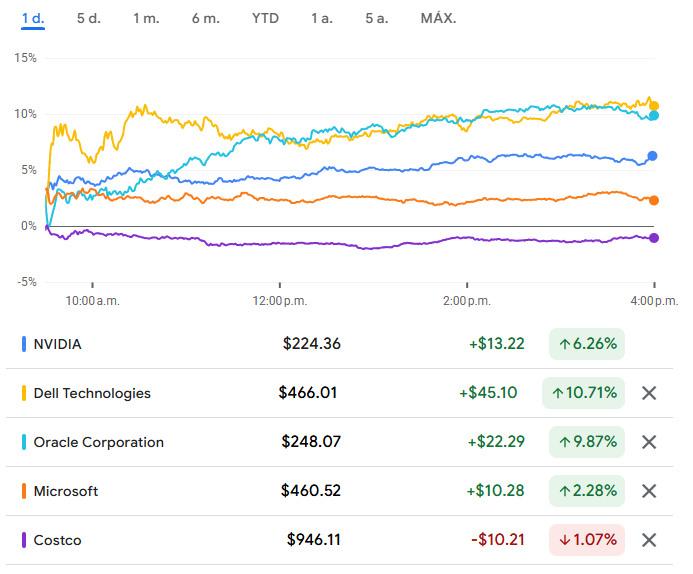
To really get a feel for how split the technology sector is right now, take a look at how some of the most heavily traded names fared after the latest round of corporate earnings.
| Ticker | Company | Recent Price Action / Performance | The Real Story Behind the Move |
| NVDA | Nvidia Corp. | Up 6.3% (Multi-day Rally) | Shocked the market with new consumer AI superchips; enterprise demand remains relentless. |
| DELL | Dell Technologies | Up 32.8% (Trailing Month) | Sitting on a massive mountain of orders for specialized AI servers. |
| ORCL | Oracle Corp. | Up 9.9% (Single-session Spike) | Rapidly expanding its cloud infrastructure footprint through smart partnerships. |
| MSFT | Microsoft Corp. | Up 2.3% (Steady Recovery) | Consistent, reliable growth as corporate clients steadily adopt its Copilot software. |
| COST | Costco Wholesale | Down 3.9% (Post-Earnings) | Hit by a minor consumer spending miss—a perfect example of money leaving retail to chase tech. |
If you look at the charts, tech stocks are acting like a textbook momentum play. The Nasdaq Composite recently blew past the 26.900 milestone, easily shaking off the minor technical red flags and bearish warning signs that popped up during the spring mini-correction.
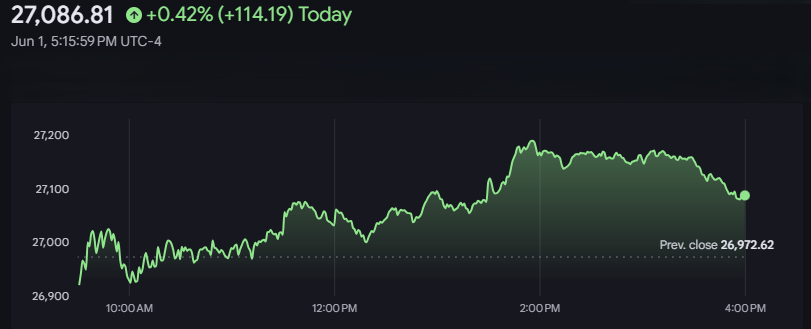
For the charting enthusiasts and technical analysts, the internal data looks incredibly strong:
The MACD Indicator: The Moving Average Convergence Divergence for major tech stocks has crossed back into a clear bullish zone above the zero line, indicating that the momentum isn't just retail hype—it's being driven by heavy volume.
The RSI Check: The 14-day Relative Strength Index is currently sitting around 68.5. Now, in a vacuum, that’s flirting with "overbought" territory. But as we've seen throughout this secular bull market, when institutional money decides to pile into tech equities, the RSI can stay hot for weeks before the market finally takes a breather.
Volume Analysis: Trading volume on green days has consistently outpaced the 20-day moving average. Translation: the big funds are actively buying the breakouts, not just watching from the sidelines.
Right now, the 20-day exponential moving average (EMA) is acting as a reliable safety net on any minor intraday dips. As long as that technical floor holds, traders are treating every small pullback as a chance to load up on shares before the next leg up.
Of course, no sector operates in a vacuum. The macro environment is still pulling its fair share of strings behind the scenes. Equity investors caught a break recently when diplomatic murmurs overseas hinted at a potential easing of geopolitical tensions. That news pushed West Texas Intermediate (WTI) crude back down toward $87 a barrel, which gave corporate America a bit of breathing room regarding energy costs.
The real thorn in the side of this rally remains the bond market. With the 10-year Treasury yield stuck at 4.6%, safe-haven assets are offering returns that make risky stocks look expensive.
Because of this, tech stocks have to be absolutely flawless. There is zero room for error. If a company trades at a massive premium, its earnings reports can't just be "good"—they have to blow expectations out of the water. Luckily for growth bulls, the tech sector did exactly that during the last earnings go-round, posting an aggregate profit expansion of roughly 50% year-over-year. It’s not an exaggeration to say tech is carrying the weight of the broader market on its shoulders.
When you boil it all down, the current market dynamic shows that artificial intelligence isn't just a buzzword anymore—it's an economic shield. Even with high interest rates and sticky inflation threatening to slow things down, big-money managers are choosing to park their capital in tech stocks because that's where the actual revenue growth is happening.
As we slide into the second half of the year, the ultimate test for these tech stocks will come down to execution. If these massive data center investments start generating clear, recurring software revenue, this historic run has plenty of fuel left in the tank. But if companies start missing their targets, or if inflation spikes again, those sky-high valuations will be put to the test. For the moment, though, the bulls are firmly in the driver's seat, and Wall Street seems perfectly happy to pay a premium for a piece of the future.