Published on: 2026-06-02
Updated on: 2026-06-02
The global electric vehicle (EV) market is hitting a massive reality check. A brutal combination of cutthroat competition, aggressive price cuts, and soaring operating costs is pushing even the strongest players into turbulent waters. Right at the center of this storm is Li Auto. The Chinese premium EV maker, once a favorite on Wall Street, has seen its shares take an absolute beating over the last few days.
Following a highly disappointing earnings report, Li Auto stock collapsed to an all-time intraday low of $14.53 per share on the Nasdaq. It is a stunning reversal that completely erases the massive valuation premiums investors happily paid during the company's boom over the past two years.
But this isn’t just an isolated incident; it’s a symptom of a much larger headache across the clean energy sector. Even the biggest names in the business are feeling the heat. Alongside the deep sell-off in Chinese tech equities, EV pioneer Tesla has also watched its stock slide down to $415.88. The fact that both industry giants are bleeding at the same time underlines a harsh truth: the era of easy, unchecked growth for EV makers is officially over, replaced by a grueling war of attrition where margins are being chopped to pieces.

So, what exactly triggered the freefall for Li Auto stock? The blame falls squarely on the company’s latest quarterly financial disclosure. For a long time, Wall Street praised Li Auto as one of the rare Chinese EV startups that could consistently turn a profit. That is why the Q1 numbers delivered such a profound shock to the market.
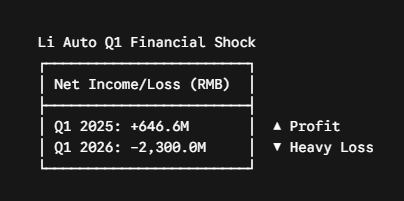
Instead of green ink, Li Auto posted a massive net loss of RMB 2.3 billion ($330 million) for the quarter. It’s a painful, night-and-day contrast to the RMB 646.6 million net profit the company pulled in during the exact same period last year.
When you look under the hood, a few key issues explain why investors completely lost confidence:
Evaporating Margins: The company's core automotive gross margin shrank to a dangerously low 6.1%, down from a healthy 19.8% last year. To keep their sales numbers up, Li Auto had to discount their cars so heavily that it practically destroyed their profitability.
Slipping Revenue: Total revenue fell to RMB 23.0 billion ($3.3 billion). That’s an 11.4% drop year-over-year, and a painful 20.1% tumble compared to the previous quarter.
Heavy Spending: Even though operational cash flow turned negative by RMB 6.1 billion, the company didn't slam the brakes on spending. They poured RMB 2.7 billion into research and development while trying to sustain an ambitious $1 billion share buyback program.
The pain isn't just contained to China. Tesla's stock has faced its own steady downward slide, dropping to $415.88. Tesla obviously operates on a different scale than its Chinese rivals, but it is battling the exact same economic headaches.
Tesla has repeatedly cut prices across North America and Europe just to defend its market share against a wave of cheaper, tech-heavy alternatives. On top of that, behind-the-scenes supply chain bottlenecks have tied up huge amounts of working capital.
A prime example is Tesla's long, frustrating supply chain dispute with Australia's Syrah Resources over low-quality graphite anode shipments from a factory in Louisiana. Even though Tesla eventually sorted out the issue to secure its battery materials outside of China, the logistical mess showed just how expensive and complicated it is to build an independent supply chain. With a cooling consumer market, high interest rates, and the massive costs of ramping up newer models like the Cybertruck, Tesla's margins are getting squeezed tightly. This industry-wide weakness has forced major fund managers to simply trim their exposure to EVs across the board.
To see just how much these financial struggles have altered the playing field, here is a quick look at how both companies stack up right now:
| Financial Metric | Li Auto Inc. (NASDAQ: LI) | Tesla Inc. (NASDAQ: TSLA) |
| Current Share Price | $14.54 | $415.88 |
| 52-Week High / Low | $32.03 / $14.53 | $512.50 / $390.20 |
| Q1 Revenue Performance | RMB 23.0B (Down 11.4% YoY) | $20.8B (Down 8.5% YoY) |
| Core Profitability Profile | Net Loss of RMB 2.3B | Net Income of $1.1B (Down 40% YoY) |
| May Delivery Metrics | 33.350 Vehicles | Approx. 72.000 Vehicles (Est.) |
| Key Strategic Focus | AI Mobility & Extended-Range EVs | Full Self-Driving (FSD) & Robotaxis |
If you look at the charts, the technical picture for Li Auto stock looks deeply damaged. The stock is trapped in a classic downtrend, carving out a clear pattern of lower highs and lower lows while trading well below both its 50-day and 200-day exponential moving averages (EMAs).
Right now, the most critical line in the sand is the recent record low of $14.53. If the selling volume picks up again and that floor breaks, the stock enters a blind spot with no historical support levels left to catch it.
On the flip side, if we see a short-term bounce, the first real test will be at $16.20. This was an old support level that will now act as a ceiling for any upward moves. A tougher resistance wall sits higher up at $18.50. which matches up with the lowered price targets recently put out by analysts at JPMorgan and Barclays.
The Relative Strength Index (RSI) is deeply oversold, sitting all the way down near 22.0. This tells us that a sudden, volatile short-covering bounce could happen at any moment. But don't mistake a quick bounce for a full recovery—the broader trend stays firmly bearish until the stock proves it can steady itself and build a solid base over a few weeks.
Even with the ugly financial numbers and a bruised stock price, Li Auto's actual production line is showing some real grit. On June 1, the company released its latest delivery data, showing they handed over 33.350 vehicles in May 2026. That pushes their lifetime deliveries to an impressive 1.702.792 cars.
At the same time, their more affordable all-electric SUV, the Li i6. has been holding its own, keeping up a steady pace of over 20.000 deliveries a month since March. The company is also doubling down on its charging network, running more than 4.088 supercharging stations across China with plans to add more high-speed 5C charging piles by the end of the year.
The million-dollar question for investors is whether this fresh lineup of vehicles and an expansion into Europe can get the cash flowing fast enough to offset the massive R&D bills that dragged down this quarter’s earnings.
The painful drop in Li Auto stock is a glaring reminder of the risks floating around the EV space right now. Even though manufacturing numbers, total deliveries, and cool new tech features are growing fast, the harsh reality of price wars and thinning margins has made Wall Street incredibly nervous about high-growth EV plays.
For investors with a lot of patience, Li Auto’s massive cash reserve of RMB 94.3 billion and its ongoing share buybacks provide a safety net against any real liquidity crisis. However, until the brutal price wars in China start to cool off and profit margins climb back into comfortable double digits, Li Auto stock is going to face a bumpy, uphill climb to win back its old premium valuation.