Published on: 2026-06-03
Updated on: 2026-06-03
Coherent stock is above Wall Street’s average target, but Wall Street has not turned bearish. Nvidia’s $2 billion optics agreement explains why: Coherent is no longer being valued as a cyclical photonics supplier, but as a bottleneck in AI data-center connectivity.
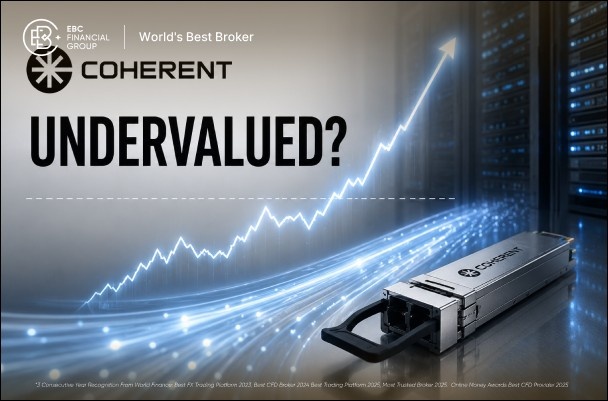
The next test is whether that demand turns into margins, capacity, and cash flow fast enough to prove analysts are still too low.
COHR closed at $426.89 after a 17.6% surge, moving above MarketBeat’s average analyst target of $379.64.
Wall Street still shows 1 strong buy, 15 buys, 6 holds, and no sells, making the target gap a lagging-consensus problem rather than a clean bearish signal.
Nvidia’s $2 billion investment and multibillion-dollar purchase commitment turn Coherent’s AI optics story into a strategic supply-chain thesis.
Q3 FY2026 revenue rose to $1.81 billion, while Datacenter and Communications revenue reached roughly 75% of the total mix.
The expected August 13, 2026, earnings update must show that margin, capacity, and cash conversion can support the premium.
MarketBeat’s 22-analyst compilation lists Coherent’s average 12-month price target at $379.64, below the latest closing price near $427. The gap does not settle the valuation debate, but it changes the burden of proof: COHR now needs analyst models to move higher, not just ratings to stay positive.
The disconnect is not sentiment. It is valuation math. MarketBeat still shows 1 strong buy, 15 buys, 6 holds, and no sells, so Wall Street has not turned against the story. The share price has simply moved beyond the level most published models are willing to defend.
The valuation debate is easiest to read through six signals: where consensus sits, how far the bull case can stretch, and whether reported results are already strong enough to force higher targets.
| Signal | Current Reading | Why It Matters |
|---|---|---|
| MarketBeat average target | $379.64 | Consensus sits below the market price |
| MarketBeat high target | $461.96 | Bullish models still allow upside |
| Q3 revenue | $1.81B | AI demand is already visible in results |
| Datacenter segment profit | $348M | Operating leverage is beginning to show |
| Q4 revenue guide | $1.91B–$2.05B | Growth must stay strong enough to force revisions |
| 9-month operating cash flow | $10M | Cash conversion remains the biggest proof gap |
The target gap is the headline, but the operating cash-flow line is the pressure point. It decides whether Coherent’s AI optics re-rating can last beyond momentum.
The target gap turns on whether AI optics is a product cycle or a capacity bottleneck. If demand is only a near-term hardware cycle, the rally has pulled forward too much future growth. If optical connectivity becomes a structural constraint in AI data centers, the current target gap may say more about stale models than excessive price.
Nvidia’s Coherent agreement is best read as a supply-security move. The March deal included a $2 billion investment, a multiyear strategic agreement, a multibillion-dollar purchase commitment, and future access and capacity rights for advanced laser and optical-networking products. Those terms imply that advanced optics are moving from useful infrastructure to scarce infrastructure.
The pressure point is bandwidth density. As AI clusters scale, the limiting factor is not only how many GPUs can be deployed, but how quickly data can move across chips, racks, and systems without overwhelming power and thermal budgets. Optical links become more valuable when distance, speed, latency, and energy efficiency start to define the economics of the data center.
That broader shift is already reshaping the public photonics universe, from transceiver suppliers to optical packaging, silicon photonics, and fiber-connectivity names. For a wider view of the listed companies exposed to the same AI optical wave, see our guide to public photonics stocks to watch before the AI optical wave.
Coherent’s role is being revalued because it sits closer to the physical constraint. The company is not being rewarded merely for selling into AI demand; it is being priced as part of the optical layer that determines whether AI systems can keep scaling. In that framework, the Nvidia agreement is less a vote of confidence than a signal that access to supply itself has become strategic.
Coherent’s latest quarter gave the AI optics re-rating something it lacked a year ago: reported evidence. Q3 FY2026 revenue reached $1.81 billion, GAAP gross margin improved to 37.7%, and non-GAAP EPS came in at $1.41. The stock is no longer rising on a distant data-center story alone; the acceleration has started to show up in revenue quality and earnings power.
The mix shift is the real tell. Datacenter and Communications revenue reached $1.362 billion in the March quarter, up from $969 million a year earlier, while Industrial revenue fell to $444 million from $529 million. Coherent is being pulled away from a more cyclical photonics profile and toward a narrower, higher-stakes AI infrastructure identity.
That narrowing cuts both ways. A larger datacenter mix gives the market a reason to assign a richer multiple, but it also makes the stock more sensitive to hyperscaler capex, AI networking deployment schedules, and capacity execution. The old diversified photonics discount is fading, but so is the protection that came with diversification.
The most important number is not revenue. Datacenter and Communications segment profit rose to $348 million, ahead of the segment’s revenue growth rate. That is the kind of operating leverage Wall Street needs to see before the average target can move closer to the share price.
Revenue growth has already won the first argument. The harder test is whether Coherent can scale AI optics without trapping too much capital in inventory, equipment, and working capital.
For the first nine months of FY2026, Coherent generated only $10 million of operating cash flow, down from $503 million a year earlier, while additions to property, plant and equipment rose to $547 million from $309 million.
Inventories increased by nearly $699 million as the company prepared for higher expected revenue. That build looks disciplined if it converts into shipments at strong margins, but it becomes the first place the premium multiple gets questioned if timing, capacity, or pricing slips.
The next earnings update gives the market a clean test. TipRanks lists Coherent’s Q4 FY2026 report date as August 13, 2026, with consensus EPS of $1.62. Coherent’s Q4 outlook calls for revenue of $1.91 billion to $2.05 billion, non-GAAP gross margin of 39% to 41%, and non-GAAP EPS of $1.52 to $1.72.
The operating cash-flow line is the pressure point. COHR has already been priced for the AI optics opportunity; the next quarter has to show whether that opportunity can become self-funding earnings power.
Coherent stock is rising because the market is revaluing optical connectivity as a bottleneck in AI infrastructure. Nvidia’s $2 billion agreement gave that thesis a hard anchor, while the June rally showed that optical networking is being treated as a broader AI supply-chain trade, not a one-stock event.
Coherent is expensive relative to current consensus, but the target gap is not a clean overvaluation signal. MarketBeat’s average target of $379.64 sits below the latest market price, while the high target of $461.96 remains above it. The stock is pricing in analyst revisions before they have fully arrived.
Nvidia’s March 2026 agreement with Coherent included a $2 billion investment, a multibillion-dollar purchase commitment, and future access and capacity rights for advanced optical products. The structure reads less like normal supplier demand and more like supply access becoming strategic.
Coherent is still a photonics company by technology, but the market is increasingly valuing it as an AI infrastructure supplier. That shift supports a richer multiple, but it also brings AI-cycle risks: hyperscaler capex, optical deployment timing, capacity execution, and margin durability.
The clearest downside trigger is not weak AI interest; it is weak execution. A soft Q4 guide, slower capacity ramp, margin pressure, poor cash conversion, or delayed hyperscaler orders would challenge the idea that Coherent deserves to trade above the average analyst target.
The next phase of Coherent’s rally will not be decided by whether AI optics matters. That debate has already moved into the price.
The expected August 13, 2026, earnings release is the first clean test of whether the market moved too early or Wall Street moved too slowly. Revenue near the top of guidance would help, but the more important signals are gross-margin resilience, progress on capacity, and whether inventory begins to turn into cash-generating shipments.
At this price, Coherent does not need the market to believe in AI optics; it needs the next quarter to prove Wall Street is still too low.