Published on: 2026-07-17
Updated on: 2026-07-17
USD/CAD has eased to around 1.40, a one-month low for the pair. The decline began with softer US inflation weighing on the dollar, but the broad dollar has since steadied while the pair has kept falling, so the latest leg increasingly reflects Canadian dollar strength rather than dollar weakness. Canada’s June CPI, released Monday 20 July, is the next test of whether that strength is durable.

The slide is a two-stage move: softer US inflation helped start it, then higher oil and Canada-specific support extended it after the broad dollar stabilised.
The latest leg increasingly reflects Canadian dollar strength rather than broad dollar weakness, so it pays to separate the dollar leg from the loonie leg before reading intent into the move.
The policy gap still favours the dollar, with the Fed at 3.50% to 3.75% against the Bank of Canada's 2.25%; the move reflects marginal news, not a change in carry, and the rate signal has been mixed.
Canada's June CPI on Monday 20 July is the next test; the headline matters on release, but core, breadth, services and shelter better gauge whether inflation is persistent.
Oil is potential support rather than a standalone driver, while a substantial speculative CAD short and the CUSMA review sit among the loonie's largest downside risks.
USD/CAD is falling in two stages: softer US inflation helped start the decline, and after the broad dollar stabilised, higher oil prices and Canada-specific support helped extend it. A wait-and-see Bank of Canada hold and improving but uneven data have underpinned the loonie. Canada’s June CPI on 20 July will test whether that CAD strength is durable.
There is a tension worth confronting first. The policy spread still favours the dollar by a wide margin: the Fed’s target range sits at 3.50% to 3.75% and has not moved all year, while the Bank of Canada is down at 2.25%. On carry alone, USD/CAD should be well supported on dips. Yet it has fallen.
The explanation is sequencing, not a change in carry. The move began on the US side, when softer US inflation took near-term support from the dollar. Once the broad dollar steadied, the pair kept drifting lower, and the driver shifted toward Canada: firmer oil, a Bank of Canada content to hold, and a run of improving but uneven data.
Spot FX responds to what changes at the margin, not the static level of a spread, and lately that news has been Canadian. The rate signal itself has been mixed, so this is better read as a two-stage move than as one clean repricing of the yield gap.
For the structural version of that gap, EBC’s note on why the Canadian dollar has been weak covers it.
A pair is only ever two independent stories, and mistaking a strong quote currency for a weak base currency is how a clean thesis turns into a poorly-timed trade. So before reading intent into a move, decompose it. Four checks do the job in a minute:
The broad dollar. If DXY is flat while USD/CAD falls, the base currency is a bystander.
Beta to the majors. If EUR/USD and GBP/USD are not moving in lockstep, the dollar is not the common factor.
The loonie’s crosses. If CAD is also bid against the euro, yen and Swiss franc, the strength is idiosyncratic to Canada, not a mirror of dollar softness.
The front end and oil. Watch the 2-year yield gap and the crude tape for whether a CAD bid is sourced in rates or commodities.
Run those today and the picture is mixed but tilting. The broad dollar has steadied after an initial soft patch, the rate signal is ambiguous, and oil has been firm while the loonie holds up against several crosses. That points to a latest leg increasingly reflecting CAD strength rather than a weak dollar, which shapes how the pair trades the CPI.
Higher crude can lift Canada’s export receipts and real national income, the terms-of-trade channel behind the loonie’s commodity beta, so firmer oil offers potential support for CAD. Two caveats stop this from being a mechanical “oil up, CAD up” trade.
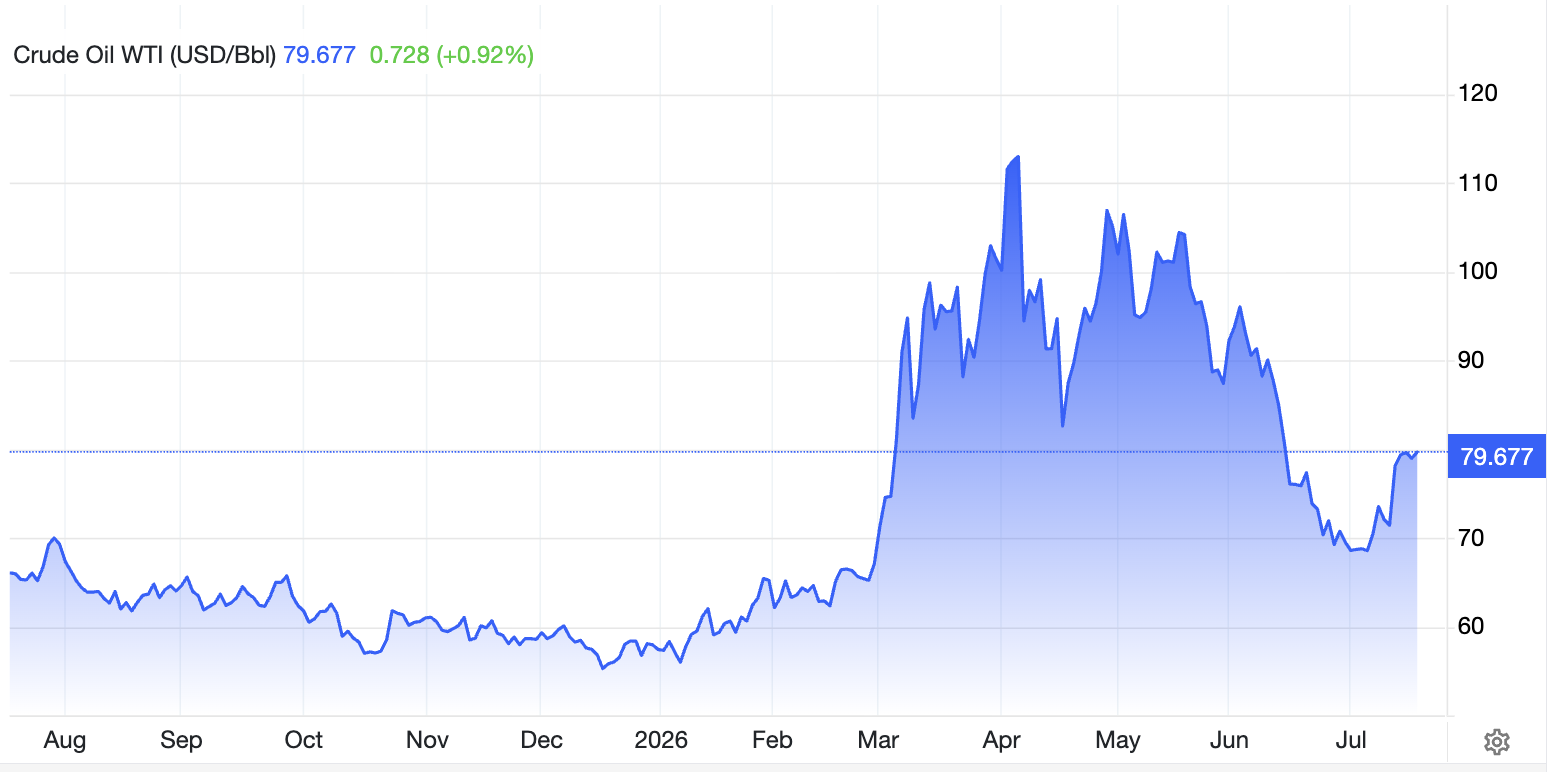
First, the correlation is regime-dependent and has spent stretches of 2026 decoupling, so treat it as a contributing factor rather than a rule. Second, oil rising on a Middle East supply scare is more ambiguous for a small open economy than oil rising on healthy global demand, because the shock that lifts export prices also threatens the growth those exports rely on.
EBC picked apart that tension when an oil rally met Fed caution earlier in the year. For now oil looks like a support rather than a standalone driver.
The Bank held at 2.25% on 15 July and published its Monetary Policy Report. The hold was expected, and the Bank gave no immediate signal that another cut is imminent, leaving policy in wait-and-see mode.
A central bank need not move rates to support its currency; declining to flag near-term easing can be enough at the margin. That posture has helped the loonie, though on its own it is modest rather than decisive.
Not every current runs in CAD’s favour. The CUSMA joint review opened on 1 July, and Washington declined to renew the agreement in its existing form; the deal stays in force while talks continue.
That leaves a trade-policy risk premium embedded in the loonie, a known unknown that caps rallies and keeps most bank forecasts elevated even as spot grinds lower. It is one of the largest identifiable downside risks for CAD.
Statistics Canada publishes June CPI on Monday 20 July, and the Bank of Canada’s response is what the currency will trade. The headline still matters, and a hot or soft surprise can move the pair on release. But for judging whether inflation is persistent, the core measures are more informative.
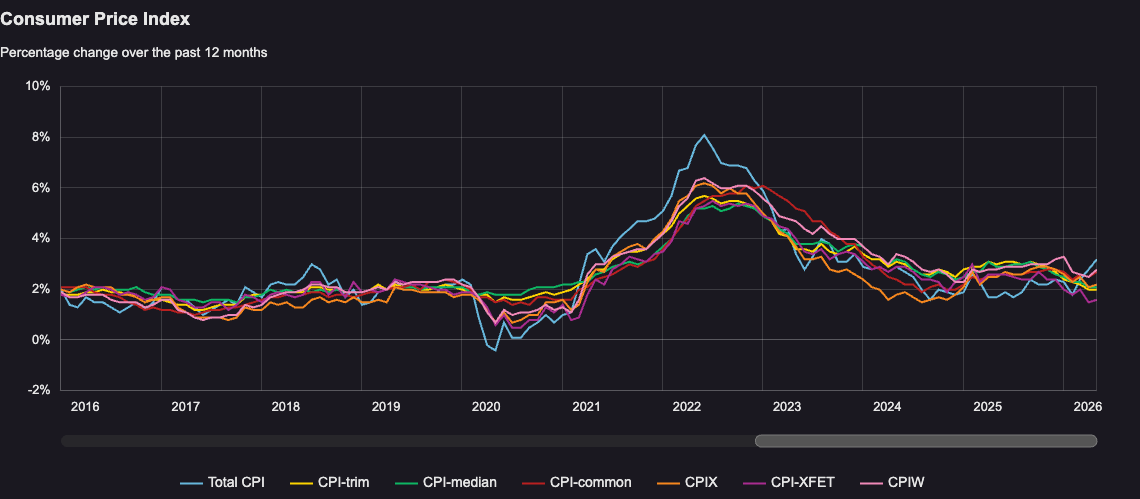
May’s headline ran hot at 3.2% year over year, the fastest since late 2023, largely on gasoline, while the Bank’s preferred core gauges, CPI-trim and CPI-median, held near 2%. The Bank has long said it looks through transitory energy swings.
So the more useful signal sits in the detail: the breadth of price increases, the three-month annualised pace of core alongside the year-over-year figure, and shelter and services, where domestic momentum surfaces.
Core that stays sticky and broad supports the case for holding, which tends to support the loonie. Core that cools convincingly gives the market a reason to price Bank of Canada cuts back in, which can take support away from CAD.
| CPI Signal | Reaction-Function Read | Possible USD/CAD Path |
|---|---|---|
| Core hot and broad | Supports holding rates; near-term cuts become less likely | CAD may strengthen, pushing USD/CAD lower |
| Core soft, momentum cooling | Rate-cut expectations may return | CAD may weaken, allowing USD/CAD to rebound |
| Headline hot, core soft | The Bank of Canada may look through the headline increase | The initial CAD move may fade |
Two caveats sit over that table. The first move is often not the real move: a headline-driven spike against a soft core may unwind once the detail catches up to the Bank’s reaction function. And positioning still matters.
Available data has shown speculators holding a substantial net short in the Canadian dollar, which can amplify a CAD rally through short-covering but leaves the loonie exposed if data disappoints.
For the level-by-level playbook, EBC’s USD/CAD setup before US and Canada CPI covers it, and its primer on how CPI drives forex covers the transmission.
Both, in sequence. Softer US inflation helped start the fall by weighing on the dollar. After the broad dollar stabilised, the latest leg increasingly reflects Canadian dollar strength, helped by firmer oil and a Bank of Canada in no hurry to cut.
Because spot FX responds to what changes at the margin, not the static level of the spread. The dollar’s carry edge is already discounted, so recent marginal news, softer US inflation then Canada-specific support, has pushed the pair lower even with the gap intact.
The headline matters on release and can move the pair, but for judging persistent inflation the core measures, breadth, services and shelter are more useful. The Bank of Canada looks through transitory energy, so a gasoline-driven headline may not change the policy outlook.
The decline is conditional. It could stall or reverse if core inflation cools and revives Bank of Canada cut expectations, if oil rolls over and removes that support, if US data or yields revive dollar demand, or if a risk-off episode pulls flows back to the dollar.
The CUSMA review is one of the largest identifiable downside risks for CAD and could set several of these in motion. The move lower holds only while oil stays firm, the Bank stays in no hurry to cut, and the loonie holds up across its crosses.
Traders looking to trade the USD/CAD move can open an account with EBC and trade the pair directly.