Published on: 2026-01-13
Updated on: 2026-01-13
Iran's currency is again sliding, with the open-market rate around 1,660,000 rials per $1 in early March 2026 after breaking 1,500,000 in late January and extending losses through February.
Inflation remains at crisis levels: annual inflation reached 44.6% in the 12 months ending late January, while point-to-point inflation hit 62.2% in Bahman (Jan. 21 to Feb. 19, 2026).
 The rial lost nearly half its value against the dollar in 2025, and 2026 has added another sharp leg down as policy reforms, sanctions pressure, and geopolitical risk tightened the hard-currency constraint.
The collapse is not a one-week panic but the product of years of high inflation, weak growth, and limited access to hard currency, now intensified by renewed sanctions pressure and rising security risks.
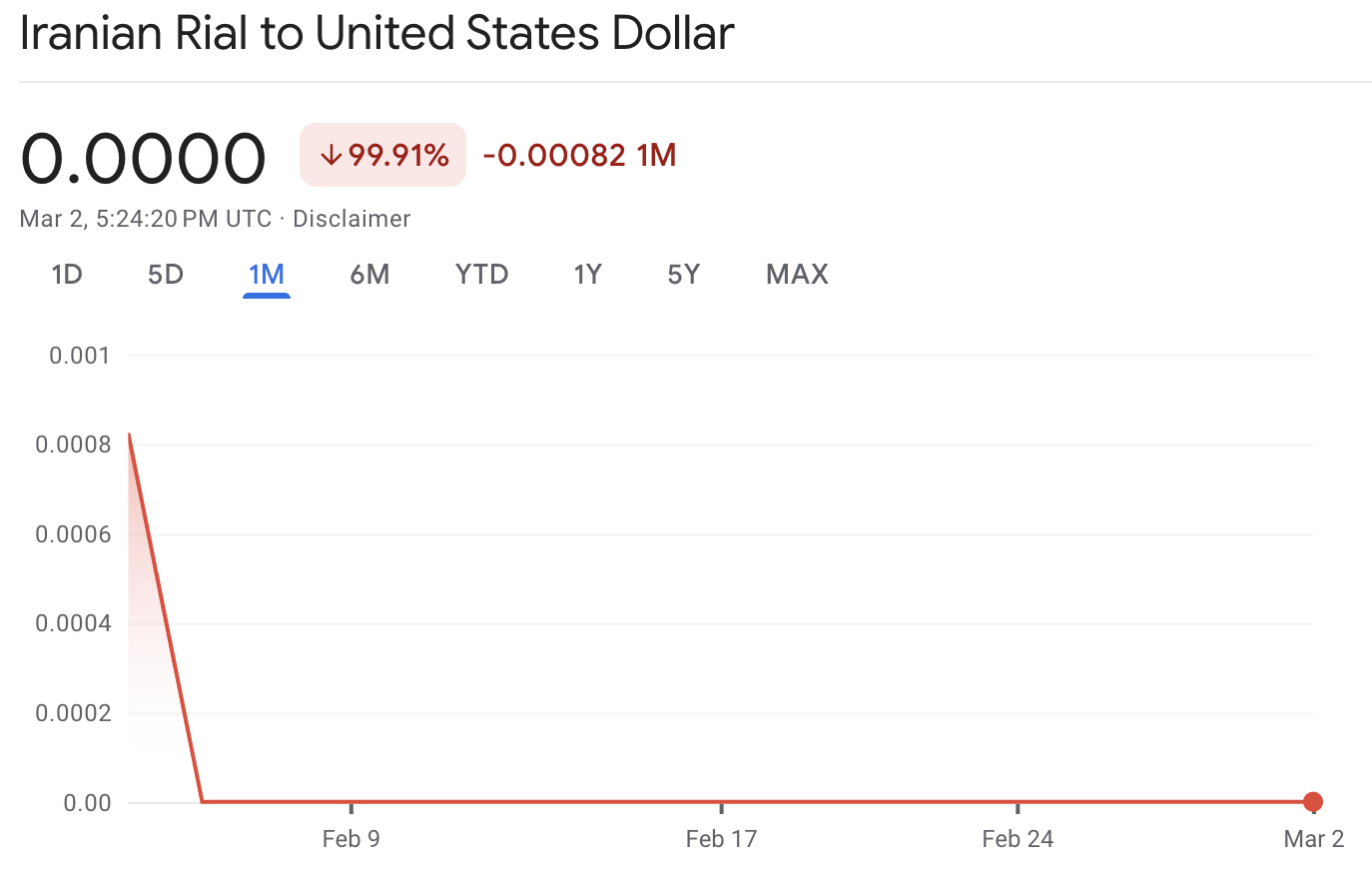
A currency does not literally trade at "zero" while a country still exists and uses it. Even in severe crises, it usually keeps a price, even if it is an ugly one.
When people say "the rial is going to zero," they usually mean one of three things:
Purchasing power can fall to near zero for ordinary people when prices outpace wages.
The exchange rate adds more zeros, so $1 moves from 1.5 million rials to 2 million, 3 million, and beyond.
A redenomination removes zeros, effectively "resetting" the currency on paper even though the underlying problem remains.
Iran is already discussing the third option. In October 2025, Iran's parliament approved a plan to remove four zeros from the rial, with a two-year preparation period and a three-year transition in which both old and new notes would circulate.
So, the honest answer is this: the rial cannot go to zero, but it can be made to feel like it has through inflation, depreciation, and a reset of the unit.
| FX tier (simplified) | Approx. level (rials per $1) | What it usually represents | Why it matters |
|---|---|---|---|
| Official administered rate | 42,000 | Policy rate used for limited official transactions | Anchors accounting in some channels, but widens distortions when far from market |
| Preferential import support (phasing out) | 285,000 | Subsidised allocation previously used for selected essentials | Being withdrawn, which pushes more demand into higher-rate channels |
| Open market / street rate | ~1,660,000 | Price that clears private demand for hard currency | Drives expectations, pricing, and real purchasing power signals |
Iran's FX market is not one market. It is a set of parallel rates, and the gap between them is part of the problem.
Scale of the distortion: Using 42,000 as the official anchor and ~1,660,000 as the open market reference implies a gap of roughly 40 times.
A multi-tier system invites three reinforcing behaviours:
When traders expect subsidies to be removed or reallocated, they pre-price a weaker currency. That dynamic intensified as officials moved to end the preferential import FX rate and replace it with consumer support mechanisms.
The larger the spread between official and market rates, the larger the profit pool for intermediaries, which drains scarce hard currency from productive use.
A system with too many price signals that the state is rationing foreign exchange rather than supplying it, which embeds devaluation expectations into everyday pricing.
Sanctions affect the rial primarily by restricting access to dollars earned from exports and hindering the ability to transfer funds.
In early 2026, pressure has again intensified via expanded sanctions activity and a renewed "maximum pressure" posture, reinforcing the hard-currency scarcity that drives open-market pricing.
When foreign currency is scarce, the open-market rate becomes a daily referendum on confidence.
High inflation is the enemy of any currency. Iran’s inflation pulse has re-accelerated into 2026, with annual inflation at 44.6% in the 12 months ending late January and point-to-point inflation at 62.2% in Bahman (Jan. 21 to Feb. 19, 2026).
The IMF’s country data still implies crisis-level inflation in 2026, listing 41.6% average consumer price inflation.
When inflation runs at these levels, individuals seek to avoid holding cash. That often means buying dollars, gold, property, or inventory.
Escalation risk can lift the “insurance premium” on the currency as markets price potential export disruption. Recent reporting has highlighted sharp stress in regional shipping routes (Strait of Hormuz), which can feed concerns about hard-currency inflows.
Policy design has shifted from subsidising import FX to pushing more transactions toward market pricing. President Masoud Pezeshkian confirmed that imports will no longer receive the preferential rate of 285,000 rials per $, with the state redirecting support toward consumers via vouchers or credits.
That is a direct mechanical driver. If a larger share of imports must source dollars at the market rate, demand rises, and the pass-through into consumer prices becomes faster, especially in an import-dependent economy.
Late-2025 and early-2026 protests linked to living-cost pressure remained a key feature of the backdrop, and authorities have also reshuffled economic leadership as the currency slid.
In parallel, heightened security risk and fears of wider conflict have added another layer of uncertainty, which tends to shorten household and business time horizons and intensify dollarisation behavior.
When political risk rises, people shorten their time horizon. That makes currency weakness self-feeding.
| Item | Reported detail |
|---|---|
| Change | Remove four zeros from the rial |
| Preparation | Central bank given two years to prepare |
| Transition | Three-year period with both old and new money circulating |
| Rationale | Simplify transactions after years of high inflation |
Iran's redenomination plan is often misunderstood as a "currency rescue." It is mainly an accounting clean-up.
For instance, if the open market value is approximately 1,660,000 rials for each $1, then following the removal of four zeros, it would appear to be about 166.0 new units for every $1, presuming the real value remains the same.
The figures appear more favourable, yet the purchasing power only enhances if inflation drastically decreases and remains low.
In short,
What it does: Makes prices readable again and reduces daily friction.
What it does not do: Stop inflation unless fiscal and monetary policy also change.
| Scenario | What happens | What it means for "zero" | Probability signal |
|---|---|---|---|
| Slow bleed (most common) | High inflation continues and the exchange rate weakens in steps | "Zero" becomes a figure of speech as more zeros are added | Inflation stays >30–40%, FX controls tighten |
| Step-change devaluation | A policy shock or funding shock causes a sharp one-off move | "Zero" feels closer because prices jump quickly | New sanctions pressure, budget stress, unrest spikes |
| Redenomination (paper reset) | Iran removes four zeros and introduces new units | "Zero" happens on the banknote, not in real life | Parliament-approved plan progresses to rollout |
All in all, a redenomination can improve convenience. However, redenomination does not solve inflation on its own: a currency's credibility comes from underlying economic fundamentals, not cosmetic changes to the number of zeros.
If inflation expectations rise further, the public's demand for dollars and gold can become relentless.
Recent inflation prints around 60% on a point-to-point basis show how quickly expectations can re-anchor higher once exchange-rate reform passes through into consumer pricing.
Multiple rates can create a two-speed economy: one for those who can access subsidised FX and another for everyone else.
The larger the divide, the greater the motivation to exploit the system, undermining trust and diminishing dollar demand.
Oil remains central because it is one of the few large sources of hard currency. Even small declines in export volumes or higher “shadow fleet” costs can hit FX supply. Recent tanker-tracking reporting flagged early-2026 softness in Iran’s oil exports as sanctions pressure intensified.
When living costs surge, governments often try quick fixes such as subsidies, handouts, or heavy controls. Those moves can buy time, but they can also increase fiscal pressure and distort markets.
If Gulf shipping becomes harder to insure or route, Iran’s trade settlement and hard-currency receipts can tighten quickly.
In early March 2026, major maritime insurers reportedly began pulling conflict-risk cover in the region, while traffic through the Strait of Hormuz was described as severely disrupted.
If you want to judge whether the rial is stabilising or accelerating lower, you should watch signals that reflect real supply and demand.
Open-market USD/IRR, especially gaps versus administered rates
Oil export signals and shipping/insurance constraints
Monthly inflation momentum, particularly food and rent
Bank liquidity stress, cash limits, and deposit behavior
Redenomination rollout milestones and pricing behavior during transition
No, not literally. "Zero" is shorthand for extreme loss of purchasing power or a redenomination that removes zeros from banknotes.
It has moved beyond that level. Open-market trackers and recent reporting have placed the street rate around 1.6–1.7 million rials per $1 in late February and early March 2026.
Yes. Many local quotes use toman in everyday pricing conventions, and some services explicitly state that 1 toman equals 10 rials.
No. Redenomination is an accounting change that can improve usability, but it does not reduce the growth rate of money, fiscal deficits, or imported inflation.
Hyperinflation is not inevitable, but the risk rises when high inflation persists, monetary financing accelerates, and confidence breaks in a way that causes rapid currency substitution.
In conclusion, the Iranian currency is unlikely to hit a literal "zero". However, it can approach a functional zero in purchasing power if inflation, liquidity growth, and confidence erosion remain entrenched.
Redenomination may soon make the numbers look smaller, but only a credible mix of fiscal restraint, monetary discipline, and a cleaner exchange rate regime can change the trajectory that matters.
Until those fundamentals turn, the market will continue to treat every rally as temporary and every policy shift as a test of credibility.
Disclaimer: This material is for general information purposes only and is not intended as (and should not be considered to be) financial, investment or other advice on which reliance should be placed. No opinion given in the material constitutes a recommendation by EBC or the author that any particular investment, security, transaction or investment strategy is suitable for any specific person.