Published on: 2026-02-27
Updated on: 2026-02-27
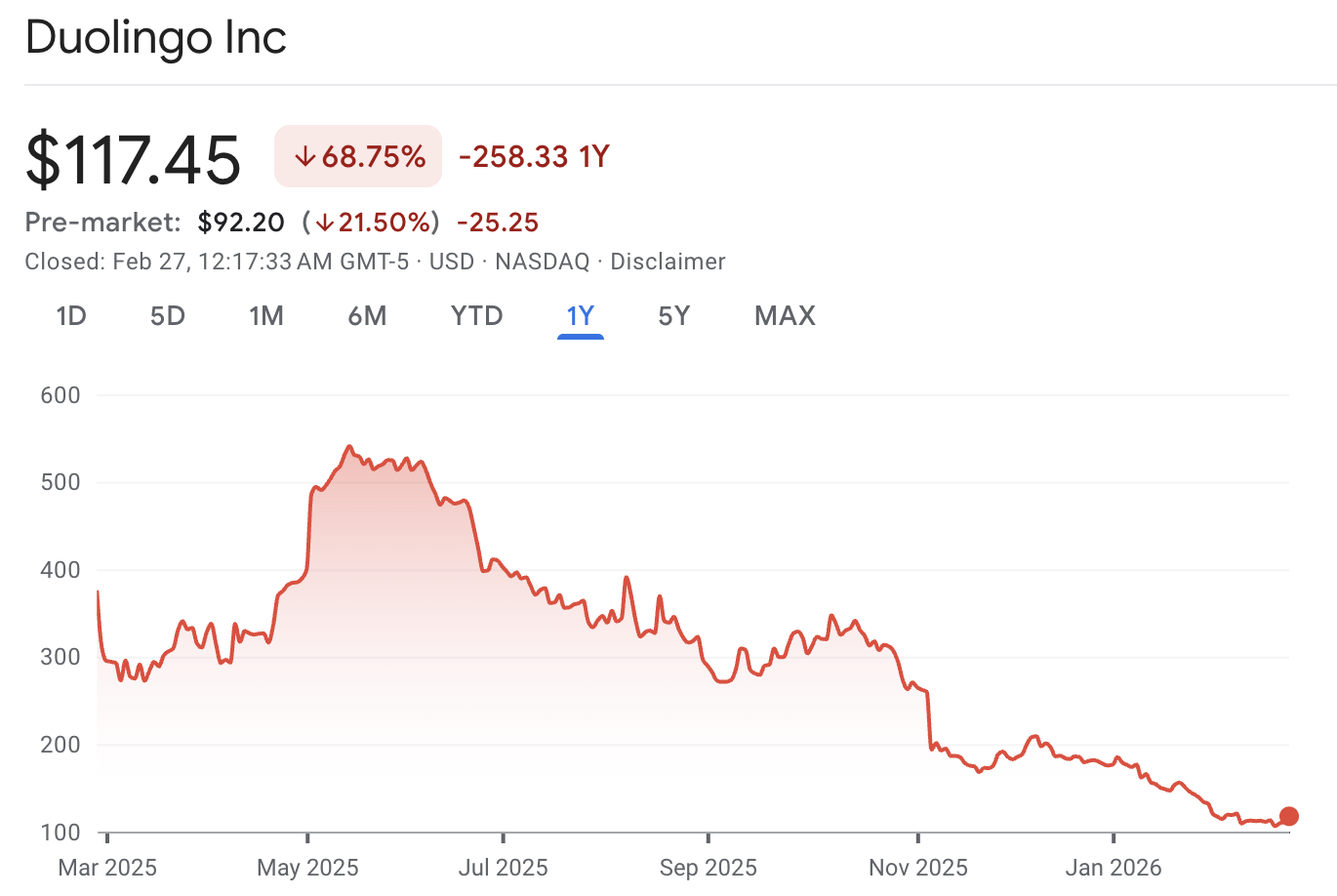
Duolingo (DUOL) was already deep in a drawdown, and now the selloff is getting worse. Duolingo stock finished Thursday at $117.45 and then slid to about $92.20 in pre-market trading, a further 21.5% drop before the regular session even opens.
At around $92, DUOL is down roughly 83% from its 52-week high of $544.93, based on the latest quoted pre-market price. The important point is not the size of the fall.
The important point is the reason. This decision is being made as Duolingo focuses on user growth and product quality rather than short-term profit. The company indicated that this choice may slow revenue growth and put pressure on profit margins in 2026.
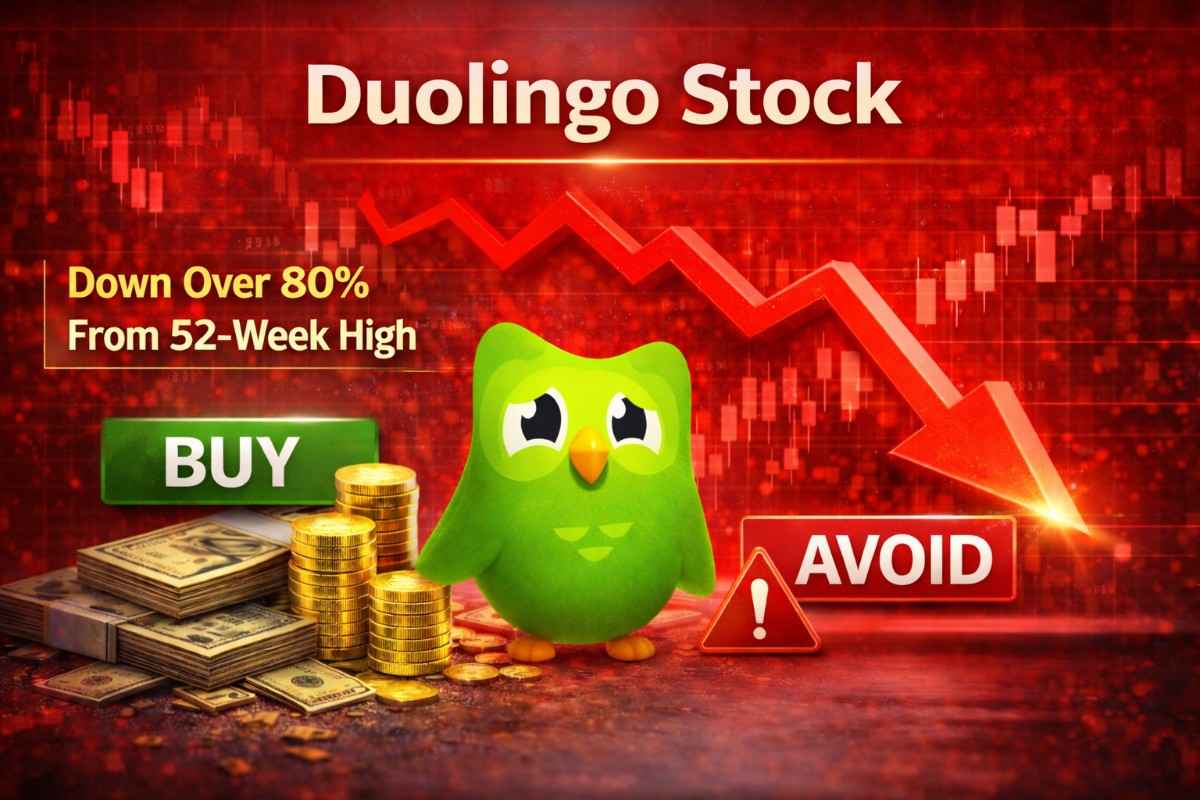
That is why we are focusing on "buy or avoid". The stock is now trading at a lower price, but it is based on a different narrative than it was during its peak.
Duolingo reported its quarterly results and discussed a strategy shift for 2026. Management announced that by the end of 2025, they expect to achieve over $1 billion in bookings and more than 50 million daily active users. They also announced a $400 million share repurchase authorization.
At the same time, management said it is deliberately prioritizing user growth and improving the free learner experience, even if that reduces near-term financial growth.
The market heard that as: "Growth will be more expensive and less profitable for a while." That is the kind of message that can knock 20% off a high-multiple stock overnight, even when the business is still growing.
| Price marker | Level | What it means |
|---|---|---|
| 52-week high | $544.93 | The peak valuation point. |
| Prior close (Thursday) | $117.45 | Where the market closed before the new selloff. |
| Pre-market price (early Friday) | $92.20 | The market’s first verdict on the new 2026 message. |
| Approx. drop from 52-week high | ~83% | This is a major re-rating, not normal volatility. |
Duolingo has been clear that it is prioritizing user growth over aggressive monetization, and it expects slower bookings growth and thinner margins during the transition.
Investors tend to forgive "investment years" when a stock is cheap. Investors punish "investment years" when a stock was previously priced as a perfect compounding machine.
Management stated that one reason for the slowdown in daily active user growth was the company's decision to increase friction and to encourage more users to subscribe. The company is now reversing that approach to re-accelerate user growth.
That is strategically reasonable, but it changes the near-term math on bookings per user.
Duolingo is moving a core AI feature, "Video Call with Lily," into a broader subscription tier and introducing new AI lesson plans.
It could increase adoption, but it may also weaken short-term pricing power if high-value features are offered in lower tiers.
Duolingo is telling investors it wants a bigger base first, then better monetization later.
Faster user growth by improving the free experience and reducing friction.
More word-of-mouth growth, which has historically been a key engine for the platform.
A wider funnel that supports newer learning categories over time (the company has pointed to areas like chess, math, and music).
Slower bookings growth in 2026 compared with what the company implies it could have delivered under a "monetize harder" approach.
Lower profitability and margin pressure during the transition year.
Is user growth re-accelerating fast enough to justify the monetization pause?
If the answer is yes, this decline may resemble capitulation. If the answer is no, the market could continue to undervalue the stock, even if the product remains strong.
Management reported exceeding 50 million daily active users and ending 2025 with over $1 billion in bookings.
If user growth remains strong, Duolingo can afford to experiment with packaging and pricing over time. A business that continues to grow its user base can eventually address its monetization strategy. A business that loses users rarely gets a second chance.
Management pointed to new subjects beyond language learning, and it framed 2026 as a "pivotal moment" because AI is changing how people learn.
Investors who buy here are betting that better teaching quality and a stronger free tier rebuild daily usage growth, which supports paid conversion later.
A $400 million share repurchase authorization is meaningful for a company with a market cap of around $5.43 billion, according to the latest quote page.
A buyback does not stop a panic selloff on its own, but it can help once the stock stabilizes.
A 11% booking growth rate is not "bad," but it is a major slowdown compared with what the market used to expect.
When a stock was once priced for premium growth, a slowdown forces a lower valuation multiple.
Management expects an adjusted EBITDA margin of 25% this year, down from 29.5% in the previous year.
That tells you that 2026 is a reinvestment year, not a margin expansion year.
When a stock breaks below prior lows and gaps down, many funds will not buy until volatility cools and the stock forms a base.
That is not a judgment on the business. It is how risk management works.

This happens when panic selling cools, shorts take profits, and dip buyers step in. The stock can recover, but it often stalls beneath the gap zone because investors seek additional confirmation.
What to watch:
Whether the price can reclaim $104–$105 and hold it for more than one session.
This happens if user growth stays strong and the market starts to believe that "growth first" will pay off in later quarters. In this scenario, the stock can become investable again, but it takes time.
What to watch:
Updates on daily active users and engagement.
Clear signs that free-tier improvements are lifting growth without destroying subscription conversion.
This occurs when the guidance appears too lenient, or when the market believes the business is entering a prolonged phase of slower growth and reduced margins.
What to watch:
Whether the stock fails to hold the low $90s and starts making new lows.
Avoid if you are a short-term trader who needs clean setups. A 21% pre-market gap is a volatility event, and those moves can whip in both directions.
Consider buying if you are a long-term investor who can tolerate big swings and believe Duolingo's user growth engine remains strong enough to justify a multi-year rebuild. The company is clearly prioritizing scale and product quality, and it is being direct about the near-term cost of that choice.
The stock is dropping because management signaled a strategy shift toward user growth over near-term monetization and guided to slower bookings growth and lower margins in 2026
At about $92 in pre-market trading, DUOL is roughly 83% below its 52-week high of $544.93.
The biggest risk is that the strategy shift leads to slower bookings growth and weaker margins for longer than the market can tolerate, which can keep the valuation compressed.
It helps, but it does not override guidance. The buyback can support the stock after it stabilizes, but it rarely stops a gap-down caused by a weaker outlook.
In conclusion, Duolingo is not getting punished because the product stopped working. Duolingo is facing consequences because management informed investors that 2026 will be a year for rebuilding growth, even if it negatively impacts near-term profitability and booking growth.
With Duolingo stock down more than 21% after hours and pointing to the low $90s, the setup is simple: this can be a high-upside "pivot works" story, or a prolonged valuation grind where rallies are sold until the company proves the new approach re-accelerates user growth.
Disclaimer: This material is for general information purposes only and is not intended as (and should not be considered to be) financial, investment or other advice on which reliance should be placed. No opinion given in the material constitutes a recommendation by EBC or the author that any particular investment, security, transaction or investment strategy is suitable for any specific person.