Published on: 2026-02-27
Updated on: 2026-02-27
The average S&P 500 return is a frequently referenced metric in investing, as it informs expectations for retirement planning, portfolio objectives, and long-term wealth accumulation. However, the term “average” can refer to multiple concepts, and its interpretation varies depending on whether the measurement period is a single year, a decade, or several decades.

In the current cycle, the question matters even more because recent performance has been unusually strong, while the backdrop for future returns is less certain. Inflation has cooled from its peak but remains a key variable, and interest rates are still high enough to compete with equities for investor capital.
Most confusion comes from three definitions that sound similar but behave very differently:
A price return reflects only changes in the index level, whereas a total return measure incorporates reinvested dividends. The widely referenced S&P 500 index series on FRED is explicitly a price index and “does not contain dividends.”
In contrast, major index products frequently benchmark against both the S&P 500’s price and yield performance, and their reports typically present total return figures over standard time horizons.
An arithmetic average represents the simple mean of annual returns. In contrast, a compound annual growth rate (CAGR) reflects the actual growth an investor experienced over time as returns compound. When returns are volatile, the arithmetic average typically exceeds the compound result.
Nominal returns are those displayed on charts, while real returns adjust for inflation's impact on purchasing power. Over extended periods, the distinction between nominal and real returns is substantial.
A valuable reference point is the long-term performance of large-cap US stocks, typically represented by the S&P 500 in institutional return series. Over multi-decade periods, the market demonstrates strong compounding, yet annual returns can vary widely.
| Series (1926–2013) | Geometric Mean | Arithmetic Mean | Standard Deviation |
|---|---|---|---|
| Large company stocks | 10.1% | 12.1% | 20.2% |
| Inflation | 3.0% | 3.0% | 4.1% |
These figures underscore the fundamental trade-off in equity investing: robust long-term compounding comes with significant volatility.
A related way the same data is presented in capital-markets work is as a “long-term annual return on stocks,” often aligned with the large-cap stock series over extended windows. One such long-horizon estimate places long-run stock returns in the low double digits over 1926–2020, alongside bond income returns and a market risk premium framework.
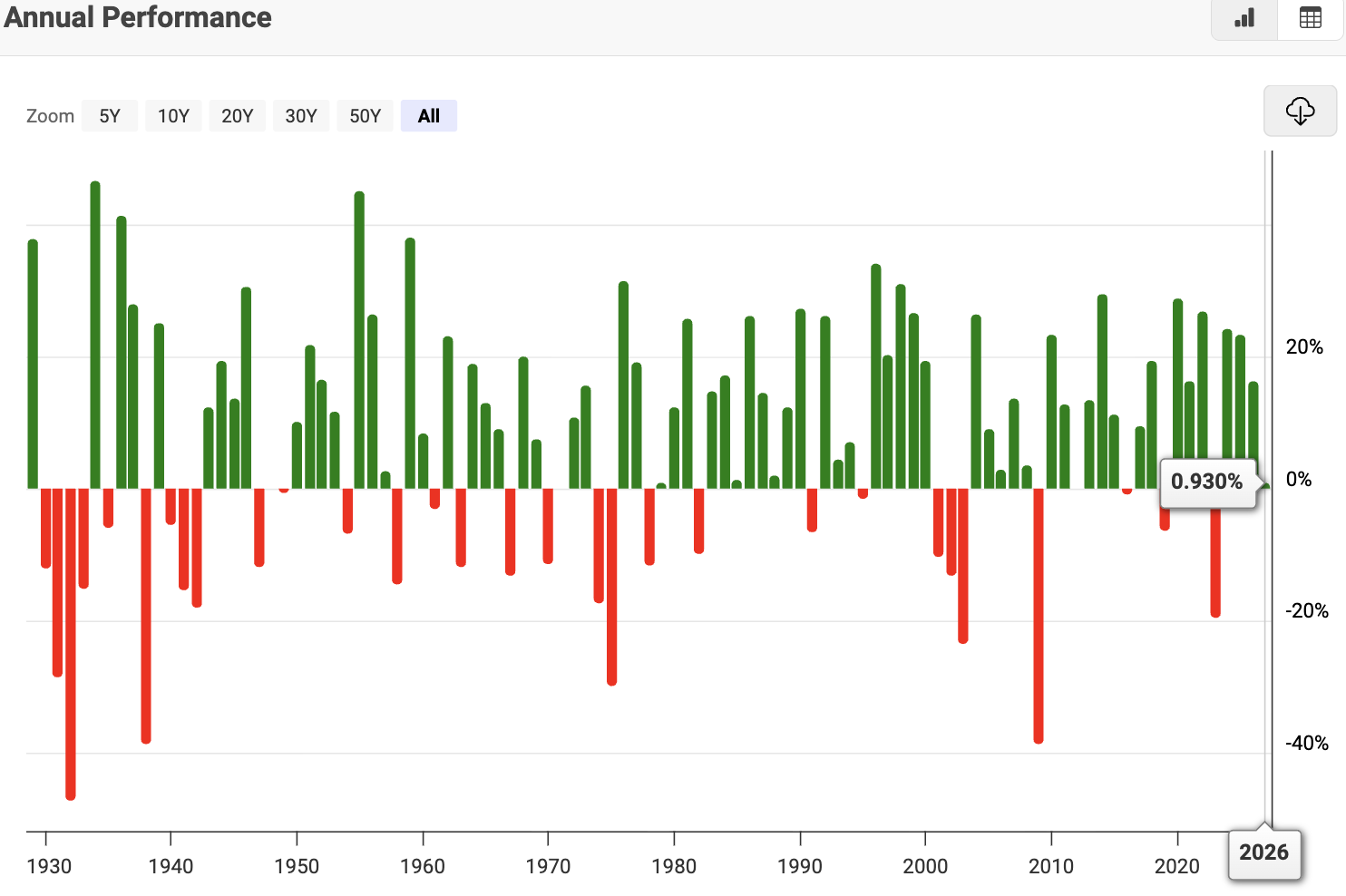
Averages may appear stable because they condense historical data into a single figure. In contrast, annual returns reveal that investor outcomes are highly dependent on timing, particularly over short- and medium-term horizons.
A recent sample of calendar-year S&P 500 total returns (including dividends) demonstrates how rapidly market leadership can shift between periods of strong gains and significant declines.
| Year | S&P 500 total return (dividends reinvested) |
|---|---|
| 1995 | 37.20% |
| 1996 | 22.68% |
| 1997 | 33.10% |
| 1998 | 28.34% |
| 1999 | 20.89% |
| 2000 | -9.03% |
| 2001 | -11.85% |
| 2002 | -21.97% |
| 2003 | 28.36% |
| 2004 | 10.74% |
| 2005 | 4.83% |
| 2006 | 15.61% |
| 2007 | 5.48% |
| 2008 | -36.55% |
| 2009 | 25.94% |
| 2010 | 14.82% |
| 2011 | 2.10% |
| 2012 | 15.89% |
| 2013 | 32.15% |
| 2014 | 13.52% |
| 2015 | 1.38% |
| 2016 | 11.77% |
| 2017 | 21.61% |
| 2018 | -4.23% |
| 2019 | 31.21% |
| 2020 | 18.02% |
| 2021 | 28.47% |
| 2022 | -18.01% |
| 2023 | 26.29% |
| 2024 | 25.02% |
| 2025 | 17.88% |
| 2026 | In progress (full-year return not available yet) |
This is what the “average S&P 500 return” is hiding: even when long-run compounding is attractive, the path is uneven and sometimes brutal.
Over a one-year horizon, the market is usually a reflection of three forces:
Equity valuations are sensitive to the discount rate. When yields rise quickly, valuations tend to compress. When yields fall, multiples often stabilise or expand.
The market can tolerate higher rates if earnings growth is strong enough. When profits soften at the same time financing costs rise, the index tends to struggle.
One-year returns are heavily influenced by positioning, volatility, and risk appetite, which can change more quickly than fundamentals.
A key implication is that employing the long-run average as a one-year forecast is generally unreliable. Short-term outcomes are frequently driven by macroeconomic factors rather than gradual productivity changes.
A ten-year period is sufficient for earnings and dividends to significantly influence returns, yet brief enough for initial valuations to remain a critical factor. The next decade can be framed as follows:
Dividend yield + earnings growth + inflation ± valuation change
If valuations begin at elevated levels and subsequently decline, this reduction can significantly impact decade-long returns. Conversely, if valuations start at depressed levels and normalize, they can contribute positively.
The next decade may differ from the previous one because certain favorable conditions may not recur. Research on S&P 500 nonfinancial firms indicates that the decades preceding the pandemic benefited from substantial declines in interest and tax expenses, which mechanically boosted profit growth. If these tailwinds diminish, future returns will depend more on real earnings growth and dividend income than on valuation expansion.

Over a 50-year period, valuation cycles continue to influence returns, but their effects tend to diminish relative to shorter horizons. The primary determinants over such extended periods are structural drivers:
real economic growth and productivity
corporate profitability and competitive dynamics
dividend and total payout behaviour
inflation’s long-run trend
A “supply-side” framing often used in cost-of-capital work estimates long-run equity return as a combination of inflation, real earnings growth, and income return. One published example places the long-run “supply of equity return” in the high single digits.
The critical consideration is not a specific forecast figure, but rather the underlying discipline: over the long term, equity returns are limited by what companies can sustainably generate through earnings and cash distributions.
Many investors hear about the average S&P 500 return and expect it to be repeated every year. In reality, annual results swing widely, and your outcome depends on how you invest.
These figures reflect the S&P 500. If you hold broad S&P 500 ETFs, your returns should closely track the index. A portfolio with other assets will behave differently.
ETF fees are usually low, but they still reduce returns and compound over time.
Long-run returns assume staying invested. Frequent trading in and out can materially change results, often for the worse.
Dividends are a major part of long-term performance. Reinvesting them typically improves compounding over the long term.
Inflation reduces purchasing power. Over time, equities have tended to outpace inflation, while cash has often lost ground to inflation.
The index is a useful benchmark. If active trading delivers less than the market over time, a disciplined, long-term index approach may be the more efficient option.
Use geometric averages for planning. Retirement math is compounding math.
Use ranges, not point forecasts. The distribution matters more than the midpoint.
Match the horizon to the goal. One-year return expectations should be cautious; 10- and 50-year expectations can be anchored in fundamentals.
Separate nominal from real. A nominal return that looks strong can still disappoint if inflation is high.
Respect sequence risk. The order of returns can matter as much as the average, especially during withdrawals.
It depends on whether you mean an arithmetic average (typical yearly outcome) or a geometric average (compound growth over time). It also depends on whether you include dividends. Over long periods, compounded returns have historically been strong, but volatility is high.
Not in all cases. Many headlines focus on price returns, whereas long-term investor outcomes are better represented by total returns, which include reinvested dividends. For decade-long comparisons or long-term wealth accumulation, total return serves as a more reliable benchmark.
A precise 10-year average depends on the specific end date and whether dividends are included. Importantly, 10-year results can diverge significantly from the long-term average if valuations change substantially during the period.
Over a 50-year period, returns are primarily influenced by earnings growth, dividends, inflation, and long-term valuation cycles. Historically, compounded equity returns have exceeded inflation over multi-decade periods, though the trajectory has included significant drawdowns.
A sensible approach is to start with long-run compounded equity history, then stress-test for a range of outcomes. Frameworks that tie equity returns to inflation, real earnings growth, and income returns can help keep expectations grounded in economics rather than in the recent market mood.
The average S&P 500 return should be regarded as a guiding reference rather than a precise timetable. While long-term compounding has historically benefited patient investors, annual results can be highly variable, and future decades may differ from the past as interest rates, inflation, and valuations change.
The most effective approach is to anchor expectations in total return, prioritize real purchasing power, and recognize the distinction between short-term and long-term market outcomes.
Disclaimer: This material is for general information purposes only and is not intended as (and should not be considered to be) financial, investment or other advice on which reliance should be placed. No opinion given in the material constitutes a recommendation by EBC or the author that any particular investment, security, transaction or investment strategy is suitable for any specific person.
1) SEC
2) FRED