Published on: 2026-02-26
Updated on: 2026-02-26
Eurobonds play a central role in global capital flows, connecting borrowers and investors across currencies and jurisdictions. Their issuance affects interest rate expectations, currency demand, and risk sentiment across financial markets.
For traders and investors, understanding the eurobond market is not just about fixed-income investing. Eurobond activity can influence foreign exchange movements, sovereign risk perception, and broader market liquidity conditions.

An Eurobond is a bond issued in a currency other than the country's. It is an international bond issued outside the home country of the currency in which it is denominated.
Despite the name, Eurobonds are not limited to Europe or the euro currency. Eurobonds, therefore, belong to the offshore segment of international capital markets, allowing issuers to raise funds globally rather than locally.
| Feature | Description |
| Currency | Different from issuing country |
| Market | International offshore bond market |
| Investors | Mainly institutional investors |
| Regulation | Often lighter than domestic markets |
| Trading | Active secondary market |
| Payments | Regular coupon payments |
| Structure | Fixed or floating interest rates |
Eurobond issuance follows a structured international process.
First, an issuer determines funding requirements and selects a suitable currency based on interest rate conditions and currency exposure.
Investment banks then underwrite the bond, helping to structure the maturity, coupon rate, and pricing. Credit rating agencies assess an issuer’s creditworthiness, which influences investor demand and yield levels.
Once issued, the bonds are sold to institutional investors and begin trading in secondary markets, where prices fluctuate according to interest rates, risk sentiment, and macroeconomic developments.
Consider a Brazilian energy company seeking long-term financing.
The company issues a 10-year US-dollar Eurobond through international banks. Investors from Europe, Asia, and North America purchase the bonds. The issuer pays annual USD coupon payments, while investors may also profit if bond prices rise.
This illustrates how Eurobonds allow companies to raise capital globally while investors gain international exposure.
When governments or corporations issue bonds in foreign currencies, demand for that currency often increases. Large eurobond issuance programs can therefore affect foreign exchange flows and short-term currency volatility.
For example, heavy USD-denominated issuance by emerging markets can temporarily strengthen dollar demand.
Strong investor demand for Eurobonds often indicates confidence in global growth and risk appetite. Weak demand may signal tightening financial conditions.
Traders frequently monitor sovereign Eurobond issuance to gauge investor sentiment toward emerging markets.
Eurobond yields reflect global borrowing costs. Changes in pricing can signal shifting expectations about central bank policy and global liquidity, factors closely watched by FX, CFD, and macro traders.
In short, Eurobonds act as a transmission channel between fixed income markets, currencies, and broader financial conditions.
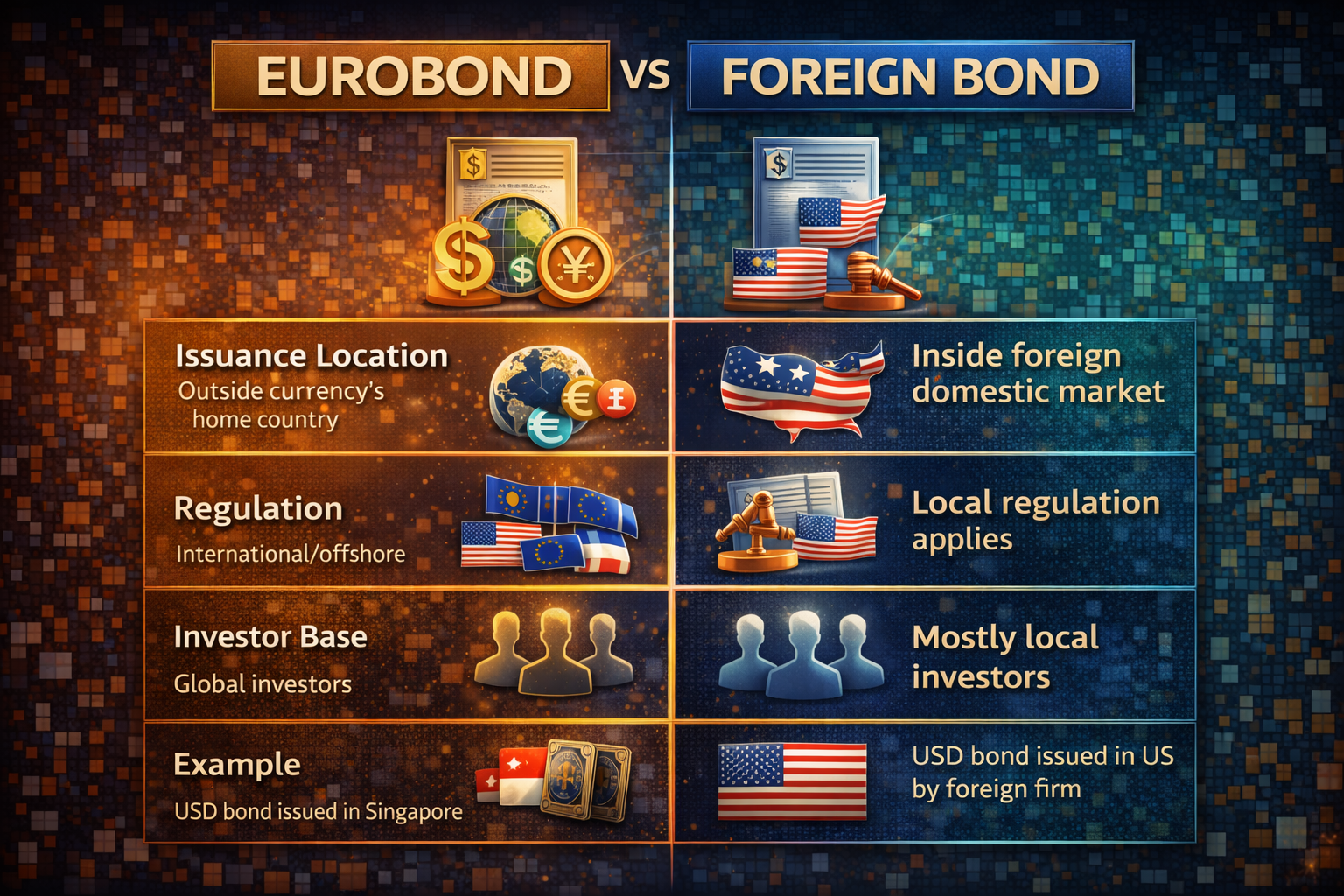
Eurobonds are often confused with foreign bonds, but the distinction depends on the issuance location. The key difference is jurisdiction: Eurobonds are issued outside the currency’s domestic regulatory framework.
| Feature | Eurobond | Foreign Bond |
| Issurance Location | Outside currency's home country | Inside foreign domestic market |
| Regulation | International/offshore | Local regulation applies |
| Investor Base | Global investors | Mostly local investors |
| Example | USD bond issued in Singapore | USD bond issued in US by foreign firm |
Borrowers gain access to deeper pools of global capital, which may lower borrowing costs compared to domestic markets. Issuers can also select currencies aligned with revenue streams or strategic financing goals.
Diversifying funding sources reduces reliance on local banking systems and can improve financial resilience.
Investors benefit from exposure to international debt markets and additional yield opportunities. Eurobonds allow portfolio diversification across currencies, regions, and economic cycles.
Institutional investors often use Eurobonds to balance risk exposure globally rather than concentrating investments domestically.
Despite their importance, Eurobonds carry risks that investors must understand. Currency risk arises when exchange rate movements reduce returns in an investor’s home currency. Interest rate risk can cause bond prices to decline when global rates rise.
Credit risk remains a central concern, particularly for lower-rated sovereign issuers. Liquidity risk may also arise if certain Eurobonds trade infrequently in secondary markets. Regulatory differences across jurisdictions can introduce additional complexity compared to domestic bonds.
No. The term refers to issuance outside the currency’s home country, not geography.
To access international investors, diversify funding sources, and potentially reduce borrowing costs.
No. Risks include credit, currency, liquidity, and interest rate risk.
Primarily pension funds, insurers, asset managers, and global institutional investors.
Usually through bond funds, ETFs, or broker platforms offering international bond exposure.
Eurobonds are a cornerstone of modern international finance, enabling governments and corporations to borrow across borders while giving investors access to global income opportunities.
Beyond fixed-income investing, Eurobonds influence currency flows, global interest rate expectations, and overall market sentiment. For traders, understanding how Eurobond issuance works provides valuable context for interpreting movements in foreign exchange markets and macroeconomic trends.
As financial markets become increasingly interconnected, knowledge of instruments such as Eurobonds helps traders better understand how capital flows worldwide, and why global debt markets remain central to financial stability and investment decision-making.
Disclaimer. This material is for educational and informational purposes only and does not constitute investment advice, financial promotion, or a recommendation to buy or sell any financial instrument. Trading and investing involve risk, including the potential loss of capital. Past performance is not indicative of future results. Readers should conduct their own research and consider their financial situation before making investment decisions.