Published on: 2026-02-27
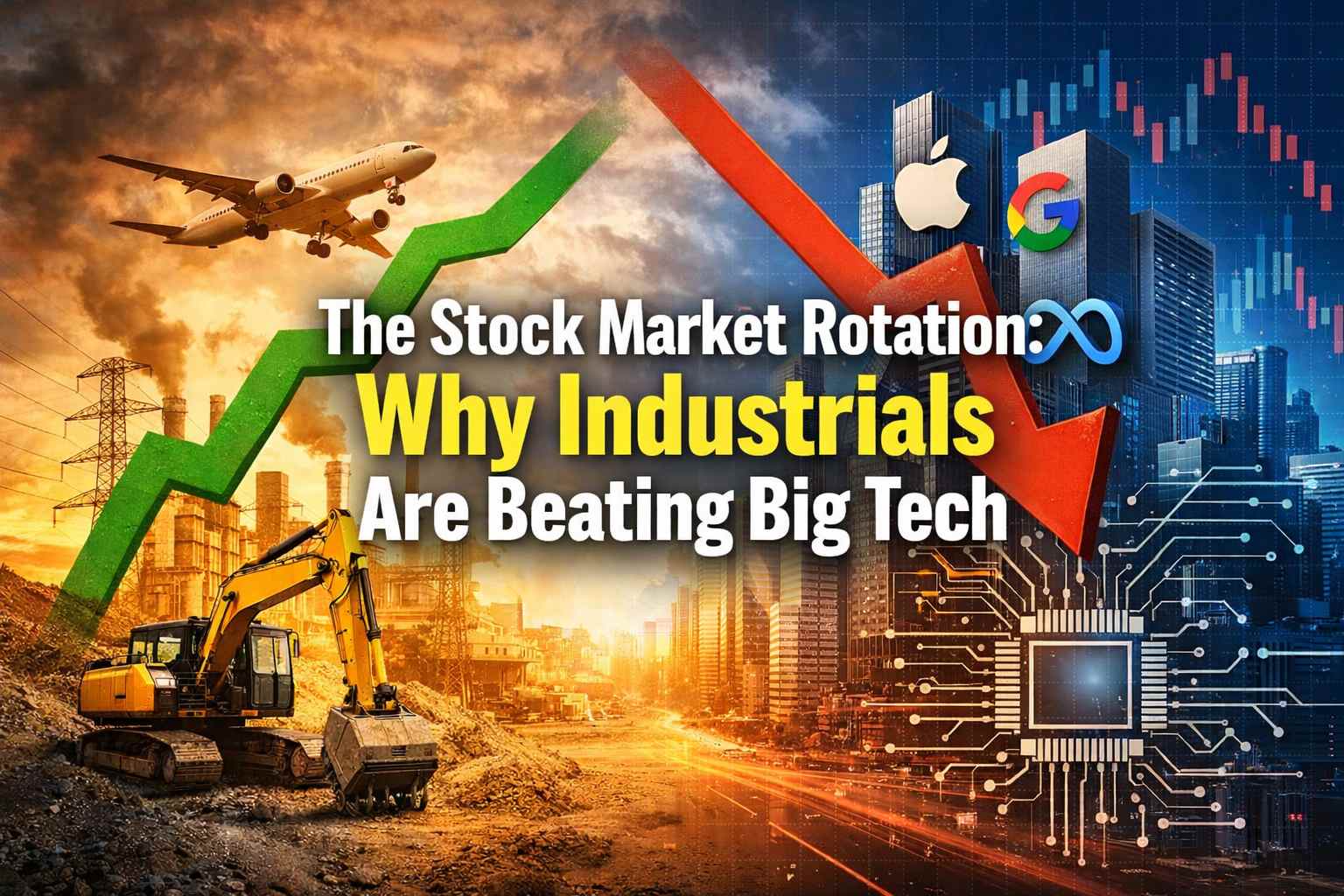
By early 2026, the stock market rotation has become pronounced. Investors are favoring industrial stocks over big tech, signaling a clear shift in market preferences. With interest rates remaining elevated, capital is moving from long-duration growth stories to industrials, capital goods, and businesses linked to the physical economy, where cash flows are more immediate, visible, and cyclical.

This “industrial stock beating big tech” shift is evident in both trading activity and market structure. By mid-February, the Industrials Select Sector SPDR (XLI) outperformed year to date, while the Technology Select Sector SPDR (XLK) lagged, reversing the trend of the past decade.
At the index level, leadership is broadening as concentration declines. The S&P 500 Equal Weight Index outperformed the cap-weighted S&P 500 by about 3 percentage points over the three months ending January 28, 2026, as the top-10 concentration fell below 40%.
Industrials are benefiting from a capex-heavy cycle that rewards companies tied to power, logistics, defense, and infrastructure, while tech faces tougher “return on AI spending” questions.
Higher real yields penalize long-duration growth stocks, making industrial cash flows more competitive on a discounted basis.
Market breadth is improving as mega-cap dominance declines, reducing the index’s reliance on a few large tech companies.
AI is not only a software theme. The buildout is increasingly physical, lifting demand for electrification, grid equipment, cooling, and industrial power systems.
Trade and tariff uncertainty is reinforcing onshore investment incentives and increasing the market’s preference for domestically anchored revenue streams.
The cleanest way to see the rotation is through sector proxies that investors actually trade.
| Measure | Industrials (XLI) | Technology (XLK) | Why It Matters |
|---|---|---|---|
| 2026 YTD Total Return (Through Feb. 13) | +12.28% | -3.06% | A decisive shift in leadership early in the year. |
| 2025 Total Return (Full Year) | +19.31% | +24.60% | Tech still led in 2025, which raises the bar for repeat outperformance. |
| 10-Year Annualized Total Return (As Of Dec. 31, 2025) | 13.31% | 22.34% | The long-run record remains tech-heavy, which makes the 2026 reversal more meaningful. |
| Forward P/E (FY1, As Of Dec. 31, 2025) | 25.29 | 29.14 | Valuation dispersion still favors industrials if growth differentials narrow. |
| Index Dividend Yield (As Of Dec. 31, 2025) | 1.27% | 0.62% | Higher income support matters when rates offer alternatives to equities. |
This is not a claim that tech’s secular story has ended. It is a reminder that markets reprice narratives when the discount rate and earnings risk change.
Industrial stocks tend to behave like classic cyclicals, with nearer-term cash flows that are easier to underwrite. Big Tech behaves like long-duration growth, especially when valuation is supported by expectations far into the future.
With the Fed holding policy in a restrictive zone, the hurdle rate for long-duration assets rises. The FOMC maintained the federal funds target range at 3-1/2 to 3-3/4% at its Jan. 28, 2026, meeting. The Treasury curve continues to price a world in which cash is not “free,” with the 2-year around 3.5% and the 10-year near 4% in late February.
When rates sit at those levels, investors demand either faster growth or lower valuation. Industrials have been offering a better mix of the two.
The AI boom has entered a phase where the bottleneck is less about code and more about power, cooling, grid connection, and uptime. That directly benefits industrial firms tied to electrification, energy management, data center power distribution, and critical equipment.
Recent earnings commentary underscores this demand. A leading electrification company reported “triple-digit” growth in data center-related sales as AI-driven buildout accelerates, with peers experiencing similar trends. This explains why industrials can outperform even as tech headlines dominate. The investment is now evident in the supply chain supporting infrastructure development.
Industrials are levered to capital spending across factories, transportation networks, and energy systems. That cycle is supported by reshoring efforts, logistics upgrades, and a push to harden supply chains.
The macro data are not screaming boom, but they are improving at the margin, which matters for cyclicals. US industrial production rose 0.7% in January, with manufacturing output up 0.6%. Capacity utilization moved up to 76.2%, still below its long-run average but trending higher. For markets, that is enough to start repricing “hard economy” earnings risk.
Industrials include aerospace and defense, where multi-year procurement cycles can stabilize revenue through macro slowdowns. In the XLI basket, aerospace and defense is a major industry weight, and several of the largest holdings sit directly in that supply chain.
This is important because it creates an additional source of demand that is less sensitive to consumer cycles. It also helps explain why industrials remain resilient even when economic growth is uneven.
Policy uncertainty tends to lift the value of domestic cash flows and tangible assets. In February, the White House imposed a temporary import surcharge of 10% for 150 days starting Feb. 24, 2026. Regardless of one’s view on the policy, markets tend to translate this into higher uncertainty around supply chains and pricing.
Industrials often benefit in two ways: they support the onshoring and retooling cycle, and they are generally seen as less exposed to global platform risk than mega-cap tech.

Big Tech’s 2023 to 2025 outperformance created a valuation regime that required near-perfect execution. In 2026, the market is increasingly focused on whether AI-related spending will generate durable incremental profits, or simply raise the cost base.
That skepticism has shown up in high-profile reactions. A major AI bellwether sold off sharply after earnings, dragging the broader tech sector lower in a single session. When the market stops rewarding “capex as a story,” the valuation multiple can compress quickly.
When a few companies dominate the index, any instability can have systemic effects. The top 10 companies still account for about 40 percent of the S&P 500, even after declining from late-2025 peaks.
As concentration declines, breadth improves, and equal-weight strategies outperform. This is not only a factor story. It is a mechanical outcome of capital rotating away from the most crowded trades.
Tech’s appeal has historically been growth, not income. But when cash yields are meaningful and equity risk premia are questioned, investors often prefer sectors with higher dividend support and less valuation fragility. As of Dec. 31, 2025, the industrials proxy carried a higher index dividend yield and a lower forward P/E than the tech proxy.
That is not a fundamental forecast. It is a statement about the market’s current willingness to pay.
Rotations are rarely permanent. The preference for industrials over tech can reverse quickly if key conditions change.
A sharp drop in yields: Falling yields typically reflate long-duration growth and can reignite Big Tech leadership.
A renewed tech earnings acceleration: If AI monetization shows up cleanly in margins, multiples can stabilize.
A cyclical growth scare: Industrials are still economically sensitive. A downside shock to global demand would test the trade.
Policy whiplash: Tariffs and trade policy can lift domestic capex, but they can also raise input costs and disrupt planning.
This environment has rewarded three approaches.
Broadening exposure beyond mega-cap tech: equal-weight allocations have outperformed in the last several months as breadth improved.
Owning “AI infrastructure” beneficiaries: companies tied to electrification and data center buildout have been capturing incremental demand.
Focusing on quality cyclicals: industrials with strong balance sheets, pricing power, and order visibility have held up better than high-beta cyclicals.
The common thread is discipline around valuation and cash-flow durability.
A stock market rotation is a shift in leadership from one sector or style to another, usually driven by changes in growth, inflation, interest rates, or earnings expectations. In 2026, leadership has broadened as investors reduce concentration in mega-cap tech.
Industrials are being supported by capex, electrification, defense exposure, and the physical buildout behind AI. At the same time, higher rates and tougher AI return questions have pressured tech multiples.
No. It means the market is repricing expectations. Tech can still lead if earnings growth re-accelerates and AI spend converts into durable profit expansion, but leadership is less automatic when rates are higher and positioning is crowded.
Rates and growth indicators are most important. Industrial production and capacity utilization offer direct insight into the real economy, while the Treasury curve reflects the discount rate applied to growth stocks.
Yes, because tariffs increase uncertainty and can encourage onshoring and retooling, which supports segments of industrials. The recent temporary import surcharge has amplified this policy effect.
The current stock market rotation is a rational repricing, not a mystery. Higher rates have raised the hurdle for long-duration growth, AI capex is being judged more harshly, and market breadth is improving as concentration fades.
Industrials are capturing the upside from tangible investment cycles, including electrification and the physical infrastructure behind AI, while Big Tech is being forced to defend valuations with results, not narratives.
Disclaimer: This material is for general information purposes only and is not intended as (and should not be considered to be) financial, investment or other advice on which reliance should be placed. No opinion given in the material constitutes a recommendation by EBC or the author that any particular investment, security, transaction or investment strategy is suitable for any specific person.